Eastern Bloc: The Rise and Fall of the Soviet Sphere of Influence
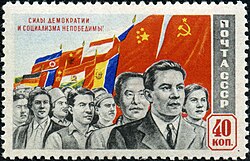
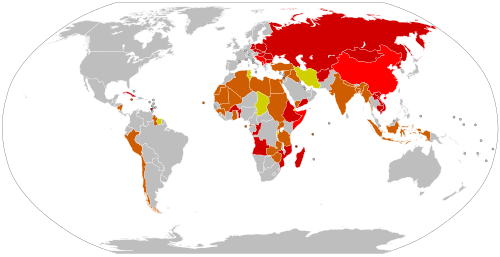
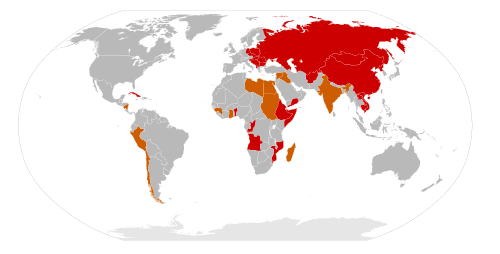
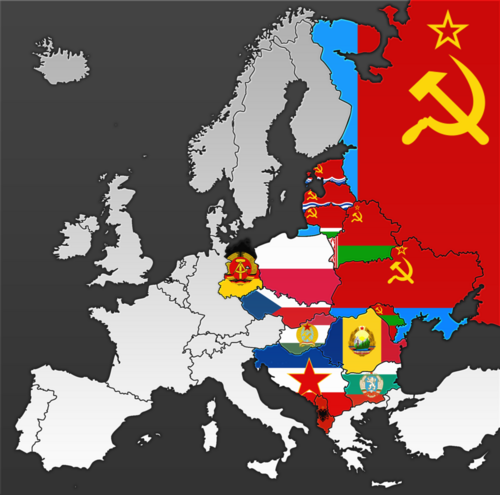
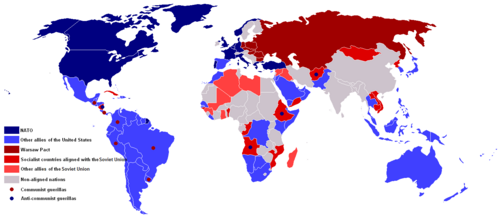
The Eastern Bloc refers to the group of Marxist-Leninist states in Central and Eastern Europe, East Asia, and Southeast Asia under the influence of the Soviet Union during the Cold War. This geopolitical entity was characterized by a shared commitment to state socialism, centralized economic planning, and a strategic military alliance designed to counter the influence of the Western Bloc.
The formation of this bloc was not a single event but a gradual process of expansion and consolidation that began during the turmoil of World War II and culminated in a rigid system of political and social control.
Key Facts
- Core Alliance: The Warsaw Pact (1955–1991) served as the primary military alliance for the Soviet-led bloc.
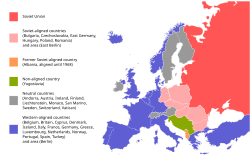
- Member States: Included the Soviet Union, Albania, Bulgaria, Czechoslovakia, East Germany, Hungary, Poland, and Romania.
- Control Mechanisms: Heavy reliance on internal security services like the KGB (USSR) and Stasi (East Germany).
- Economic Model: Emphasis on heavy industry and centralized planning, often resulting in chronic consumer shortages.
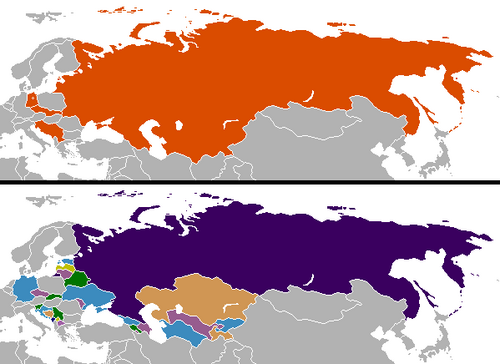
- Collapse: The bloc largely dissolved between 1989 and 1991, leading to significant national boundary changes.
Foundation and Expansion
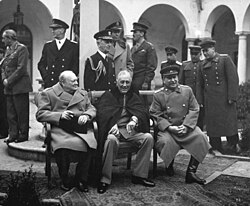
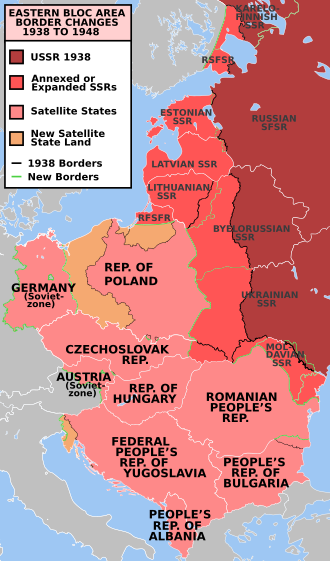
The roots of the Eastern Bloc lie in the strategic movements of the Soviet Union between 1939 and 1940. As the Eastern Front of World War II shifted, the Soviet Union expanded its territory and influence. The geopolitical landscape was further shaped by the Allied conferences, most notably the Yalta Conference in February 1945, where the "Big Three"—Winston Churchill, Franklin D. Roosevelt, and Joseph Stalin—discussed the post-war reorganization of Europe.
Following the war, the Soviet Union established stricter control over Eastern Europe. While some states initially maintained a degree of autonomy, the Tito–Stalin split highlighted the tensions between the Soviet center and those seeking a more independent path to socialism, such as Yugoslavia.
Political Control and Civil Restrictions
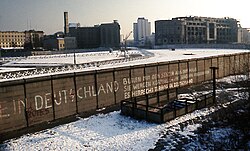
To maintain stability and loyalty, the Eastern Bloc states employed extensive surveillance and political restrictions. Each nation operated its own internal security apparatus to monitor citizens and suppress dissent:
- Soviet Union: KGB
- East Germany: Stasi, Volkspolizei, and KdA
- Czechoslovakia: STB and LM
- Albania: Sigurimi
- Yugoslavia: UDBA
- Hungary: ÁVH and Munkásőrség
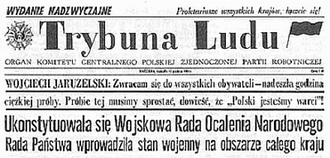
Information was tightly controlled through state-run newspapers. Examples include Trybuna Ludu in Poland, Neues Deutschland in East Germany, and Pravda in the Soviet Union. These publications served as the primary vehicles for government propaganda.
Economic Life and Urban Development
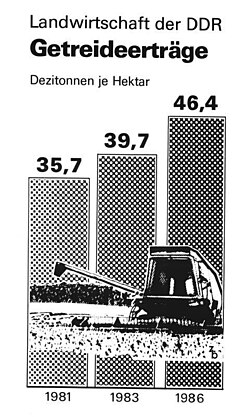
The economies of the Eastern Bloc were defined by a strong emphasis on heavy industry. While this led to rapid initial growth in some sectors, it often came at the expense of consumer goods and housing quality.
Housing and Living Standards
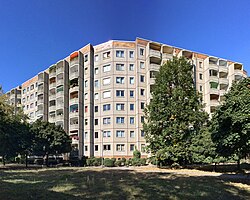
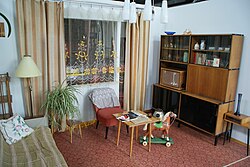
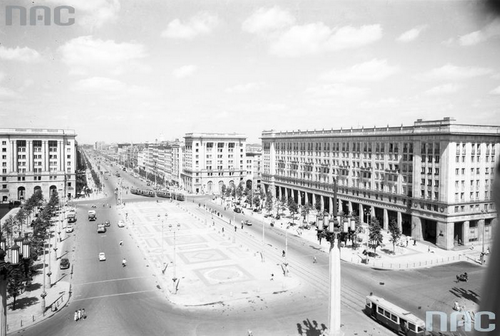
Urban design was characterized by mass-produced housing projects, such as the Plattenbau apartment blocks in East Germany and the khrushchyovka (low-cost, prefabricated apartments) in the Soviet Union. Despite these efforts, overcrowding remained a significant issue, with many households reporting more than one person per room.
Shortages and GDP
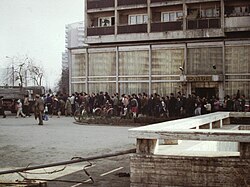
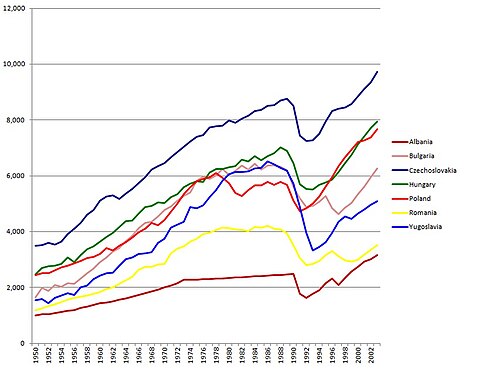
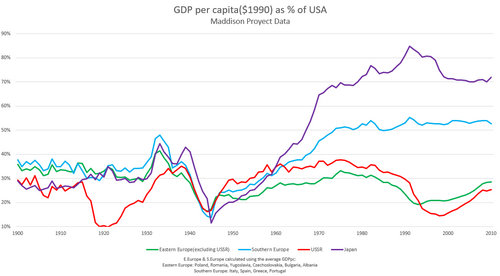
By the 1980s, systemic inefficiencies led to widespread shortages of basic goods. In Romania, for example, lines for cooking oil became a common sight. Economic data shows a widening gap in GDP per capita between the Eastern Bloc and the United States throughout the mid-to-late 20th century.
| Country | Area (000s km²) | 1950 Pop (mil) | 1985 Pop (mil) | Annual Growth | Density (1980/km²) |
|---|---|---|---|---|---|
| Albania | 28.7 | 1.22 | 2.96 | +4.07% | 90.2 |
| Bulgaria | 110.9 | 7.27 | 8.97 | +0.67% | 80.1 |
| Czechoslovakia | 127.9 | 13.09 | 15.50 | +0.53% | 119.5 |
| East Germany | 108.3 | 17.94 | 16.69 | -0.20% | 154.6 |
| Poland | 312.7 | 24.82 | 37.23 | +1.43% | 114.3 |
| Soviet Union | 22,300 | 182.32 | 272.00 | +1.41% | 11.9 |
Resistance and Collapse
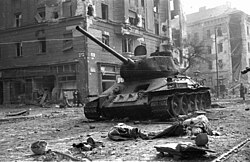
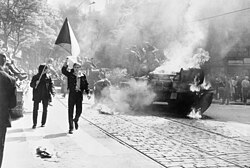
The rigidity of the Soviet system sparked several major uprisings. The 1953 East Germany uprising, the 1956 Hungarian Revolution, and the 1968 Prague Spring in Czechoslovakia were all attempts to reform the socialist system or gain independence, often resulting in violent crackdowns by Soviet forces.
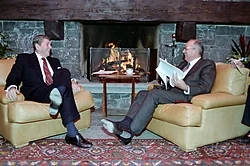
The decline of the bloc accelerated in the 1980s. Soviet General Secretary Mikhail Gorbachev introduced reforms to end the Cold War, while movements like Solidarity in Poland challenged the ruling party's authority. By 1989, the "Iron Curtain" began to open, leading to the collapse of communist governments across Eastern Europe and the eventual dissolution of the Soviet Union in 1991.
Frequently Asked Questions
What was the Warsaw Pact?
The Warsaw Pact was a collective defense treaty established in 1955 between the Soviet Union and seven of its satellite states in Central and Eastern Europe, serving as a military counterweight to NATO.
Which countries were part of the Eastern Bloc?
The primary members included the Soviet Union, Poland, East Germany, Czechoslovakia, Hungary, Romania, Bulgaria, and Albania. Yugoslavia was also a communist state but maintained a more independent relationship with the USSR.
How did the Eastern Bloc handle housing?
The states focused on mass-produced, prefabricated housing like the Plattenbau and khrushchyovkas to address shortages, though many residents still faced overcrowding and limited access to central heating.
What caused the collapse of the Eastern Bloc?
The collapse was driven by a combination of economic stagnation, chronic shortages of consumer goods, internal political unrest (such as the Solidarity movement), and the reformist policies of Mikhail Gorbachev.
Are there any remaining communist states today?
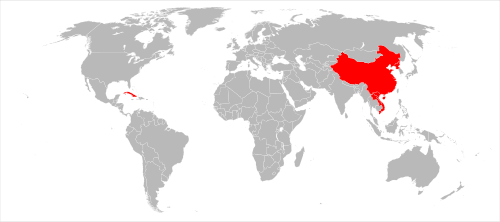
Yes, as of 1993, states such as China, Cuba, Laos, North Korea, and Vietnam have remained communist states.