Tyrrell and the Rise of the Dublin School of Classics
In the mid-19th century, classical studies at Trinity College Dublin were relatively quiet, with many graduates opting for careers in law or public service over academia. This changed dramatically in the 1860s with the emergence of a group of scholars who would become known as the Dublin School of classics. Central to this intellectual revival was Tyrrell, a man whose spontaneous teaching style and rigorous scholarship helped elevate the prestige of the subject.
Early Academic Career and the Dublin School
Tyrrell's path to a fellowship at Trinity College was a test of persistence; he secured the position in 1868 after two previous unsuccessful attempts. Alongside colleagues like John Pentland Mahaffy (appointed 1864) and Arthur Palmer (appointed 1867), Tyrrell helped spearhead an expansion in classical publications and academic influence. In 1871, he was elected Professor of Latin, succeeding the late William Hugh Ferrar.
As an educator, Tyrrell eschewed rigid structures. His lectures were characterized by a spontaneous question-and-answer format. While his student, Louis Claude Purser, noted that these sessions were highly effective, he admitted they lacked a systematic approach and might have appeared as mere "desultory conversations" to an outside inspector.
Literary Ventures: Kottabos and Hermathena
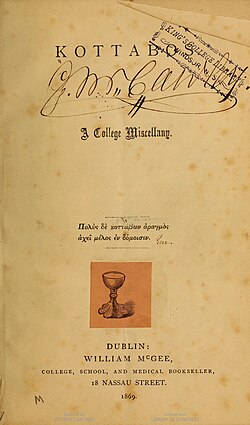
Beyond the classroom, Tyrrell fostered a vibrant intellectual culture. In 1869, he co-founded the literary magazine Kottabos with Edward Sullivan, serving as its first editor-in-chief until 1881. The magazine was a "polyglot miscellany of jeux d'esprit" (witty intellectual diversions), where Tyrrell famously wrote reports on college cricket matches using the formal style of the ancient Greek historian Thucydides.
Seeking a more rigorous academic outlet, Tyrrell also helped establish Hermathena in 1873. His contributions here were markedly more critical; for instance, he published a scathing review of John H. Hogan's edition of Euripides's Medea, citing severe grammatical and metrical errors and suggesting Hogan study the basics of Greek accidence and iambic trimeter before editing further works.
Contributions to Classical Scholarship
Tyrrell's most significant scholarly achievement began in 1879 with the publication of the first volume of the letters of Cicero, the Roman statesman and philosopher. This work was pioneering in the English language for its attempt to date each letter and arrange them chronologically. Breaking from the tradition of grouping letters by the recipient, Tyrrell assigned a unique number to each of the 931 letters.
The Regius Professorship and Professional Ties
From 1880 to 1898, Tyrrell served as the Regius Professor of Greek. During this tenure, he collaborated with Louis Claude Purser on the Cicero editions, though Tyrrell remained the senior partner. He was also a mentor and supporter of other scholars; he published a textual note on Aristophanes's Frogs written by A. E. Housman under his own name in The Classical Review and later sponsored Housman's appointment as Professor of Latin at University College London in 1892.
Tyrrell's professional life was also marked by strong alliances and rivalries. He was a lifelong friend of Richard Claverhouse Jebb, often siding with him in debates against John Pentland Mahaffy. This tension peaked in 1884 during a dispute over Archibald Sayce's edition of Herodotus, resulting in a "minor civil war" among the scholars at Trinity.
Later Years and Administrative Roles
In 1898, Tyrrell stepped down from the Regius Professorship, succeeded by J. B. Bury. He subsequently served as the university's Public Orator (1899) and Professor of Ancient History (1900). While the latter role was less aligned with his literary interests, it was a common practice of the era to view Trinity Fellows as omniscient across multiple disciplines.
The turn of the century brought physical challenges. Starting in 1899, Tyrrell suffered from thrombosis (blood clots) in his legs, which ended his participation in sports like tennis and rackets and took a toll on his physical appearance and energy.
Despite his health, he continued to hold significant positions. After being passed over for the college provost position in 1904, he became a Senior Fellow and the college registrar. By 1906, his total salary was £1,386 14s (approximately £145,800 in 2025). In his final years, he served as senior dean and catechist, overseeing the religious education of students.
Key Facts
- The Dublin School: A group of scholars including Tyrrell, Mahaffy, and Palmer who expanded the prestige of classics at Trinity College Dublin.
- Cicero Edition: The first English-language attempt to chronologically date and number all 931 of Cicero's letters.
- Kottabos: A literary magazine co-founded by Tyrrell in 1869 known for its witty, multilingual content.
- Regius Professor: Tyrrell held the Regius Professorship of Greek from 1880 to 1898.
- British Academy: Tyrrell was honored as one of the founding fellows of the British Academy in 1901.
| Year | Position/Achievement | Institution/Publication |
|---|---|---|
| 1868 | Fellow | Trinity College Dublin |
| 1869 | First Editor | Kottabos Magazine |
| 1871 | Professor of Latin | Trinity College Dublin |
| 1879 | Editor (Cicero's Letters) | First Volume Published |
| 1880-1898 | Regius Professor of Greek | Trinity College Dublin |
| 1901 | Founding Fellow | British Academy |
| 1904 | Registrar | Trinity College Dublin |
Frequently Asked Questions
What was the "Dublin School" of classics?
The Dublin School refers to a group of academics at Trinity College Dublin, including Tyrrell, John Pentland Mahaffy, and Arthur Palmer, who significantly increased the number of publications and the overall prestige of classical studies starting in the 1860s.
How did Tyrrell's edition of Cicero's letters differ from previous ones?
Unlike traditional editions that grouped letters by the person receiving them, Tyrrell arranged the 931 letters chronologically and assigned each a number. It was the first English-language work to attempt a comprehensive dating of the entire corpus.
What was the nature of the magazine Kottabos?
Kottabos was a literary magazine co-founded by Tyrrell and Edward Sullivan in 1869. It was described as a "polyglot miscellany of jeux d'esprit," featuring a mix of languages and witty, intellectual pieces, including sports reports written in the style of Thucydides.
What health issues affected Tyrrell in his later life?
Starting in 1899, Tyrrell suffered from thrombosis of the legs. This condition forced him to stop playing sports and significantly impacted his physical and mental energy.
What role did Tyrrell play in the British Academy?
Tyrrell was recognized for his scholarly contributions by being chosen as one of the founding fellows of the British Academy in 1901.