American School of Classical Studies at Athens
The American School of Classical Studies at Athens (ASCSA) stands as a premier institution for the advanced study of Greek culture, spanning from antiquity to the modern era. Established in 1881, it was the first American overseas research center and has since grown into the largest of the eighteen foreign archaeological institutes located in Athens, Greece.
Operating as a privately funded, nonprofit educational and cultural institution, the ASCSA serves as a consortium for nearly 200 colleges and universities across the United States and Canada. While its campus is located in the heart of Athens, its administrative base is situated in Princeton, New Jersey. The School is also a member of the Council of American Overseas Research Centers (CAORC), a federation dedicated to the conservation of cultural heritage and the interpretation of modern societies.
Key Facts
- Founded: 1881.
- Status: Largest of the 18 foreign archaeological institutes in Athens.
- Primary Sites: Manages the Athenian Agora and Ancient Corinth.
- Governance: Supervised by a Managing Committee of North American academic representatives and a Board of Trustees.
- Resources: Operates two libraries, an archaeological science laboratory, and a publications department.
Governance and Administration
The ASCSA is governed by two primary bodies to ensure both academic excellence and financial stability. The Managing Committee, an academic advisory body, consists of elected representatives from the consortium of over 190 North American colleges and universities. They oversee the School's research facilities and academic programs.
Parallel to this, the Board of Trustees manages the legal responsibilities of the institution. Comprising experts from academia, law, philanthropy, and business, the Board is responsible for the School's property, finances, and endowment.
Major Archaeological Projects
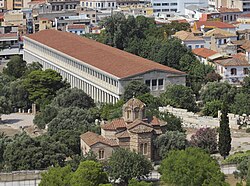
The ASCSA is renowned for its leadership in field archaeology and the subsequent publication of its findings. The institution is primarily responsible for two of Greece's most significant archaeological sites:
- Ancient Corinth: Excavations began here in 1896 and have continued with very little interruption to the present day.
- Athenian Agora: Ground was first broken at this site in 1932.
At both locations, the School maintains extensive facilities for studying the archaeological record and operates museums to showcase its discoveries. Digital access to artifacts and excavation records is provided through ASCSA.net.
Affiliated and Past Projects
Beyond its primary sites, the ASCSA has been involved in numerous surveys and excavations across Greece, including:
- Peloponnese: Southern Argolid, Messenia, Lerna, Argos, Franchthi cave, Halieis, and the Palace of Nestor at Pylos.
- Central Greece and Corinthia: Isthmia, Kenchreai, Nemea, Sicyon, and the islet of Mitrou.
- Crete: Vrokastro, Azoria, Mochlos, Gournia, Kavousi, and Kommos.
- Other Regions: Olynthus (Macedonia), Samothrace (North Aegean), Mt. Lykaion (Acadia), and Haghia Irini (Keos).
Academic Publications
To disseminate its research, the ASCSA maintains a robust publications department. Its flagship peer-reviewed journal, Hesperia, is published quarterly. Additionally, the School produces monographs for final archaeological fieldwork reports, supplements to Hesperia, Gennadeion monographs, and various guides and volumes related to its scholarly activities.
| Category | Details |
|---|---|
| Established | 1881 |
| Type | Overseas Research Center / Higher Education |
| Location | Athens, Greece (Urban Campus) |
| Consortium Size | Nearly 200 North American colleges and universities |
| Key Publications | Hesperia (Quarterly Journal) |
Frequently Asked Questions
What is the primary purpose of the ASCSA?
The ASCSA is dedicated to the advanced study of all aspects of Greek culture, from antiquity to the present, providing resources for students and scholars worldwide.
Which archaeological sites are managed by the School?
The School is primarily responsible for the Athenian Agora and Ancient Corinth, though it has been involved in many other projects across Crete, the Peloponnese, and Macedonia.
How is the ASCSA funded and governed?
It is a privately funded, nonprofit institution governed by a Managing Committee of academic representatives and a Board of Trustees responsible for financial and legal management.
What scholarly resources does the ASCSA provide?
The School operates two distinguished libraries, an archaeological science laboratory, and publishes the peer-reviewed journal Hesperia.
Who can access the ASCSA's archaeological records?
Excavation records and artifacts are made available to a wider audience through the ASCSA.net online database.