Tyche: The Greek Goddess of Fortune and Fate
In the unpredictable landscape of ancient Greek belief, few figures were as pervasive as Tyche. Known as the presiding tutelary deity of fortune and prosperity, Tyche governed the destiny of cities and the individual lives of people. While she began as a bringer of positive messages regarding events beyond human control, her role evolved significantly over centuries, eventually embodying the capricious and often blind nature of fate itself.
Tyche is often identified as one of the Oceanids—the daughters of the Titans Oceanus and Tethys—though other traditions name Zeus and Aphrodite or Prometheus as her parents. Her influence spanned from the smallest personal victory to the rise and fall of great empires, making her a central figure in both religious worship and philosophical debate.
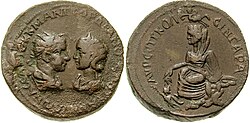
Key Facts
- Primary Role: Goddess of fortune, prosperity, and the destiny of cities.
- Roman Equivalent: Fortuna.
- Defining Symbol: The mural crown (representing city walls).
- Common Attributes: Cornucopia (horn of plenty), ship's rudder, and the wheel of fortune.
- Family: Often cited as the daughter of Oceanus and Tethys; mother of Plutus (god of wealth).
The Evolution of Fortune: From Classical to Hellenistic
During the Classical period, Tyche was primarily seen as a benevolent force. However, the Hellenistic period—marked by the sweeping socio-political upheavals following Alexander the Great—transformed her image. She became the personification of the whims of fate, encompassing both positive and negative outcomes.
The historian Polybius argued that Tyche was the cause of events for which no other explanation could be found, such as sudden frosts, droughts, or unexpected political shifts. Similarly, the poet Pindar noted that Tyche could grant victory to a lesser athlete, regardless of skill. This version of the goddess, sometimes referred to by the epithet Automatia ("she who does what she will"), reflected a world where human affairs felt unstable and arbitrary.
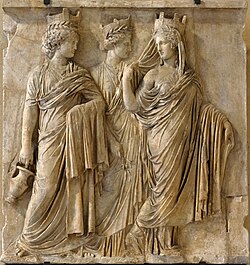
The Tychai: Guardians of the City
As the concept of the city-state evolved, Tyche expanded from a universal goddess to a localized protector. Cities began to venerate their own Tychai—specific, iconic versions of the goddess tailored to the fortune of a particular community. This practice persisted into the Roman and early Christian eras, where the Tychai of the empire's greatest cities were often grouped together in art.
Worship and Cultural Influence
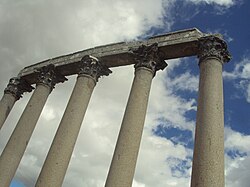
Tyche's worship was widespread across the Mediterranean. In Alexandria, the Tychaeon (the temple of Tyche) was regarded as one of the most magnificent structures of the Hellenistic world. In Crete, specifically at Itanos, she was worshipped as Tyche Protogeneia. In Athens, she was honored as Agathe Tyche, often alongside other deities like Dionysus in Corinth.
Her influence extended beyond Greece into the Parthian Empire. While Parthian kings initially used a variety of Olympian gods on their coins to appeal to Greek subjects, by the reign of Vologases I (AD 51), Tyche became the primary Greek image used. In this context, she was linked to the Khvarenah, the Zoroastrian concept of divine rulership, bestowing legitimacy upon the king.
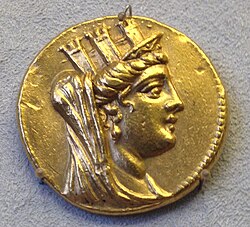
Iconography and Artistic Depictions
Archaeologists and historians identify Tyche in art through several distinct symbols:
- Mural Crown: A crown shaped like city walls, identifying her as the protector of a city. In Sparta, this crown specifically depicted soldiers repelling Amazons.
- Cornucopia: The horn of plenty, symbolizing the prosperity she provides.
- Ship's Rudder: A gubernaculum, signifying her ability to steer the course of events.
- Wheel of Fortune: Representing the cyclical and unpredictable nature of fate.
In the late Roman period, four specific Tychai were frequently depicted: those of Rome, Constantinople, Alexandria, and either Antioch or Trier. For example, the Tyche of Alexandria was often shown with sheaves of corn and her foot resting on the bow of a ship, while the Tyche of Antioch was depicted with a swimmer representing the Orontes River at her feet.
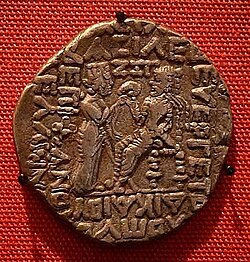
Summary of Tyche's Regional Representations
| City/Region | Key Attributes/Characteristics | Significance |
|---|---|---|
| Rome | Military costume | Known as Fortuna in the Western Empire |
| Constantinople | Cornucopia | Appeared on coins into early Christian Rome |
| Alexandria | Corn sheaves, ship's bow | Linked to maritime steering of events |
| Antioch | Orontes River personification | Maintained relevance into the reign of Justinian |
| Sparta | Mural crown with Amazons | Tied to the city's foundation myth |
Frequently Asked Questions
Who is the Roman equivalent of Tyche?
The Roman equivalent of Tyche is Fortuna, the goddess of luck and fate.
What does the mural crown symbolize?
The mural crown, which resembles city walls, identifies Tyche as the tutelary deity and protector of a specific city's fortune and destiny.
How did Tyche's role change during the Hellenistic period?
She shifted from being a bringer of positive messages to embodying the blind, unpredictable, and often capricious nature of fate, reflecting the instability of the era.
Which constellation is associated with Tyche?
The constellation Virgo is sometimes identified as the heavenly figure of Tyche, though it is also associated with Demeter, Dike, and Astraea.
What is the relationship between Tyche and Plutus?
In some literary traditions, Tyche is named as the mother of Plutus, the god of wealth, although he is more commonly cited as the son of Demeter and Iasion.