The Timeless Elegance of Narcissus: A Comprehensive Guide to Daffodils and Paperwhites
Few flowers signal the arrival of spring as vibrantly as the Narcissus. Known widely as daffodils and paperwhites, these perennial bulbs are celebrated globally for their striking trumpet-shaped blooms and fragrant scents. From the wild landscapes of the Mediterranean to the meticulously manicured gardens of the Netherlands, the genus Narcissus encompasses a diverse array of species and cultivars that have captivated botanists, artists, and gardeners for centuries.
Botanically, Narcissus belongs to the family Amaryllidaceae and the order Asparagales. The type species for the genus is Narcissus poeticus. These plants are monocots, meaning their leaves have parallel veins and they grow from a single seed leaf.
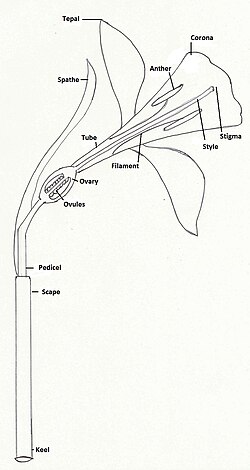
Botanical Characteristics and Anatomy
The structure of a Narcissus flower is unique, characterized by a complex arrangement of parts that distinguish it from other lilies. The flower typically consists of a proximal floral tube, known as the hypanthium, which supports the rest of the bloom.
Surrounding this tube are the free tepals (a term used when petals and sepals look identical). The most distinctive feature, however, is the corona, also called the paraperigonium. This is the central "cup" or "trumpet" that gives the daffodil its iconic appearance. Inside the corona, the reproductive organs are housed, including the androecium (stamens) and the gynoecium (the ovary, style, and stigma).
![N. poeticus. Thomé: Flora von Deutschland, Österreich und der Schweiz (1885)[2] 1. Longitudinal section, 2. Anthers, 3. Stigma, 4. Cross section of ovary](/images/99/ae/99ae55d393d2c5cbc6afc02dae002bf67d513a20cd131aacdb3916b1bc059bff.jpg)
The reproductive system is designed for efficiency, featuring a trilocular ovary (an ovary divided into three cells) and typically six stamens. Once pollinated, the plant produces seeds that allow the species to propagate in the wild.
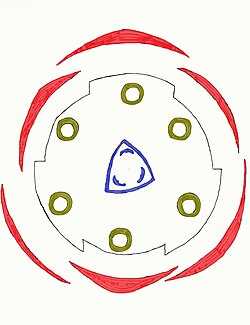
Vegetative Structure
Below the soil, Narcissus plants rely on bulbs for energy storage, allowing them to survive dormant periods and bloom rapidly in early spring. These bulbs support sturdy stems and narrow, strap-like leaves that facilitate photosynthesis during the growing season.
Diversity of Species and Forms
The genus Narcissus is broadly categorized into two primary forms: the "Daffodil" form and the "Paperwhite" form. While they share the same genus, they differ significantly in appearance, fragrance, and bloom time.
Various species highlight this diversity. For example, N. candidissimus is known for its pure white elegance, while N. major, N. triandrus, and N. jonquilla showcase different variations in size and color.
![N. candidissimus by Pierre-Joseph Redouté, 1808[37]](/images/b8/f3/b8f32b11851b8121da64f7120332d55b828270831168f10486c91ce5f34a9acb.jpg)
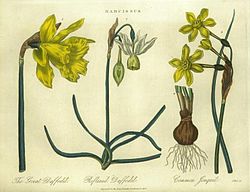
Other notable species include N. juncifolius and N. poeticus, the latter of which is often found in the wild across Europe, including regions like Bosnia and Herzegovina.
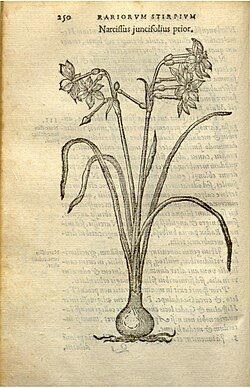
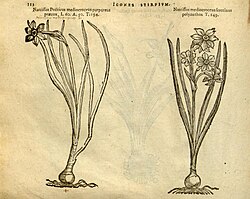
Distribution, Habitat, and Production
Narcissus species are widely distributed, with a strong presence in the Mediterranean basin and Western Europe. They thrive in various habitats, from the hills of Israel to the damp meadows of Wales.
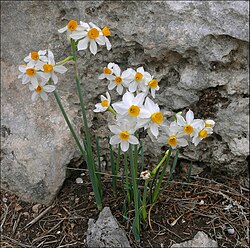
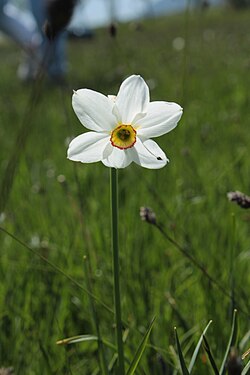
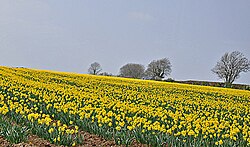
Commercial production is a major industry, particularly in the Netherlands. The region is world-renowned for its massive bulb exports and stunning displays, such as those found at the Keukenhof gardens.

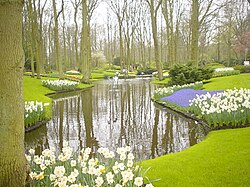
Cultivation and Horticultural Varieties
Gardeners prize Narcissus for their relative ease of cultivation. Modern breeding has resulted in a vast range of cultivars categorized into different divisions based on their shape and color.
Popular cultivars include "Tête-à-Tête," known for its compact size, and "Dutch Master," famous for its large, classic trumpet. These varieties are often bred for specific traits, such as double blooms or unique color gradients ranging from pure white to deep orange.
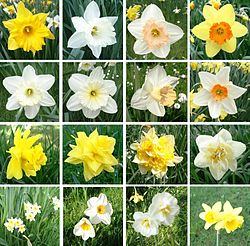
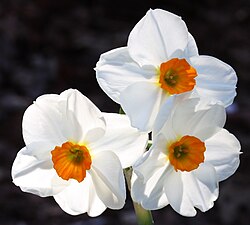
Cultivar Summary Table
| Cultivar | Division | Colour | Area (ha) |
|---|---|---|---|
| "Tête-à-Tête" | 6: Cyclamineus | Yellow | 663 |
| "Carlton" | 2: Large cup | Yellow | 54 |
| "Bridal Crown" | 4: Double | White–Yellow | 51 |
| "Dutch Master" | 1: Trumpet | Yellow | 47 |
| "Jetfire" | 6: Cyclamineus | Yellow–Orange | 42 |
| "Ice Follies" | 2: Large cup | White | 36 |
Cultural and Symbolic Significance
The Narcissus has a deep-rooted history in human culture. In Greek mythology, the flower is linked to the story of Narcissus, a youth who fell in love with his own reflection. This connection is mirrored in ancient art, such as Minoan paintings from Crete.
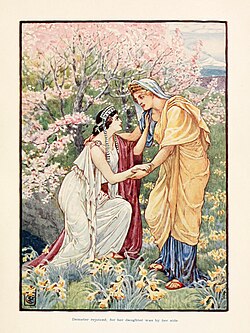
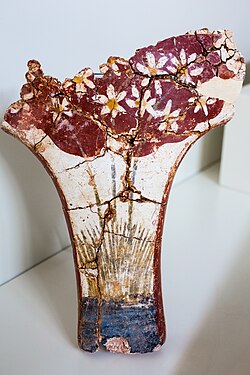
In literature, the flower is immortalized in William Wordsworth's famous poem, "I wandered lonely as a Cloud." Beyond Western culture, the "Chinese Sacred Lily" holds a place of honor in Eastern traditions, and in Islamic culture, N. poeticus has been used to symbolize the eye.
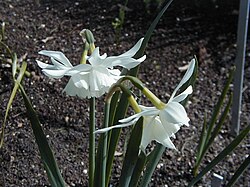
Some varieties also carry somber meanings; for instance, N. triandrus 'Thalia' is traditionally considered a grave flower.
Science, Toxicity, and Pharmacology
While beautiful, Narcissus plants contain alkaloids, which make them toxic if ingested. This toxicity serves as a natural defense mechanism against pests and animals. In humans, poisoning can lead to gastrointestinal distress, and topical contact may cause skin irritation in some individuals.
Despite their toxicity, these biological properties are studied in pharmacology for potential therapeutic uses. The chemical compounds found within the bulbs are of interest for their biological activity and potential medical applications.
Key Facts
- Scientific Name: Narcissus L.
- Type Species: Narcissus poeticus
- Family: Amaryllidaceae
- Key Feature: The corona (central cup or trumpet).
- Major Producer: The Netherlands.
- Toxicity: Contains alkaloids; toxic if ingested.
- Cultural Links: Greek mythology, Wordsworth's poetry, and Islamic symbolism.
Frequently Asked Questions
What is the difference between a daffodil and a paperwhite?
Both are part of the Narcissus genus, but "daffodils" typically refer to the larger, often yellow, trumpet-shaped varieties, while "paperwhites" are generally smaller, pure white, and highly fragrant.
Are Narcissus flowers poisonous?
Yes, they contain alkaloids that are toxic to humans and animals if ingested. They can also cause skin irritation upon contact for some people.
What is the "corona" of a Narcissus flower?
The corona is the central, cup-like structure (the "trumpet") that sits in the middle of the tepals, giving the flower its distinctive shape.
Where are most commercial daffodils produced?
The Netherlands is the primary global center for the production and export of Narcissus bulbs.
Which species is considered the type species for the genus?
The type species is Narcissus poeticus.
How do Narcissus plants propagate?
They propagate both sexually through seeds and vegetatively through their bulbs, which can divide over time to create new plants.