Understanding the Perianth: The Protective Envelope of a Flower
When we look at a flower, we are often captivated by its vibrant colors and delicate shapes. While we focus on the reproductive elements, there is an essential, non-reproductive structure working behind the scenes: the perianth. Derived from the Greek words peri (around) and anthos (flower), the perianth serves as a protective envelope that surrounds the sexual organs of a plant.
In certain plant groups, such as monocots, this structure is also referred to as a perigonium, perigon, or perigone. Interestingly, the term is not exclusive to flowering plants; in mosses and liverworts (Marchantiophyta), the perianth refers to the sterile, tube-like tissue that protects the female reproductive structure or the developing sporophyte.
The Anatomy of the Perianth
In most flowering plants, the perianth is composed of two distinct parts: the calyx and the corolla. The calyx is made up of sepals, which are typically the outermost part of the flower, while the corolla consists of the petals. In many monocots, these two layers are indistinguishable from one another, and they are collectively referred to as tepals.
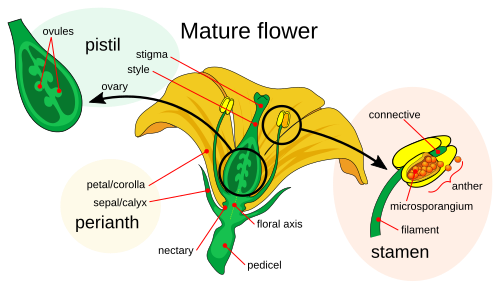
The arrangement and appearance of these parts can vary significantly. When the calyx is green, it is described as sepaloid, but it can also be brightly colored, a condition known as petaloid. Similarly, when undifferentiated tepals resemble petals, they are also called petaloid. While the primary role of the corolla and petals is to attract pollinators, some plants use specialized structures to enhance this effect.
Classifying Perianth Structures
Botanists use specific terms to describe how the perianth is organized. If the calyx and corolla are clearly separate, the flower is described as dichlamydeous (or heterochlamydeous). If they are indistinguishable, it is called homochlamydeous. When the perianth is organized into two distinct layers, it is known as biseriate.
The way these parts are attached to one another also defines their classification:
- Apotepalous: Used when the perianth consists of separate tepals.
- Syntepalous: Used when the tepals are fused together.
- Gamopetalous (or sympetalous): Used when the petals are united to form a tubular corolla.
- Monochlamydeous: A term used if either the petals or the sepals are entirely absent.
While most flowers arrange their perianth in circular layers called whorls, some taxa, such as magnolias and water lilies, arrange them in a spiral on the nodes. Flowers with spiral arrangements often feature undifferentiated perianths.
Specialized Structures: The Corona and Pappus
Some plants possess an additional structure known as the corona (also called a paraperigonium, paraperigon, or paracorolla). The corona is a ring or a set of appendages made of adaxial tissue that arises from the corolla or the outer edge of the stamens. It is frequently located where the corolla lobes meet the corolla tube. Some plants, like the passionflower (*Passiflora* spp.), can have as many as eight coronas arranged in concentric whorls, while milkweeds (*Asclepias* spp.) feature three distinct coronas that assist in a flytrap-style pollination scheme.
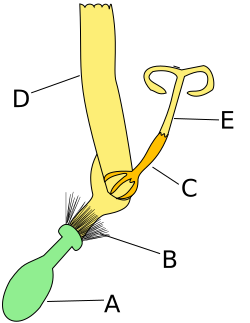
In the Asteraceae family, a modified calyx known as the pappus is often present. If this structure is shaped like a crown, it is also referred to as a corona.
Summary of Perianth Terminology
| Term | Definition/Description |
|---|---|
| Calyx | The outer whorl of a flower, composed of sepals. |
| Corolla | The inner whorl of a flower, composed of petals. |
| Tepals | Undifferentiated parts where the calyx and corolla are indistinguishable. |
| Monochlamydeous | A perianth where either the sepals or petals are missing. |
| Corona | A ring or set of appendages arising from the corolla or stamens. |
| Pappus | A modified calyx, common in the Asteraceae family. |
Key Facts
- The perianth is the non-reproductive part of a flower that surrounds the sexual organs.
- The two main components of the perianth are the calyx (sepals) and the corolla (petals).
- Tepals are used to describe parts when the calyx and corolla cannot be distinguished.
- A corona is a specialized ring or set of appendages that can augment pollinator attraction.
- In monochlamydeous flowers, one of the perianth whorls (either petals or sepals) is completely absent.
Frequently Asked Questions
What is the difference between a calyx and a corolla?
The calyx is the outermost whorl of a flower, typically consisting of green sepals, while the corolla is the inner whorl, typically consisting of the colorful petals.
When should I use the term "tepals" instead of "petals" or "sepals"?
You should use the term tepals when the calyx and corolla are indistinguishable from one another, a common occurrence in many monocots.
What is a corona in botanical terms?
A corona is an additional structure consisting of a ring or appendages of tissue that arises from the corolla or the outer edge of the stamens, often serving to assist in pollination.
Can a flower have a perianth if it doesn't have petals?
Yes. If a flower is missing either the petals or the sepals, it is described as being monochlamydeous.
How are perianth parts arranged in a flower?
Perianth parts are most commonly arranged in circular layers called whorls (biseriate), but in some plants like magnolias, they are arranged in a spiral.