AphroditeGreek mythologyGoddess of loveVenusMount Olympus

Aphrodite: The Goddess of Love, Beauty, and Desire

Aphrodite: The Goddess of Love, Beauty, and Desire In the vast pantheon of ancient Greek mythology, few figures are as enduring or as influential as Aphrodite. As a prominent member of th...

Aphrodite: The Goddess of Love, Beauty, and Desire

In the vast pantheon of ancient Greek mythology, few figures are as enduring or as influential as Aphrodite. As a prominent member of the Twelve Olympians, she governs the realms of love, lust, passion, pleasure, beauty, and sexuality. Her influence spans from the heights of Mount Olympus to the depths of human emotion, making her one of the most complex and widely worshipped deities in the classical world.
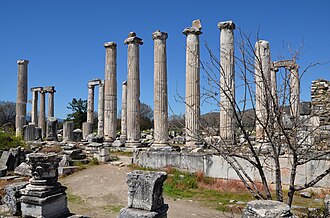
Ruins of the temple of Aphrodite at Aphrodisias

Key Facts

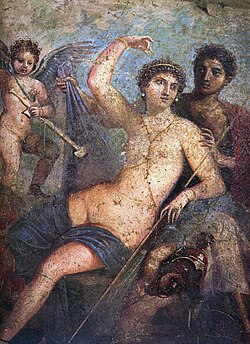
First-century AD Roman fresco of Mars and Venus from Pompeii
  • Domain: Love, lust, passion, pleasure, beauty, and sexuality.
  • Abode: Mount Olympus.
  • Roman Equivalent: Venus.
  • Parents: Zeus and Dione (according to Homer) or Uranus (according to Hesiod).
  • Symbols: Rose, seashell, pearl, mirror, girdle, anemone, narcissus, and dove.
  • Sacred Animals: Dolphin, sparrow, dove, swan, hare, goose, bee, fish, and butterfly.

Origins and Genealogy

Satala Aphrodite, discovered in Satala, Armenia Minor (present-day Gümüşhane Province, Turkey) in 1873, British Museum[151][152]

The origins of Aphrodite are as multifaceted as her character. Scholars often trace her roots back to Near Eastern traditions, noting similarities to the goddess Ishtar. Some theories also suggest she may have roots in the Indo-European dawn goddess. Her lineage varies significantly depending on the source: Homer describes her as the daughter of Zeus and Dione, whereas Hesiod provides a more primordial account, claiming she was born from the severed genitals of Uranus.
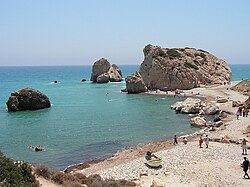
Petra tou Romiou ("The rock of the Greek"), Aphrodite's legendary birthplace in Paphos, Cyprus

Divine Relationships and Offspring

Aphrodite's family tree is intricate, involving many of the most powerful gods. She was married to Hephaestus but famously had a relationship with Ares, the god of war. Her children include a wide array of deities and figures, such as:

  • Eros, Anteros, Himeros, and Pothos (the Erotes) from her time with Ares.
  • Aeneas, the son of Anchises.
  • Harmonia and Phobos and Deimos.
  • Hermaphroditos, through Hermes.

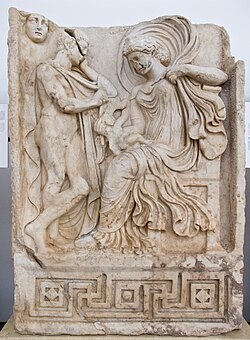
Greek relief from Aphrodisias, depicting a Roman-influenced Aphrodite sitting on a throne holding an infant while the shepherd Anchises stands beside her.

Mythology and Legends

First-century AD Roman fresco from Pompeii showing the virgin Hippolytus spurning the advances of his stepmother Phaedra, whom Aphrodite caused to fall in love with him in order to bring about his tragic death.[208]

Aphrodite's myths are often characterized by intense emotion and tragic consequences. One of her most famous tales involves Adonis, a beautiful mortal whose death caused the goddess great grief. The myth of Adonis is thought to be derived from the ancient Sumerian legend of Inanna and Dumuzid. Another pivotal moment in mythology is the Judgment of Paris, an event that set the stage for the Trojan War.
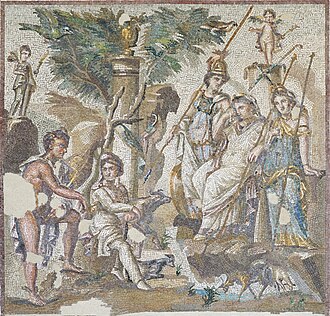
Ancient Greek mosaic from Antioch dating to the second century AD, depicting the Judgment of Paris

The Tragedy of Myrrha

According to the poet Ovid, Aphrodite's influence could be both creative and destructive. She cursed Myrrha with an insatiable lust for her own father, King Cinyras, after Myrrha's mother boasted that her daughter was more beautiful than the goddess. This curse led to Myrrha being transformed into a myrrh tree after giving birth to Adonis.
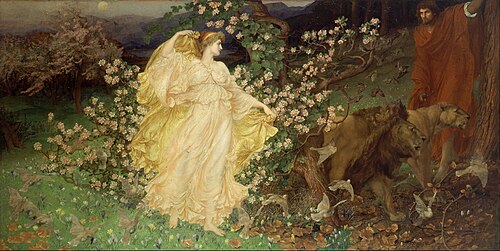
Venus and Anchises (1889 or 1890) by William Blake Richmond

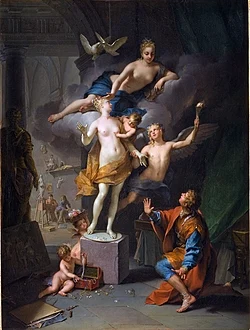
Pygmalion and Galatea (1717) by Jean Raoux, showing Aphrodite bringing the statue to life

Iconography and Artistic Legacy

Throughout history, Aphrodite has been a central subject for artists. In classical art, she is frequently depicted emerging from a seashell, a motif that became iconic during the Renaissance. Her representation has evolved from early terracotta figurines to grand marble statues and vibrant frescoes.

The Birth of Venus (c. 1485) by Sandro Botticelli,[115] Uffizi, Florence

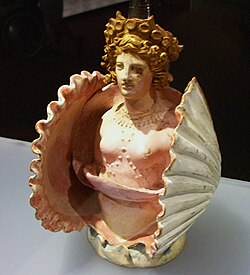
Early fourth-century BC Attic pottery vessel in the shape of Aphrodite inside a shell from the Phanagoria cemetery in the Taman Peninsula

The Aphrodite of Rhodes, c. 2nd century BC, Rhodes Archaeological Museum.

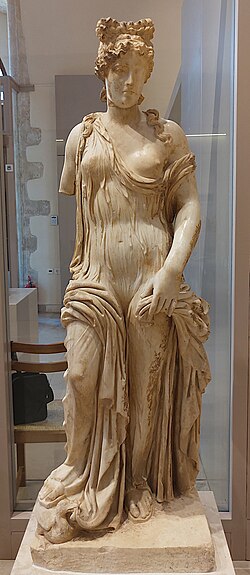
Marble statue of Aphrodite Rhithymnia, mid-2nd century AD, Archaeological Museum of Rethymno, Crete.

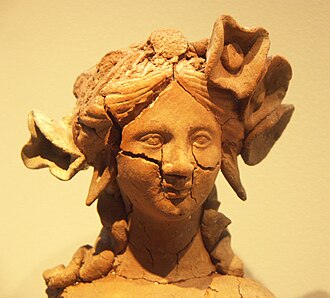
Terracotta figurine of Aphrodite, 2nd century BC, Archaeological Museum of Pella.

The so-called "Venus in a bikini", depicts her Greek counterpart Aphrodite as she is about to untie her sandal, with a small Eros squatting beneath her left arm, 1st-century AD.[b]

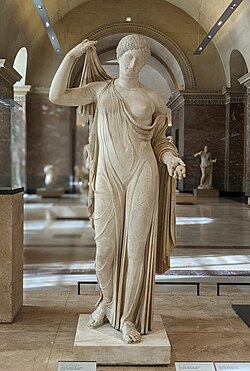
The Aphrodite of Fréjus statue on display. Aphrodite holds the apple of Discord in her left hand

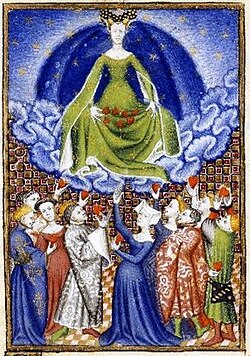
Fifteenth century manuscript illumination of Venus, sitting on a rainbow, with her devotees offering her their hearts

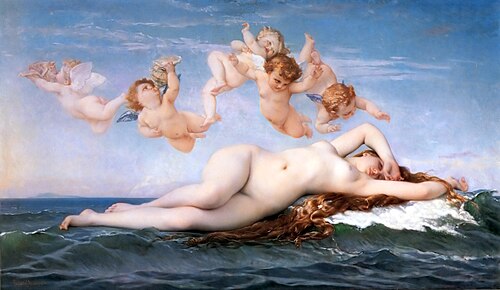
The Birth of Venus (c. 1863) by Alexandre Cabanel

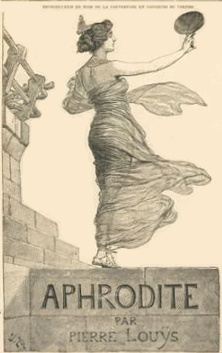
Illustration by Édouard Zier for Pierre Louÿs's 1896 erotic novel Aphrodite: mœurs antiques

Summary of Divine Attributes

Aphrodite's Essential Attributes
Category Details
Primary Domains Love, Beauty, Sexuality, Passion
Sacred Trees Myrrh, Myrtle, Apple, Pomegranate
Sacred Symbols Rose, Seashell, Pearl, Mirror, Girdle
Planetary Association Venus

Frequently Asked Questions

Who are the parents of Aphrodite?

In Homeric tradition, she is the daughter of Zeus and Dione. In Hesiodic tradition, she was born from the remains of Uranus.

What is the Roman equivalent of Aphrodite?

The Roman goddess equivalent to Aphrodite is Venus.

What are the symbols of Aphrodite?

Common symbols associated with her include the rose, seashell, pearl, mirror, girdle, anemone, and narcissus.

Which animals are sacred to Aphrodite?

Her sacred animals include the dolphin, sparrow, dove, swan, hare, goose, bee, fish, and butterfly.

Who was Adonis?

Adonis was a mortal lover of Aphrodite. The myth of his life and death is often linked to the Sumerian legends of Inanna and Dumuzid.

References

  1. Ancient Greek: Ἀφροδίτη, romanized: Aphrodítē; Attic Greek pronunciation: [a.pʰro.dǐː.tɛː], Koine Greek: [a.ɸroˈdi.te̝], Modern Greek: [a.froˈði.ti]
  2. Museo Archeologico Nazionale (Napoli) so-called Venus in a bikini", Cir.campania.beniculturali.it: The statuette portrays Aphrodite on the point of untying the laces of the sandal on her left foot, under which a small Eros squats, touching the sole of her shoe with his right hand. The Goddess is leaning with her left arm (the hand is missing) against a figure of Priapus standing, naked and bearded, positioned on a small cylindrical altar while, next to her left thigh, there is a tree trunk over which the garment of the Goddess is folded. Aphrodite, almost completely naked, wears only a sort of costume, consisting of a corset held up by two pairs of straps and two short sleeves on the upper part of her arm, from which a long chain leads to her hips and forms a star-shaped motif at the level of her navel. The "bikini", for which the statuette is famous, is obtained by the masterly use of the technique of gilding, also employed on her groin, in the pendant necklace and in the armilla on Aphrodite's right wrist, as well as on Priapus' phallus. Traces of the red paint are evident on the tree trunk, on the short curly hair gathered back in a bun and on the lips of the Goddess, as well as on the heads of Priapus and the Eros. Aphrodite's eyes are made of glass paste, while the presence of holes at the level of the ear-lobes suggest the existence of precious metal ear-rings which have since been lost. An interesting insight into the female ornaments of Roman times, the statuette, probably imported from the area of Alexandria, reproduces with a few modifications the statuary type of Aphrodite untying her sandal, known from copies in bronze and terracotta. For extensive research and a bibliography on the subject, see: de Franciscis 1963, p. 78, tav. XCI; Kraus 1973, nn. 270–271, pp. 194–195; Pompei 1973, n. 132; Pompeji 1973, n. 199, pp. 142–144; Pompeji 1974, n. 281, pp. 148–149; Pompeii A.D. 79 1976, p. 83 note 218; Pompeii A.D. 79 1978, I, n. 208, pp. 64–65, II, n. 208, p. 189; Döhl, Zanker 1979, p. 202, tav. Va; Pompeii A.D. 79 1980, p. 79 n. 198; Pompeya 1981, n. 198, p. 107; Pompeii lives 1984, fig. 10, p. 46; Collezioni Museo 1989, I, 2, n. 254, pp. 146–147; PPM II, 1990, n. 7, p. 532; Armitt 1993, p. 240; Vésuve 1995, n. 53, pp. 162–163; Vulkan 1995, n. 53, pp. 162–163; LIMC VIII, 1, 1997, p. 210, s.v. Venus, n. 182; LIMC VIII, 2, 1997, p. 144; LIMC VIII, 1, 1997, p. 1031, s.v. Priapos, n. 15; LIMC VIII, 2, 1997, p. 680; Romana Pictura 1998, n. 153, p. 317 e tav. a p. 245; Cantarella 1999, p. 128; De Caro 1999, pp. 100–101; De Caro 2000, p. 46 e tav. a p. 62; Pompeii 2000, n. 1, p. 62.
  3. Anteros was originally born from the sea alongside Aphrodite; only later became her son.
  4. Hard, p. 202
  5. Homer, Iliad 5.370.