Two-Empire System of Biological Classification
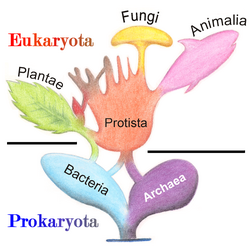
The two-empire system, also known as the two-superkingdom system, served as the primary top-level framework for biological classification from the early 20th century until the rise of the three-domain system. This model simplifies the vast diversity of cellular life by dividing all organisms into two overarching categories based on their cellular structure: Prokaryota and Eukaryota.
At its core, this system distinguishes between organisms that lack a distinct nucleus and those that possess one. While modern genetics has shifted the scientific consensus toward more complex models, the two-empire system remains a significant milestone in the history of taxonomy and continues to be discussed by some evolutionary biologists.
Key Facts
- Primary Divisions: Life is split into two empires: Prokaryota (simple cells) and Eukaryota (complex cells).
- Historical Context: It was the dominant system before the introduction of the three-domain system.
- Predecessor: It followed Haeckel's three-kingdom system (Animalia, Plantae, and Protista).
- Modern Status: Largely superseded by genetic analysis, though still supported by a minority of scientists.
- Core Debate: The system challenges the three-domain model by questioning the fundamental separation of Archaea and Bacteria.
Evolution of Biological Classification
The way scientists categorize life has evolved as technology—particularly genetic sequencing—has improved. Before the two-empire system became prevalent, Ernst Haeckel proposed a three-kingdom system consisting of Animalia, Plantae, and Protista. As our understanding of cellular biology grew, the need to distinguish between prokaryotes (cells without a nucleus) and eukaryotes (cells with a nucleus) led to the adoption of the two-empire or two-superkingdom approach.
Eventually, the three-domain system was introduced, which further split the prokaryotes into two distinct domains: Bacteria and Archaea. While this is now the widely accepted view, the transition was not without controversy.
Scientific Perspectives and Debates
Not all biologists immediately embraced the shift to three domains. Some argued that the three-domain system overemphasized the differences between Archaea and Bacteria. For instance, the renowned evolutionary biologist Ernst Mayr expressed strong skepticism, stating he saw no merit in a three-empire classification.
Other prominent figures, such as Thomas Cavalier-Smith, continued to advocate for the two-empire system. Additionally, scientist Radhey Gupta proposed a return to this model, suggesting that the most meaningful division among prokaryotes is not between Bacteria and Archaea, but between their membrane structures:
- Monoderms: Organisms surrounded by a single membrane, including archaebacteria and gram-positive bacteria.
- Diderms: Organisms with both an inner and outer cell membrane, including gram-negative bacteria.
Comparison of Classification Models
The following table outlines the progression of biological classification systems and the key groups they identified over time.
| Scientist/Year | System Level | Key Groups/Kingdoms |
|---|---|---|
| Linnaeus (1735) | 2 Kingdoms | Plantae, Animalia |
| Haeckel (1866) | 3 Kingdoms | Protista, Plantae, Animalia |
| Chatton (1925) | 2 Empires | Prokaryota, Eukaryota |
| Whittaker (1969) | 5 Kingdoms | Monera, Protista, Fungi, Plantae, Animalia |
| Woese et al. (1990) | 3 Domains | Archaea, Bacteria, Eucarya |
| Cavalier-Smith (1998) | 6 Kingdoms | Bacteria, Protozoa, Chromista, Fungi, Plantae, Animalia |
Frequently Asked Questions
What is the main difference between Prokaryota and Eukaryota?
The primary difference is the cellular structure. Prokaryota consist of simple cells without a membrane-bound nucleus, while Eukaryota consist of complex cells that contain a nucleus and other membrane-bound organelles.
Why did some scientists prefer the two-empire system over the three-domain system?
Some biologists believed that the three-domain system placed too much emphasis on the division between Archaea and Bacteria, arguing that the distinction between prokaryotes and eukaryotes was more fundamental.
What are monoderms and diderms?
These are terms used by Radhey Gupta to classify prokaryotes based on their cell membranes. Monoderms have a single membrane (e.g., gram-positive bacteria and archaebacteria), while diderms have an inner and outer membrane (e.g., gram-negative bacteria).
Is the two-empire system still used today?
While it is no longer the general standard in biological science due to advancements in genetic analysis, it is still referenced in historical contexts and supported by a small number of scientists.
How does the two-empire system relate to the three-kingdom system?
The two-empire system succeeded Haeckel's three-kingdom system (Animalia, Plantae, and Protista) by introducing a higher level of classification that separated all prokaryotic life from eukaryotic life.