Tusculan Papacy: The Era of Benedict VIII, John XIX, and Benedict IX
The early 11th century in Rome was defined by a violent shift in power. In 1012, a political upheaval ended the long-standing domination of the Crescentii family, paving the way for the rise of the Tusculan dynasty. This era saw the papacy become a family affair, as the sons and nephews of Count Gregory I of Tusculum ascended to the throne of St. Peter, blending spiritual authority with secular ambition.
The Rise of Benedict VIII (1012–1024)
Pope Benedict VIII entered the papacy as a layman, a testament to the political nature of his election. A strong proponent of papal supremacy—the doctrine that the pope holds full, supreme, and universal power over the church—Benedict VIII frequently intervened in ecclesiastical affairs across the Italian peninsula.
His ascent was supported by a powerful family network. His brother Romanus served as the city prefect (the "Senator of all the Romans"), while his other brother, Alberic, acted as Consul and Senator, overseeing the courts of justice in the Imperial Palatinate near Santa Sabina. This family grip on power was further bolstered by their history in the court of Emperor Otto III, where Gregory I had served as naval prefect and Alberic as master of the imperial palace.
Upon taking office, Benedict VIII immediately launched a military campaign to dismantle the strongholds of the Crescentii family in Sabina. This aggression led the Crescentii to appoint a rival, Antipope Gregory VI, in 1012. While John Crescentius remained the Prefect of Rome for a time, he was soon stripped of much of his property.
Alliance with Emperor Henry II
Benedict VIII forged a critical alliance with Emperor Henry II. In late 1013, the emperor visited Rome, and together they worked to reshape the religious landscape of Italy. A synod convoked by the emperor deposed the archbishop of Ravenna, replacing him with the emperor's half-brother, Arnulf.
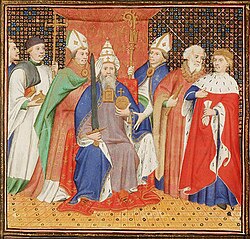
On February 14, 1014, in a ceremony at Old Saint Peter's Basilica, Benedict VIII crowned Henry II as emperor. This coronation was supported by twelve individuals identifying as the Senate of Rome. The relationship remained strong; Benedict visited Henry in Bamberg in 1020, and the emperor returned to Italy the following year.
The Henricianum and Territorial Struggles
During the pope's visit to Bamberg, Henry II issued the Henricianum. This document repeated the Diploma Ottonianum and reinforced land donations dating back to the Frankish Papacy. Along with the forged "Donation of Constantine," the Henricianum became a cornerstone for papal claims to territorial sovereignty for centuries to come.
However, these legal claims often clashed with reality. While the Tusculans remained powerful in the Latin mountains, the pope's actual temporal power was severely limited. Various hereditary counts controlled the surrounding regions: the Counts of Segni held Campagna, the Crescentii held Sabina, and the Counts of Galeria controlled Tuscany. Historian Gregorovius noted that the popes possessed little more than "yellowed deeds of gift" in their archives.
Military and Moral Reforms
Benedict VIII's papacy was also marked by military activity. He likely played a role in the 1016 victory of Pisan and Genoese fleets over the Arabs and may have schemed with the Normans against the Byzantines in southern Italy. He personally led forces against Mussetus at the battle of Luni, though the rebellion against the Greeks was eventually defeated in 1018. On the moral front, Benedict and Henry II held a council in Ravenna in 1022 that issued strict prohibitions against clerical concubinage (priests living with partners).
The Succession: John XIX and Benedict IX
Following Benedict VIII, his brother Romanus ascended as Pope John XIX (1024–1032). Unlike his predecessor, John XIX retained his secular titles, being referred to as "Count Palatine and Consul." While he cooperated with Emperor Conrad II, he was considered less adept than Benedict VIII. John XIX sought a rapprochement with Byzantine emperor Basil II, even considering declaring the patriarch of Constantinople an ecumenical bishop, though this was blocked by Italian bishops and the congregation of Cluny.
The dynasty reached a turbulent peak with Pope Benedict IX (1032–1044, 1045, 1047–1048), the nephew of the previous two popes. His reign is often described as the "Nero of the Tusculan Papacy." While some sources suggest his first twelve years were adequate, others, including successor Victor III, describe a reign of horror characterized by robberies, murders, and adulteries.
The Chaos of the Mid-11th Century
The instability of Benedict IX's rule led to a series of rapid successions and conflicts. In 1045, the people of Rome drove him out, leading to the election of Pope Sylvester III. Benedict IX later resigned in favor of John Gratian, who became Pope Gregory VI.
This chaos prompted the intervention of Holy Roman Emperor Henry III. In 1046, Henry III summoned the three rival claimants—Benedict IX, Sylvester III, and Gregory VI—to a synod in Sutri. Only Gregory VI attended; he was found guilty of simony (the buying or selling of church offices) and deposed. Sylvester III was deprived of his orders and sent to a monastery. Benedict IX was excommunicated for simony, and Henry III installed Bishop Suidger of Bamberg as Pope Clement II.
Key Facts
- Dynastic Control: The Tusculan family (Benedict VIII, John XIX, and Benedict IX) dominated the papacy in the early 11th century.
- The Henricianum: A pivotal document issued by Henry II that supported papal territorial and sovereignty claims.
- Political Alliances: Benedict VIII maintained a strong strategic partnership with Emperor Henry II to secure his position against the Crescentii.
- Simony: The practice of selling church offices led to the deposition of multiple popes during the synod of Sutri in 1046.
- Temporal Power: Despite legal claims, the popes of this era struggled to maintain actual control over Italian territories against local counts.
| Pope | Reign | Key Relationship/Characteristic | Major Event/Document |
|---|---|---|---|
| Benedict VIII | 1012–1024 | Ally of Emperor Henry II | The Henricianum |
| John XIX | 1024–1032 | Brother of Benedict VIII | Attempted Byzantine rapprochement |
| Benedict IX | 1032–1048 (intermittent) | Nephew of Benedict VIII & John XIX | Synod of Sutri (1046) |
Frequently Asked Questions
Who were the Tusculans?
The Tusculans were a powerful Roman family led by Count Gregory I of Tusculum. They seized control of the papacy in 1012, placing three family members—Benedict VIII, John XIX, and Benedict IX—on the papal throne.
What was the significance of the Henricianum?
The Henricianum was a document issued by Emperor Henry II that confirmed land donations to the papacy. It served as a legal basis for the church's claims to territorial sovereignty and power in the following centuries.
What is simony and why did it matter in 1046?
Simony is the act of buying or selling ecclesiastical offices. It was a central charge during the synod of Sutri, leading Emperor Henry III to depose Pope Gregory VI and excommunicate Benedict IX.
How did Benedict VIII's relationship with the Emperor differ from his successors?
Benedict VIII had a highly effective and mutually beneficial alliance with Emperor Henry II. His successor, John XIX, was considered less adept at cooperating with the next emperor, Conrad II, though he remained an independent actor.
Why was Benedict IX described as the "Nero" of the papacy?
This description refers to the reports of his extreme moral deviance, including allegations of murder and adultery, and his perceived rule as a "captain of banditti" rather than a spiritual leader.