Tsar: The History and Evolution of the Slavic Imperial Title
The title tsar (also spelled czar or tzar) is a powerful symbol of Slavic sovereignty. Derived from the Latin caesar, the term was designed to convey the status of an "emperor" in the medieval European sense—a ruler possessing the same rank as a Roman emperor. While Western Europeans often viewed the title as equivalent to "king," its users often intended it to signal a higher, imperial authority, often validated by ecclesiastical officials or other emperors.
From the early Bulgarian empires to the vast reaches of the Russian Tsardom, the title has evolved from a diplomatic concession to a symbol of absolute autocracy. Today, while the formal monarchies have largely vanished, the term persists as a metaphor for high-level authority in modern governance.
Key Facts
- Etymology: Derived from the Latin caesar via the Gothic kaisar.
- First User: Simeon I of Bulgaria was the first monarch to adopt the title.
- Major States: Used officially in the First and Second Bulgarian Empires, the Serbian Empire, and the Tsardom of Russia.
- Last Holder: Simeon II of Bulgaria is the only living person to have borne the title.
- Modern Usage: In the US and UK, "czar" refers to high-level civil servants or presidential advisors.
Etymology and Linguistic Roots
The word tsar is a linguistic descendant of the Latin title caesar, used by Roman emperors. It entered Slavic languages through the Gothic term kaisar and served as a Slavic equivalent to the Greek basileus, a term referring to Byzantine emperors and biblical kings. While basileus was the Greek counterpart to caesar, the Greek term for the Latin imperator was autokrator.
The Title in Bulgaria
Bulgaria holds a primary place in the history of the title. In 705, Emperor Justinian II named Tervel of Bulgaria "caesar," making him the first foreigner to receive the honor. However, it was not until 913 that Simeon I formally adopted the title of tsar following a coronation by the Patriarch of Constantinople. After years of conflict, the Byzantine government recognized the title in 924 and 927.
Because Byzantine political theory allowed for only two emperors (Eastern and Western), the Bulgarian ruler was recognized as a basileus in the capacity of a "spiritual son" of the Byzantine emperor.
![[[Alphonse Mucha]]'s The Slav Epic cycle No.4: Tsar Simeon I of Bulgaria (1923)](/images/46/25/462532dad79e8dcb2a608ec70f8338d3f4ca4e764413ce4923b50d7b8c7d9349.jpg)
The title saw a resurgence in the modern era. After Bulgaria's liberation from Ottoman rule in 1878, monarchs were initially titled knyaz (prince). Upon declaring full independence in 1908, Ferdinand I adopted the title of tsar, which remained in use until the monarchy was abolished in 1946.
![Simeon Saxe-Coburg-Gotha is the only living person to have borne the title of "tsar" (as Simeon II of Bulgaria).[8]](/images/89/f1/89f11f12bfbe08f4702c2adc3f9ee96d2f1f43a972c25dcb47cc04376ddf693e.jpg)
The Serbian Empire
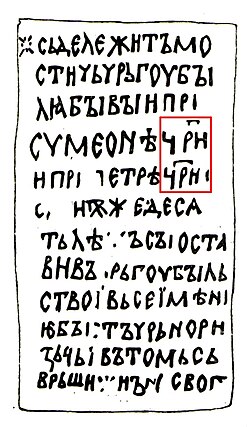
In Serbia, the title of tsar (Serbian: car) was used by two monarchs, replacing the previous title of kralj (king). In 1346, Stefan Dušan was crowned "Emperor of Serbs and Greeks" in Skopje. This coronation was performed by the Serbian patriarch, alongside the Bulgarian patriarch and the archbishop of Ohrid.
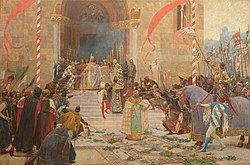
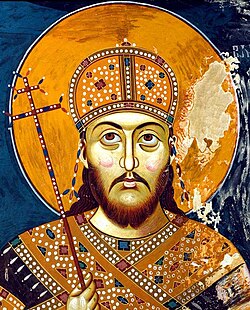
Following Dušan's death in 1355, his son Stefan Uroš V succeeded him. The title was also contested by Simeon Uroš (Siniša) in Thessaly, and later by his son John Uroš, who eventually retired to a monastery around 1373.
The Tsardom of Russia
The trajectory of the title in Russia differed from its Balkan counterparts. Early in the Kievan Rus' period, the title was used sparingly, such as by church officials for Yaroslav the Wise to distance him from Constantinople. For much of the medieval period, the title held more religious or moral value than political challenge.
The shift toward political sovereignty began with Ivan III (r. 1462–1505), who used the title in diplomatic relations with the West to assert independence from the Golden Horde. By 1480, he was referred to as imperator in Latin and keyser in German correspondence. This "title inflation" was fueled by Moscow's ambition to become the "Third Rome" after the fall of Constantinople in 1453.
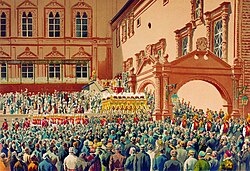
Ivan IV, known as "the Terrible," became the first Russian ruler to be formally crowned as tsar of all Russia in 1547. Over time, the perception of the title shifted. By the 18th century, tsar was sometimes viewed as inferior to "emperor" or as an "oriental" designation. Catherine the Great, for example, used the title tsaritsa specifically for the annexed Crimea.
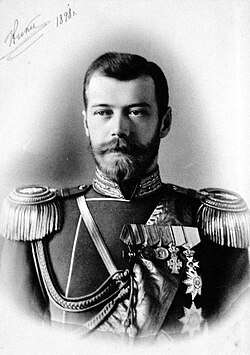
Among the indigenous peoples of Siberia and the Caucasus, the Russian autocracy was often identified as the "White Tsar" (Belyi Tsar), a term with roots in Mongolian traditions.
Other Occurrences and Modern Metaphors
The title appeared briefly in Montenegro, where Šćepan Mali (Stephen the Little) ruled as tsar from 1768 to 1773, claiming to be the former Russian emperor Peter III.
In modern English, "czar" has become a metaphor for positions of high authority, often implying dictatorial power. In the United States, it describes sub-cabinet-level executive advisors, such as the "drug czar" or "cybersecurity czar." One of the earliest American examples was Judge Kenesaw Mountain Landis, the baseball commissioner appointed to clean up the sport after the 1919 Black Sox scandal.
| Region/State | Key Period of Use | Notable Ruler | Context/Meaning |
|---|---|---|---|
| Bulgaria | 913–1018; 1185–1396; 1908–1946 | Simeon I | First to adopt the title; later used as a national royal title. |
| Serbia | 1346–1371 | Stefan Dušan | Used to denote "Emperor of Serbs and Greeks." |
| Russia | 1547–1721 (Official) | Ivan IV | Symbol of the "Third Rome" and absolute autocracy. |
| Montenegro | 1768–1773 | Šćepan Mali | Brief rule by a pretender to the Russian throne. |
| USA (Modern) | Late 19th Century–Present | Various Advisors | Colloquial term for high-level executive officials. |
Frequently Asked Questions
What is the difference between a tsar and a king?
Etymologically, tsar is derived from caesar (emperor), whereas king (such as the Slavic kralj) denotes a lower rank of sovereignty. While Westerners often translated tsar as king, the rulers who used the title generally intended to claim imperial status equivalent to that of the Roman or Byzantine emperors.
Who was the first person to be called a tsar?
Simeon I of Bulgaria was the first monarch to officially adopt the title of tsar following his coronation by the Patriarch of Constantinople in 913.
Why is the term "czar" used in the US government?
In the United States, "czar" is a colloquial term for a high-level civil servant or sub-cabinet advisor who is given broad authority to oversee a specific policy area, such as terrorism or cybersecurity.
What does the term "White Tsar" refer to?
The "White Tsar" (Belyi Tsar) was a title used by the Russian Empire when communicating with Muslim and indigenous peoples in Central Asia, the Caucasus, and Siberia, drawing on Mongolian traditions of authority.
Is there anyone still alive who has held the title of tsar?
Yes, Simeon II of Bulgaria is the only living person to have borne the title of tsar.