Troposphere Dynamics: Earth's Vital Atmospheric Layer
The troposphere is the foundational layer of Earth's atmosphere, serving as the primary stage for nearly all weather phenomena. Derived from the Ancient Greek words tropos (meaning 'turning' or 'change') and sphaira (sphere), its name reflects the rotational turbulence that constantly mixes the air within this layer. This dynamic movement is essential for determining the atmospheric structure and the complex weather patterns we experience daily.
Containing approximately 80% of the total mass of the planetary atmosphere and 99% of its water vapor and aerosols, the troposphere is where life thrives and weather unfolds. Because it is in constant motion, it forms a planetary boundary layer (PBL)—a region near the surface where rotational friction affects air flow. The height of this boundary layer can vary from a few hundred meters up to 2 km, depending on latitude, landforms, and the time of day.

Key Facts
- Mass Concentration: Holds 80% of the atmosphere's total mass and 99% of its water vapor.
- Average Height: Approximately 13 km (8.1 mi), varying from 6 km at the poles to 18 km at the equator.
- Temperature Trend: Generally decreases as altitude increases.
- Atmospheric Boundary: Separated from the stratosphere by the tropopause.
- Composition: Primarily nitrogen (78.08%) and oxygen (20.95%).
Atmospheric Structure and Composition
The composition of the troposphere is a complex mix of gases and moisture. While nitrogen and oxygen dominate the mass, the presence of water vapor is critical for weather. This water vapor originates from oceans, lakes, rivers, and vegetation through evaporation and transpiration. Interestingly, the atmosphere's water vapor is naturally slightly acidic, with a pH of approximately 5.0 to 5.5, due to the formation of carbonic acid when water combines with carbon dioxide.
As altitude increases within the troposphere, the air becomes less dense and the temperature drops. This temperature decline is measured by the environmental lapse rate (ELR). The rate of cooling is influenced by whether the air is dry or saturated with moisture. In dry air, the process is governed by the dry adiabatic lapse rate (DALR), while in moist air, the wet adiabatic lapse rate (WALR) accounts for the energy released during condensation.

The Role of the Tropopause
The upper limit of the troposphere is the tropopause. This layer acts as a functional border between the troposphere and the stratosphere. It is characterized as an inversion layer, meaning that unlike the troposphere where temperature decreases with height, the temperature in the tropopause remains constant before increasing in the stratosphere. This temperature inversion limits the vertical mixing of air between the two layers.
Pressure and Temperature Variations
Air pressure is at its maximum at sea level and decreases with altitude due to hydrostatic equilibrium—the balance where air pressure equals the weight of the air above a specific point. This relationship is mathematically linked to air density, gravity, and temperature.
Temperature distribution is heavily influenced by latitude. The Earth's surface absorbs solar energy and radiates it outward, heating the troposphere from the bottom up. This leads to significant variations:
- Equator: Average sea level temperature of 20 °C, dropping to -70 to -75 °C at the tropopause.
- Middle Latitudes: Average sea level temperature of 15 °C, dropping to -55 °C at the tropopause.
- Polar Regions: Average sea level temperature of 0 °C, dropping to -45 °C at the tropopause.

Atmospheric Circulation and Flow
The movement of air in the troposphere is not uniform. While the general flow is from west to east, it can be interrupted by different patterns. Meteorologists describe these using two primary terms:
- Zonal Flow: A regime indicating a dominant west-to-east flow.
- Meridional Flow: A pattern characterized by north-to-south or south-to-north movement, often showing amplified troughs and ridges.


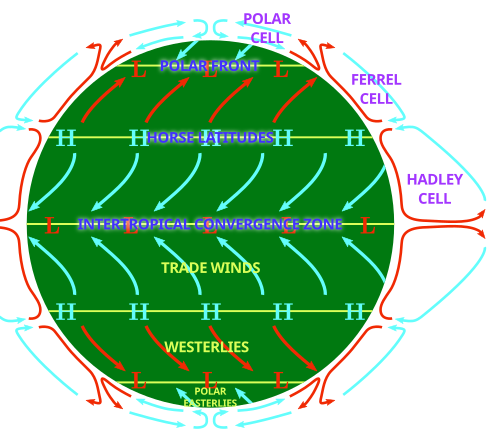
These flows are part of a larger three-cell model that explains the global circulation of the planetary atmosphere.
Comparison Across the Solar System
The troposphere is not unique to Earth. Other planetary bodies in our solar system possess them, though their characteristics vary wildly.
| Planet/Moon | Primary Characteristics | Key Feature |
|---|---|---|
| Venus | Extremely dense; high CO2 | Strong greenhouse effect; surface temp ~467 °C |
| Mars | Driven by dust and surface heating | High diurnal temperature range; dust-driven lapse rate |
| Titan | Nitrogen-rich; substantial atmosphere | Methane rain and haze layers |
| Jupiter | No solid surface | Transitions smoothly into a fluid interior |

Frequently Asked Questions
Why does the temperature decrease with altitude in the troposphere?
The temperature decreases because the Earth's surface absorbs solar energy and radiates it outward, heating the air from the bottom up. As air rises, it expands due to lower pressure, which causes it to cool.
What is the difference between zonal and meridional flow?
Zonal flow refers to air moving primarily from west to east, whereas meridional flow refers to air moving north to south or south to north.
What defines the tropopause?
The tropopause is the boundary layer where the temperature lapse rate changes. It marks the transition from the troposphere (where temperature decreases with height) to the stratosphere (where temperature begins to increase).
How does humidity affect the lapse rate?
When air contains water vapor, the cooling process involves condensation. This changes the rate of temperature decrease from the dry adiabatic lapse rate to the saturated (or wet) adiabatic lapse rate.
Is the troposphere the same height everywhere on Earth?
No. The troposphere is thicker at the equator (averaging 18 km) due to surplus heating and vertical expansion, and thinner at the poles (averaging 6 km in winter).