Horse Latitudes: The Science and Mystery of the Subtropical Ridges
Located approximately 30 degrees north and south of the equator, the horse latitudes are regions defined by sunny skies, calm winds, and minimal precipitation. Known scientifically as subtropical ridges or highs, these areas represent a critical junction in Earth's atmospheric circulation where the trade winds meet the westerlies.
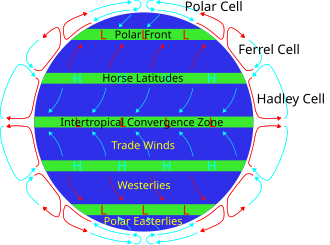
These belts of high pressure play a fundamental role in global weather patterns, influencing everything from the location of the world's largest deserts to the paths taken by tropical cyclones.
Key Facts
- Location: Approximately 30° North and 30° South of the equator.
- Weather Characteristics: High pressure, calm winds, sunny skies, and very little rain.
- Climatological Impact: Responsible for the formation of major hot deserts worldwide.
- Atmospheric Driver: Created by the sinking air of the Hadley cell.
- Seasonal Movement: The ridge migrates poleward in summer and equatorward in winter.
The Origins of a Name: Etymology and Folklore
The term "horse latitudes" carries several historical explanations, ranging from documented maritime traditions to popular folk etymologies.
The "Dead Horse" Ritual
One documented explanation stems from the "dead horse" ritual practiced by seamen. Sailors were often paid partly in advance, and after spending their wages, they entered a period of unpaid work to settle their debt—a time known as "dead horse" time. To celebrate working off this debt, sailors would parade a straw-stuffed horse effigy around the deck before throwing it overboard. Because westward-bound ships from Europe typically reached the subtropics just as this debt was settled, the latitude became associated with the ceremony.
Folk Etymologies and Alternative Theories
A popular folk theory suggests that Spanish ships transporting horses to the West Indies would become becalmed (stuck due to lack of wind) in these latitudes. The resulting water shortages often forced crews to throw dead or dying horses overboard.
Another theory, proposed by Edward Taube, relies on the maritime term "horsed." A ship was said to be "horsed" when it made progress by latching onto a strong current despite insufficient wind, much like a carriage being pulled by a horse. Additionally, some suggest the name arose from a translation error of the German term Rossbreiten, where Ross (horse) was used instead of the intended meaning.
Atmospheric Formation and the Hadley Cell
The formation of the horse latitudes is a result of complex atmospheric convection. Intense heating at the thermal equator causes air to rise along the Intertropical Convergence Zone (ITCZ). As this rising air mass moves toward the mid-latitudes, it cools and begins to sink.
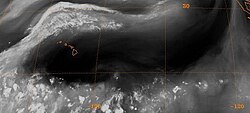
This sinking air creates a ridge of high pressure near the 30th parallel in both hemispheres. This process is part of the Hadley cell, a circulation pattern reinforced during summer by mechanisms such as the Rodwell–Hoskins mechanism. Because sinking air inhibits cloud formation and precipitation, these high-pressure zones are the primary cause of the world's major hot deserts.
Global Desert Distribution
| Hemisphere | Desert Name | Region |
|---|---|---|
| Northern | Sahara | Africa |
| Northern | Arabian & Syrian | Middle East |
| Northern | Mojave & Sonoran | North America |
| Southern | Atacama | South America |
| Southern | Namib & Kalahari | Southern Africa |
| Southern | Great Australian | Australia |
Seasonal Migration and ENSO Influence
The subtropical ridge is not static; it migrates poleward during late spring, reaching its highest latitude in early autumn, before retreating toward the equator during the winter. This movement is closely tied to the progression of the monsoon trough.
The El Niño–Southern Oscillation (ENSO) significantly impacts these ridges. During La Niña, the northern hemisphere ridge can have a more northerly axis, whereas El Niño tends to result in flatter, more southerly ridges. These shifts alter the tracks of tropical cyclones. For example, in the Atlantic, El Niño can cause the subtropical ridge to sit about 5 degrees further south, leading to more southerly recurvature for storms.
Impact on Weather and Air Quality
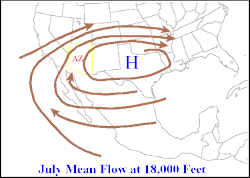
The position of the subtropical ridge dictates regional moisture levels. In North America, the ridge's movement influences the monsoon conditions in the Desert Southwest. When the ridge moves north toward the Four Corners, moisture can spread into Arizona; when it moves south, it cuts off moisture, bringing hot, dry continental air.
On the western edges of continents, the high-pressure cell pushes tropical air poleward. In the United States, the Bermuda High creates the hot, sultry summer conditions typical of the Gulf of Mexico and the East Coast. However, these ridges can also impact air quality. When surface winds are light, the sinking air (subsidence) can trap particulates in urban areas, leading to widespread haze or fog if humidity levels rise overnight.
Frequently Asked Questions
Why are the horse latitudes so dry?
The dryness is caused by sinking air within the subtropical ridge. As air descends, it warms and inhibits the formation of clouds and precipitation, creating stable, high-pressure conditions.
How do the horse latitudes affect tropical cyclones?
The subtropical ridge acts as a steering mechanism. Tropical cyclones often form near the equatorward edge of the ridge and move poleward, following the ridge's axis before recurving into the westerlies.
What is the difference between the "calms of Cancer" and "calms of Capricorn"?
These are names for the subtropical anticyclones in the respective hemispheres: the "calms of Cancer" refers to the belt in the Northern Hemisphere, while the "calms of Capricorn" refers to the belt in the Southern Hemisphere.
Does the position of the ridge change with the seasons?
Yes. The ridge migrates poleward during the summer months, reaching its peak latitude in early autumn, and moves back toward the equator during the colder seasons.
Can the subtropical ridge affect air quality in cities?
Yes. The sinking air (subsidence) under the ridge can lead to a buildup of particulates, resulting in haze, especially when surface winds are light.