Trombone: History, Construction, and Varieties of the Sliding Brass Instrument
The trombone is a distinctive brass instrument known for its unique ability to change pitch using a telescoping slide. Classified as a sliding aerophone sounded by lip vibration, it occupies a vital role in orchestras, jazz ensembles, and wind bands. Unlike most brass instruments that rely on valves or finger holes, the trombone's slide allows for seamless glissandi and precise microtonality.
From its origins as the Renaissance sackbut to the complex valve-equipped models of the modern era, the trombone has evolved to provide a rich, powerful voice across a wide frequency range.

Key Facts

- Classification: A cylindrical bore brass instrument (aerophone).
- Defining Feature: A telescoping slide used to alter the length of the tubing and change pitch.
- Common Materials: Yellow brass (70% copper, 30% zinc), rose brass, red brass, and occasionally sterling silver.
- Standard Range: Varies by type, from the high-pitched piccolo to the deep contrabass.
- Key Innovation: The F attachment, developed by Christian Friedrich Sattler, extends the instrument's lower range.
The Evolution of the Trombone
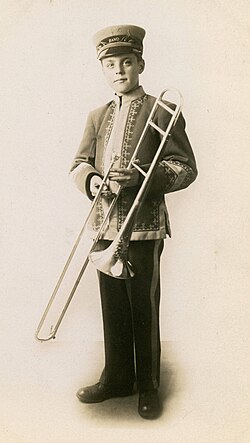
The Sackbut Era
The precursor to the modern trombone, the sackbut, appeared in the 15th century. Used extensively across Europe for outdoor events, liturgical settings, and dance bands, it often served as the contratenor part. In 16th-century German city-states, trombonists were employed to stand watch in city towers and herald the arrival of dignitaries, symbolizing the city's wealth and strength.
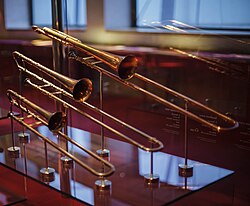
Classical and Romantic Transitions
During the Classical period, the alto trombone was occasionally featured as a solo instrument in divertimenti and serenades, such as those by Leopold Mozart and Michael Haydn. By the early 19th century, the instrument began integrating into the symphony orchestra. While often associated with Ludwig van Beethoven—who used them in his 5th, 6th, and 9th symphonies—earlier works like Joachim Nicolas Eggert's 1807 Symphony in E♭ also featured independent trombone parts.
Modern and Experimental Use
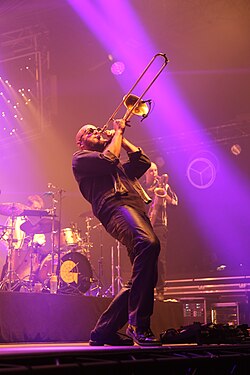
In the 20th century, the trombone expanded into jazz and experimental music. Composers like John Cage and Luciano Berio pushed the instrument's boundaries, introducing extended techniques such as multiphonics, percussive sounds, and vocalizations.
Construction and Technical Specifications
![Trombone with F attachment slide position second harmonics.[19]](/images/28/46/284685830543e91cc6ed419a4de29a946243212662659194d55f7d280c2be66e.png)
Bore and Bell Design
The trombone is a cylindrical bore instrument, meaning much of its tubing maintains a constant diameter. Tenor trombones typically feature a bore between 0.450 inches (small bore) and 0.547 inches (large/orchestral bore). The bore then expands into the bell, which usually measures between 7 and 8.5 inches in diameter.
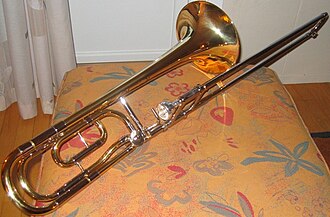
Valve Attachments
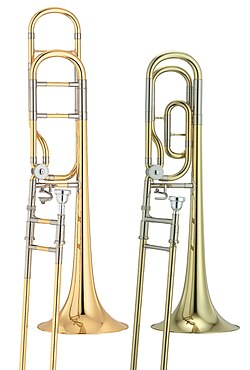
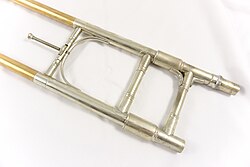
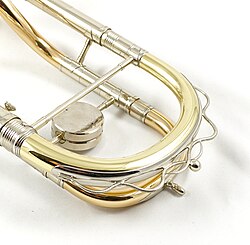
The F attachment, invented by Christian Friedrich Sattler in the late 1830s, adds approximately 3 feet of tubing via a rotary valve. This lowers the fundamental pitch from B♭ to F, filling gaps in the harmonic series and extending the lower range.
Regional Variations
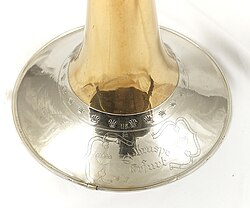
- German/Austrian: Often made of gold brass with very thin metal and a Kranz (wreath) ring on the bell rim. They typically feature a very long leadpipe.
- French: Historically preferred smaller bore sizes (around 0.450 inches) and smaller bells (up to 6 inches), often utilizing a section of three tenor trombones.
Types of Trombones
| Type | Typical Pitch | Key Characteristics |
|---|---|---|
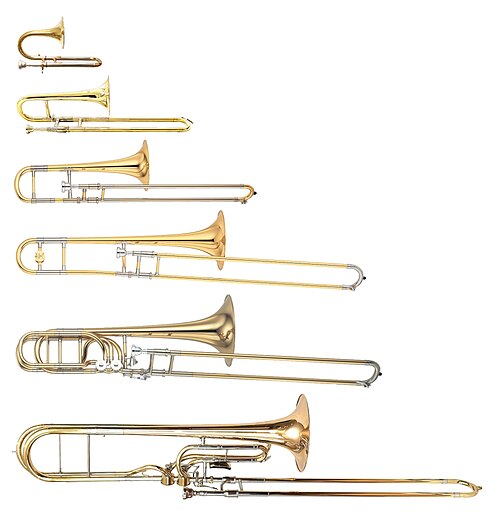
| Soprano/Piccolo | B♭ / F | Smallest size, highest pitch. |
| Alto | E♭ | Used in early Classical solo works. |
| Tenor | B♭ | The most common orchestral and jazz model. |
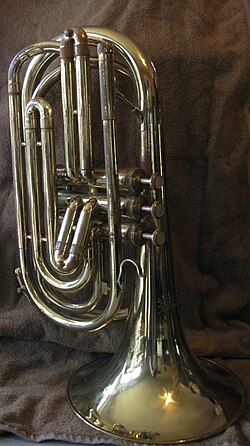
| Bass | B♭ | Larger bore and bell; often includes F and G♭ valves. |
| Contrabass | F / B♭ | Lowest range; used in Wagnerian operas and film scores. |
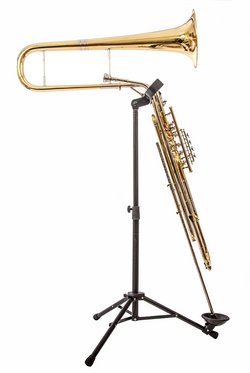
| Cimbasso | F (usually) | Upright valve trombone used in Italian opera. |
Specialized Hybrids
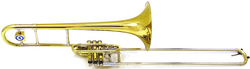
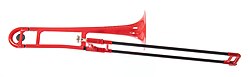
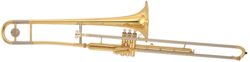
The Superbone is a duplex design featuring both a slide and three valves, allowing for greater agility. Other variants include the Flugabone (a marching hybrid) and the pBone, a durable version made from ABS plastic.
Playing Technique and Physics
Slide Positions
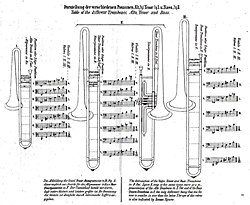
In the modern system, the trombone uses seven primary slide positions. Each successive position outward (roughly 3.25 inches) lowers the pitch by one semitone. Because the partials of the harmonic series are closer together in higher registers, players can often use alternate positions to play the same note.
Harmonics and Intonation
Players can "bend" notes by adjusting lip tension to compensate for slight slide inaccuracies. On instruments without an F attachment, there is a gap between the fundamental (B♭1) and the first harmonic (E2), though skilled players can produce weak "falset" notes in this range.
![Trombone first position harmonic series, "where additional overtones may be used to stretch the upper range a bit higher."[19]](/images/1a/38/1a3808b1ff1f242c2907acfead5a96d3dee4468901499a9e9a5b317252a86142.png)
Frequently Asked Questions
![Trombone seventh position harmonic series.[19]](/images/1a/57/1a57c6e6ebc49fd7629923a2b480bdab5e36a9b936a98b9c52992db225c001d7.png)
![Trombone slide position "pedal tones".[19]](/images/5f/90/5f904f69b0b1794a40ea315178408b7755c76b9f7cb2bd3c2a15c4ea5664f23b.png)
What is the difference between a sackbut and a modern trombone?
The sackbut is the Renaissance ancestor of the trombone. It generally has smaller dimensions, a more conical bell that is less flared, and a different tonal quality suited for early music.
What does the F attachment actually do?
The F attachment adds extra tubing to the instrument via a valve, lowering the fundamental pitch from B♭ to F. This allows the player to reach lower notes and use alternate slide positions for higher notes.
Why is the trombone considered a cylindrical bore instrument?
It is classified as cylindrical because the majority of its tubing—specifically the slide section—maintains a constant diameter before expanding into the bell.
What is a Cimbasso?
The cimbasso is a valve-operated bass trombone, typically pitched in F, used primarily in late Romantic Italian operas by composers like Verdi and Puccini.
How do slide positions work?
The slide changes the length of the instrument's tubing. Extending the slide increases the length, which lowers the pitch. There are seven standard positions, each roughly a semitone apart.