Tree of Life: The Evolution of Biological Classification
The tree of life, or universal tree of life, is a powerful metaphor, conceptual model, and research tool used by scientists to explore the evolution of life. It describes the complex relationships between organisms—both living and extinct—mapping how different species diverged from common ancestors over millions of years.
While the concept is now central to modern biology, it began as a simple simile. In his seminal 1859 work, On the Origin of Species, Charles Darwin noted that the affinities of beings within the same class have sometimes been represented by a great tree, believing this comparison largely spoke the truth.
Key Facts
- Definition: A phylogenetic tree is a diagram representing the evolutionary relationships among various biological species.
- Darwin's Contribution: Introduced the "timetree" concept, linking phylogeny (evolutionary relationships) with specific time intervals (generations).
- The Three Domains: Modern classification identifies Bacteria, Archaea, and Eukarya as the highest ranks of life.
- Modern Tools: Databases like TimeTree and the Open Tree of Life now integrate thousands of studies and hundreds of thousands of species.
The Early History of Natural Classification
Long before the theory of evolution, humans used tree-like diagrams to organize knowledge. In the 18th century, branching diagrams known as "keys" (claves) were common in natural history. However, these early attempts lacked an evolutionary context.
In 1801, Augustin Augier created the "Arbre botanique" (Botanical Tree). While it looked like a family tree, it was not evolutionary; instead, it represented the perfect order of nature as established by God at Creation.
By 1809, Jean-Baptiste Lamarck included a branching diagram of animal species in his Philosophie zoologique. Although Lamarck believed in the transmutation of life forms, he did not believe in common descent. He viewed life as developing in parallel lineages, moving spontaneously from simple to complex forms.
Further precursors appeared in the mid-19th century. In 1840, American geologist Edward Hitchcock published a paleontological chart featuring separate trees for plants and animals.
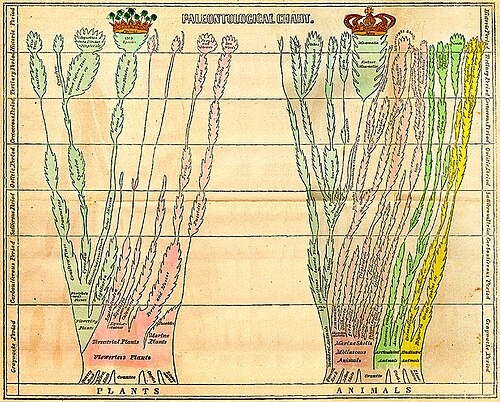
Other early attempts included Robert Chambers' 1844 work, Vestiges of the Natural History of Creation, which tentatively suggested "there may be branching" in the history of life, and Heinrich Georg Bronn's 1858 hypothetical tree, which lacked a specific mechanism for change.
Darwin and the Concept of the Timetree
Charles Darwin transformed the tree metaphor into a scientific tool. In On the Origin of Species, he presented a diagram that functioned as a timetree—a phylogenetic tree scaled to time. In his model, the vertical axis represented thousands of generations, showing how small differences between varieties steadily increase until they result in distinct species or genera.
Darwin's diagram illustrated the principle of evolution: some lineages diversify into new species, while others go extinct. This provided a visual framework for the theory of common descent.
The Contributions of Ernst Haeckel
Following Darwin, Ernst Haeckel expanded the visual representation of biodiversity. In the 1860s, he sketched ancestors of Homo sapiens and later, in 1866, produced a tree of life featuring three kingdoms: Plantae, Protista, and Animalia. This is often cited as the earliest model of global biodiversity.
Haeckel's 1879 "Pedigree of Man" further refined this, tracing all life forms back to the Monera and placing humans at the apex of the tree.
![Universal phylogenetic tree in rooted form, showing the three domains (Woese, Kandler, Wheelis 1990, p. 4578[22])](/images/a7/59/a759d552c55a16256743d024bd1c9f2461544df5bdf4c32b598882c6e2141222.png)
Modern Developments and Molecular Phylogenetics
The late 20th century brought a revolution in how the tree of life is constructed, shifting from physical characteristics to molecular phylogenetics (the study of evolutionary relationships using genetic data).
In 1990, Carl Woese, Otto Kandler, and Mark Wheelis proposed a new system based on microbial evolution. They introduced the domain as the highest taxonomic rank, dividing life into three distinct lines of descent: Bacteria, Archaea, and Eukarya.
The Digital Era of Evolutionary Mapping
Recent years have seen the creation of massive, data-driven databases to map the history of life:
- TimeTree: Released in various versions, the fifth version (2022) incorporates 4,185 studies and 148,876 species.
- Open Tree of Life: A project that combines information from nearly 500 previously published trees into a single, open-access database.
- Metagenomic Trees: A 2016 unrooted tree utilized ribosomal protein sequences to show that the majority of life's branches are composed of bacteria.
| Era/Scientist | Key Contribution | Nature of the Tree |
|---|---|---|
| Augustin Augier (1801) | Arbre botanique | Static/Creationist order |
| Jean-Baptiste Lamarck (1809) | Philosophie zoologique | Parallel lineages (no common descent) |
| Charles Darwin (1859) | On the Origin of Species | Timetree based on common descent |
| Ernst Haeckel (1866) | Generelle Morphologie | Biodiversity model with three kingdoms |
| Carl Woese et al. (1990) | Three-Domain System | Molecular phylogenetics (Bacteria, Archaea, Eukarya) |
Frequently Asked Questions
What is the difference between a phylogenetic tree and a timetree?
A phylogenetic tree shows the branching relationships and common ancestry between species. A timetree is a specific type of phylogenetic tree that includes a time scale, indicating when specific divergence events occurred.
What are the three domains of life?
The three domains are Bacteria, Archaea, and Eukarya. This classification system, proposed in 1990, is based on molecular evidence and represents the highest rank of biological classification.
Did Lamarck believe in a common ancestor?
No. While Lamarck believed in the transmutation of species, he proposed that life developed through parallel lineages of spontaneous generation rather than diverging from a single common ancestor.
How is the tree of life constructed today?
Modern trees are primarily constructed using molecular phylogenetics, which analyzes genetic sequences (such as ribosomal protein sequences) to determine how closely related different organisms are.
What is the Open Tree of Life?
The Open Tree of Life is a collaborative project and online database that synthesizes data from hundreds of individual phylogenetic trees to create a comprehensive map of all known life.