Three-Domain System: The Classification of All Cellular Life
For decades, biologists categorized life based on visible characteristics and simple cellular structures. However, the introduction of the three-domain system in 1990 by Carl Woese, Otto Kandler, and Mark Wheelis fundamentally shifted our understanding of biological kinship. By analyzing genetic markers rather than just physical traits, this system groups all cellular life into three primary domains: Archaea, Bacteria, and Eukarya.
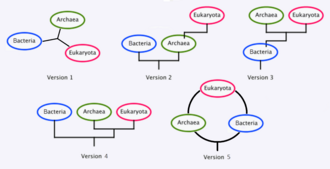
The most significant departure from previous models, such as the five-kingdom classification, was the recognition that Archaea—previously grouped with bacteria as "archaebacteria"—are entirely distinct organisms. This discovery revealed that the divide between the two types of prokaryotes (organisms without a cell nucleus) is as profound as the divide between bacteria and humans.
![A phylogenetic tree based on rRNA data, emphasizing the separation of bacteria, archaea, and eukarya as proposed by Carl Woese et al. in 1990,[1] with the hypothetical last universal common ancestor](/images/d4/8b/d48bd9327efc7d94906c70d34307fba414a8906cb29b367f96cc41572a9ae005.webp)
Key Facts
- Proposed by: Carl Woese, Otto Kandler, and Mark Wheelis in 1990.
- Basis of Classification: Differences in 16S rRNA genes.
- The Three Domains: Bacteria, Archaea, and Eukarya.
- Prokaryotic Split: Separates Bacteria from Archaea, noting that Archaea are often more closely related to eukaryotes.
- Evolutionary Root: Proposes that all three domains arose from a common ancestor with primitive genetic machinery called a progenote.
The Scientific Journey to Three Domains
The path to accepting the three-domain system was fraught with professional resistance. Carl Woese based his arguments on the analysis of 16S rRNA genes, suggesting that the primary lines of descent for life were deeper than previously thought. Initially, Woese used the term "kingdom" for these groups, but the nomenclature shifted to "domain" in 1990 to reflect a level of classification above the kingdom.
Prominent biologists, including Ernst Mayr and Salvador Luria, initially objected to the division of prokaryotes. Woese's meticulous, labor-intensive work earned him a reputation as a "crank" and later as "Microbiology's Scarred Revolutionary." Despite this, the accumulation of supporting data led the scientific community to accept the validity of Archaea by the mid-1980s.
Detailed Breakdown of the Three Domains
Domain Bacteria
Bacteria are prokaryotic organisms characterized by bacterial rRNA and membranes composed primarily of diacyl glycerol diester lipids. They lack a nuclear membrane and were the first prokaryotes discovered. While once called "Eubacteria" (true bacteria), they are now simply known as Bacteria.
Most known pathogenic prokaryotes belong to this domain. Because they are easier to grow in laboratories than archaeans, they are more extensively studied. Examples include:
- Cyanobacteria: Photosynthesizing bacteria related to plant chloroplasts.
- Spirochaetota: Gram-negative bacteria, including those responsible for Lyme disease and syphilis.
- Actinomycetota: Gram-positive bacteria, such as Bifidobacterium animalis found in the human gut.
Domain Archaea
Though they are also prokaryotic and lack a nuclear membrane, Archaea possess distinct biochemistry and RNA markers that separate them from Bacteria. They are considered some of the oldest species on Earth and are famous for their exotic metabolisms and ability to survive in extreme environments.
Notable examples include:
- Methanogens: Organisms that produce methane gas.
- Halophiles: Organisms that thrive in highly salty waters.
- Thermoacidophiles: Organisms that live in acidic, high-temperature environments.
Domain Eukarya
Eukarya consists of organisms with cells containing a membrane-bound nucleus. This domain encompasses all non-microscopic organisms and many large single-celled species. The structure of eukaryotes likely resulted from the joining of different cell types to form organelles (specialized subunits within a cell).
Key groups within Eukarya include:
- Holozoa: Animals and their allies.
- Viridiplantae: Green plants.
- Holomycota: Mushrooms and related fungi.
- Amoebozoa: Social and solitary amoebae.
- Stramenopiles: Including brown algae.
- Discoba: Including euglenoids.
Ecological Niches and Specializations
Each domain typically occupies a specific biological role. Bacteria are often the most prolific reproducers in moderate environments. Archaea are the masters of extreme niches, adapting quickly to high sulfur, high acid, or extreme heat. Eukaryotes exhibit the greatest flexibility in forming cooperative colonies, leading to the development of complex multicellular organisms.
Interestingly, some organisms defy easy categorization. Parakaryon myojinensis is a unique single-celled organism that displays features of both prokaryotes and eukaryotes, remaining incertae sedis (of uncertain taxonomic placement).
The Two-Domain Debate and Modern Alternatives
The three-domain system is not without challengers. Scientists such as Thomas Cavalier-Smith and Radhey S. Gupta have proposed alternative models. Recent phylogenomic analyses suggest that Eukaryota may not be a separate sister group to Archaea, but rather a clade that branched off from within the Archaea.
Specifically, research into Asgard archaea (such as Lokiarchaeota) has revealed eukaryotic signature proteins and membrane-remodeling capabilities. By the mid-2020s, the consensus shifted toward the idea that the host cell of eukaryotes evolved from Asgard archaea, supporting a two-domain system over the traditional three.
| Feature | Bacteria | Archaea | Eukarya |
|---|---|---|---|
| Cell Type | Prokaryotic | Prokaryotic | Eukaryotic |
| Nucleus | Absent | Absent | Present |
| Membrane Lipids | Diacyl glycerol diester | Distinct/Unique | Complex/Organelles |
| Typical Environment | Moderate/Diverse | Extreme (Heat, Salt, Acid) | Diverse/Multicellular |
| Example | Cyanobacteria | Methanogens | Animals, Plants, Fungi |
Frequently Asked Questions
What is the main difference between the three-domain system and the five-kingdom system?
The three-domain system adds a higher level of classification above the kingdom. Its primary distinction is the separation of Archaea from Bacteria into two completely different domains, whereas earlier systems grouped them together as prokaryotes.
Why was the three-domain system initially controversial?
It challenged the long-held belief in a unified "Prokarya." Many prominent biologists rejected the idea that the two types of prokaryotes were fundamentally different, and Carl Woese's unconventional methods initially led some to view him as a "crank."
What is a progenote?
A progenote is a hypothetical common ancestor of all cellular life that possessed poorly developed genetic machinery, from which the three domains of life eventually diverged.
Is the three-domain system still the only accepted model?
No. While widely taught, it is contested by the two-domain hypothesis. Recent evidence suggests eukaryotes evolved from within the Archaea (specifically the Asgard archaea), meaning Eukarya might be a branch of Archaea rather than a separate domain.
What makes Archaea different from Bacteria?
Although both lack a nucleus, Archaea have distinct RNA markers and biochemistry. They also possess unique metabolisms that allow them to thrive in extreme environments where most bacteria cannot survive.