Transmutation of Species: The Pre-Darwinian Roots of Evolutionary Thought
Long before Charles Darwin published On the Origin of Species in 1859, the scientific and philosophical world was already grappling with the possibility that life changes over time. This early conceptual framework, known as transmutation or transformism, proposed that one species could change into another. These ideas were not merely biological hypotheses but were deeply intertwined with 18th-century views on human progress and Deism—the belief that a creator set the universe in motion according to natural laws without further divine intervention.
The journey toward modern evolutionary theory was marked by intense debate, shifting terminology, and a struggle against the established scientific orthodoxy of the time. By examining the thinkers who preceded Darwin, we can see how the foundation for natural selection was laid through centuries of observation and speculation.
Key Facts
- Transmutation was the primary term for evolutionary change before the word "evolution" gained general biological use around 1865–1870.
- Jean-Baptiste Lamarck proposed one of the first cohesive theories of transformism in 1809, emphasizing the inheritance of acquired characteristics.
- Erasmus Darwin, Charles Darwin's grandfather, theorized a universal transformation of both organic and inorganic matter.
- Vestiges of the Natural History of Creation (1844) was a controversial bestseller that popularized the idea of a progressive ascent of life.
- Early opposition was led by influential figures like Georges Cuvier and Richard Owen, who argued for the immutability of species.
The Evolution of Terminology
The language used to describe biological change was fluid for decades. "Transmutation" was borrowed from alchemy, where it referred to turning base metals into gold. In a biological context, Joseph Gottlieb Kölreuter first used the term to describe changes resulting from hybridization. Other terms included the "development hypothesis" and the "theory of regular gradation."
The word "evolved" in its modern sense appeared as early as 1826 in an anonymous paper, while "evolution" appeared in Herbert Spencer's Social Statics (1851). However, these terms did not replace "transmutation" in general scientific discourse until the late 1860s.
Early Foundations: From the 10th to the 17th Century
Ideas regarding species change date back much further than the Enlightenment. In the 10th and 11th centuries, Ibn Miskawayh and the Brethren of Purity developed early concepts of biological change, which were further expanded by Ibn Khaldun in the 14th century.
By the late 17th century, Robert Hooke observed that species vary and become extinct. His work was heavily influenced by the fossil record, specifically comparing the modern pearly nautilus to the extinct curled shells of ammonites.
The Enlightenment and the Rise of Transformism
During the 18th century, thinkers began to propose more structured theories of progression. Jacques-Antoine des Bureaux argued for a "genealogical ascent of species" driven by crossbreeding. Similarly, Retif de la Bretonne suggested that complex species like humans developed step-by-step from "less perfect" animals, driven by nature's aim toward perfection rather than random chance.
Erasmus Darwin's Universal Change
Erasmus Darwin proposed a theory of universal transformation, suggesting that both living and non-living matter changed over time. He noted that "useless appendages" in some species were remnants of organs that were once useful. He believed that plants and animals could pass acquired traits to their offspring, driven by competition and the needs of the organism.
Lamarck and the Inheritance of Acquired Traits
In 1809, Jean-Baptiste Lamarck published Philosophie Zoologique. Unlike later theories, Lamarck did not believe in a single common ancestor; instead, he proposed that simple life forms were continuously created via spontaneous generation. He argued that an innate life force drove organisms toward greater complexity.
Lamarck is most famous for the idea that organs used frequently become stronger and more developed, while those not used wither away. He claimed these acquired characteristics were inherited by the next generation, allowing species to adapt to their environments.
The Path to Darwin: Edinburgh and the 'Vestiges'
The "Edinburgh school" of comparative anatomy, including Robert Grant, further refined these ideas by investigating homology (the similarity in structure between different species) to prove common descent. Charles Darwin himself studied under Robert Grant and Robert Jameson, the latter of whom fostered interest in transformism among his students.
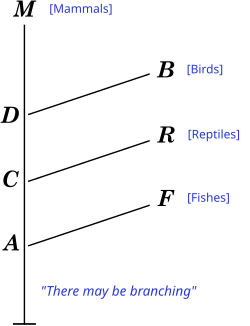
In 1844, Robert Chambers anonymously published Vestiges of the Natural History of Creation. This book suggested that the fossil record showed a main line of progression leading to humanity, guided by a preordained plan. While criticized by both conservative scientists and radical materialists for its inaccuracies, it primed the public for the arrival of Darwin's theory.
Scientific Opposition and the Archetype
The road to acceptance was not easy. Many scientists, influenced by natural theology, viewed species as immutable. Charles Lyell, while rejecting scriptural geology, still believed species were fixed and only went extinct when their specific habitats changed.
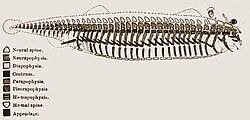
Richard Owen, a leading anatomist, proposed the concept of archetypes—divine blueprints in the mind of the creator that produced related species. While Owen used anatomical homologies to support his views, he vehemently opposed transmutation, fearing its political and social implications.
Summary of Pre-Darwinian Evolutionary Thought
| Thinker/Work | Core Mechanism | Key Belief |
|---|---|---|
| Erasmus Darwin | Universal Transformation | Acquired traits and cosmological change drive improvement. |
| Jean-Baptiste Lamarck | Use and Disuse | Spontaneous generation and inheritance of acquired traits. |
| Robert Chambers (Vestiges) | Orthogenetic Plan | Life follows a preordained path of ascent toward humanity. |
| Richard Owen | Divine Archetypes | Species are fixed ideas in the mind of a creator. |
Frequently Asked Questions
What is the difference between transmutation and evolution?
In the 19th century, transmutation was the term used to describe the change of one species into another. Evolution is the modern term that encompasses these ideas, specifically through the mechanism of natural selection introduced by Charles Darwin.
Did Lamarck believe in a common ancestor?
No. Lamarck believed that simple life forms were created continuously through spontaneous generation and then evolved independently up a linear ladder of complexity.
How did Deism influence early evolutionary ideas?
Deism provided a philosophical framework where God created the universe and its natural laws but did not intervene. This allowed early thinkers to propose that species changed according to natural law rather than divine miracles.
Why was the book 'Vestiges of the Natural History of Creation' so controversial?
It was controversial because it suggested that humans were simply the final step in an animal ascent, which offended conservative religious thinkers, while its lack of scientific rigor was criticized by professional naturalists.
What are 'archetypes' in the context of Richard Owen's work?
Archetypes were conceptual divine blueprints that Owen believed the creator used to design species. He argued that similarities in anatomy (homologies) reflected these underlying divine patterns rather than common descent.