Trad Jazz: The Evolution of the Traditional Jazz Revival
Trad jazz, short for "traditional jazz," is a vibrant musical style that flourished in the United States and Britain from the 1930s through the 1960s. Rooted in the early New Orleans Dixieland style, it represented both a preservation of jazz's origins and a populist movement that brought the genre to wide audiences.
While it began as a way to honor the foundations of the genre, trad jazz evolved into a cultural phenomenon, influencing everything from the big band era to the British beat boom of the 1960s.
Key Facts
- Origins: Based on the New Orleans Dixieland jazz style.
- Peak Era: Flourished between the 1930s and 1960s in the US and UK.
- Key Figures: Influenced by Louis Armstrong and King Oliver; popularized in Britain by Chris Barber and Acker Bilk.
- Legacy: Paved the way for skiffle and British rhythm and blues.
- Instrumentation: Features a mix of brass, woodwinds, and rhythm sections including banjos and tubas.
The Beginnings of the Revival
The revival of Dixieland began on the US West Coast in the late 1930s. This movement emerged as a backlash against the Chicago style, which had moved closer to the polished sound of swing. Musicians like Turk Murphy and Lu Watters (with the Yerba Buena Jazz Band) returned to the repertoire of early pioneers such as W. C. Handy, Jelly Roll Morton, Louis Armstrong, and Joe "King" Oliver, often utilizing tubas and banjos in their rhythm sections.
Simultaneously, a revival took hold in New Orleans, sparked by the rediscovery of Bunk Johnson in 1942 and later recordings by Jelly-Roll Morton. This commitment to authenticity eventually led to the establishment of Preservation Hall in the French Quarter during the 1960s.
The style is often characterized as hot jazz, exemplified by early King Oliver pieces. However, the music shifted as individual performers stepped forward as soloists. Louis Armstrong, formerly an ensemble player in King Oliver's Creole Jazz Band, became the most influential soloist of this era, creating a massive demand for this new approach in the late 1920s and early 1930s. Other revered stylists of the period include Muggsy Spanier, Wingy Manone, Bix Beiderbecke, and Sidney Bechet.
Influence on Later Eras
The impact of trad jazz extended far beyond the revivalists. Many icons of the big band era, including Benny Goodman, Gene Krupa, and Glenn Miller, began their musical journeys in trad jazz.
Trad Jazz in Britain
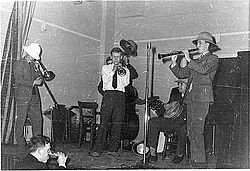
In the United Kingdom, the trad revival gained momentum during the Second World War, pioneered by George Webb's Dixielanders. While boogie-woogie, jump blues, and "stride" piano (a rhythmic piano style) were popular in the 1940s, Ken Colyer's Crane River band maintained a strict adherence to New Orleans purism.
Humphrey Lyttelton, who initially played with Webb, formed his own band in 1948. While rooted in the Louis Armstrong tradition, Lyttelton gradually moved toward a more mainstream approach, adding three saxophones to his ensemble by 1958.
The 1950s and 60s saw the rise of the "Three B's"—Chris Barber, Acker Bilk, and Kenny Ball—all of whom achieved significant commercial success with hit records. Other notable acts included George Chisholm, Terry Lightfoot, Monty Sunshine, Mick Mulligan (with George Melly), and Mike Cotton, the latter of whom transitioned to R'n'B between 1963 and 1964.
The genre also had a lighter, more comedic side, represented by the New Vaudeville Band, the Temperance Seven, and the Bonzo Dog Doo-Dah Band. Interestingly, the influence of Dixieland can be heard in the recordings of the Beatles, the Rolling Stones, the Kinks, and the Small Faces, while The Who performed trad jazz in their early years.
Provincial Bands and the Beat Boom
Beyond the major cities, amateur provincial bands enjoyed strong local followings and gathered at "Jazz Jamborees." Notable groups included the Saints Jazzband (Manchester), the Steel City Stompers (Sheffield), the Second City Jazzband (Birmingham), the Clyde Valley Stompers (Glasgow), the Tranquil Valley Stompers (London), and the Merseysippi Jazz Band, which toured internationally.
The trad scene also served as a catalyst for other genres. Chris Barber provided a platform for Alexis Korner and Lonnie Donegan, sparking the skiffle craze and the subsequent British rhythm and blues movement that fueled the 1960s beat boom.
Summary of Trad Jazz Characteristics
| Category | Details |
|---|---|
| Core Influence | New Orleans Dixieland |
| Primary Instruments | Trumpets, trombones, clarinets, saxophones, banjos, double basses, drums, pianos, and organs |
| Key US Figures | Louis Armstrong, King Oliver, Jelly Roll Morton, Bunk Johnson |
| Key UK Figures | Chris Barber, Acker Bilk, Kenny Ball, Humphrey Lyttelton, Ken Colyer |
| Associated Genres | Hot jazz, Skiffle, British R'n'B, Swing |
Frequently Asked Questions
What is the difference between Trad jazz and Dixieland?
Trad jazz is a broader term for the "traditional jazz" revival that took place in the US and Britain from the 1930s to 1960s, which was heavily based on the earlier New Orleans Dixieland style.
Who were the "Three B's" of British trad jazz?
The "Three B's" refers to Chris Barber, Acker Bilk, and Kenny Ball, three of the most commercially successful musicians of the British trad jazz scene.
How did trad jazz influence 1960s rock music?
Trad jazz provided a foundation for the skiffle craze and British rhythm and blues through musicians like Lonnie Donegan and Alexis Korner. Additionally, early versions of bands like The Who performed trad jazz, and others like the Beatles and Rolling Stones incorporated Dixieland stylings into their records.
What instruments are typically used in a trad jazz band?
Typical instruments include trumpets, trombones, clarinets, and saxophones for the melody, with a rhythm section consisting of banjos, double basses (or tubas), drums, and pianos or organs.
What was the role of Preservation Hall?
Preservation Hall was founded in the French Quarter of New Orleans during the 1960s as a result of the traditional jazz revival, serving as a venue to preserve and perform the original New Orleans style.