Totemism: Cultural Symbols, Sacred Objects, and Anthropological Perspectives
A totem is a spirit being, sacred object, or symbol that serves as an emblem for a specific group of people, such as a family, clan, lineage, or tribe. While the term is an anglicisation of the Ojibwe word doodem, the belief in tutelary spirits—guardian spirits that protect a person or group—is a global phenomenon found in various cultures under different names and practices.
In modern contexts, the term has been adopted by neoshamanic, New Age, and mythopoetic movements. In these circles, a totem often refers to a personal identification with a spirit guide, separate from traditional tribal religious practices.
Key Facts
- Origin: The word "totem" comes from the Ojibwe term doodem.
- Anishinaabe Meaning: In Anishinaabemowin, doodem refers to the extended family and is linked to the concept of the heart.
- Pacific Northwest: Totem poles are monumental carvings used as family crests or to recount ancestral stories.
- Australian Indigenous Culture: Totems represent spiritual relationships with the natural world, though some groups prefer the term "token."
- Anthropological View: Perspectives have evolved from seeing totemism as a "primitive stage" of human development to viewing it as a complex system of social organization.
The Ojibwe Doodem System
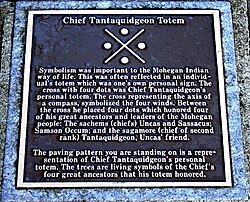
The Anishinaabe peoples are organized into doodeman (clans), which are primarily named after animal totems. The term doodem literally translates to "the expression of, or having to do with one's heart," emphasizing the deep connection to the extended family.
According to Anishinaabe oral tradition, the Mide way of life was taught to the Waabanakiing peoples by the Miigis beings who emerged from the Atlantic Ocean. Six of these beings established the odoodeman for the eastern peoples. The five original Anishinaabe totems include:
- Wawaazisii (bullhead)
- Baswenaazhi (crane/echo-maker)
- Aan'aawenh (pintail duck)
- Nooke (bear/tender)
- Moozwaanowe (little moose-tail)
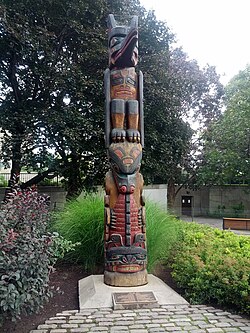
Totem Poles of the Pacific Northwest
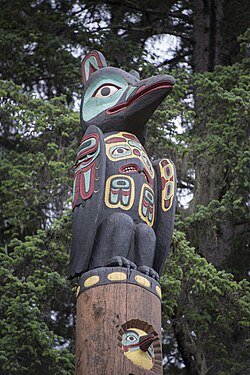
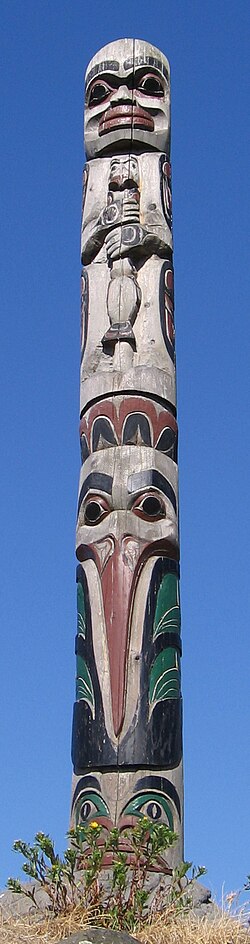
Among the Indigenous peoples of the Pacific Northwest, totem poles are monumental carved structures featuring designs of bears, birds, frogs, humans, and supernatural or aquatic creatures. These poles function similarly to heraldry, serving as crests for chiefs or families and commemorating significant events.
These poles are narrative devices; the stories they depict are traditionally read from the bottom of the pole to the top.
Totemism in Aboriginal and Torres Strait Islander Cultures
For Aboriginal Australians and Torres Strait Islanders, totems describe the spiritual and mutual relationships between humans and the natural world. Because "totem" is an imported Ojibwe term, some Indigenous groups object to its use, with some regions adopting the word "token" instead.
Practices vary significantly by region. For example, the Yuin of coastal New South Wales may have multiple totems based on gender, family, or ceremony. The Ngarrindjeri associated their lakinyeri (clans) with ngaitji (plant or animal totems). Among Torres Strait Islanders, these are called auguds, which can be categorized as kai augud (chief totem) or mugina augud (little totem).
Anthropological Perspectives and Evolution
Early ethnologists, such as James George Frazer and John Ferguson McLennan, viewed totemism as a universal stage of human development. McLennan suggested that all humans once passed through a totemistic phase, while Andrew Lang proposed a nominalistic view, suggesting totems began as names used to differentiate clans, which later evolved into mystical relationships.
Sociological and Structural Views
Émile Durkheim argued that totemism was a form of collective worship that reinforced social cohesion. In contrast, A.R. Radcliffe-Brown and Franz Boas were skeptical of a unified definition. Radcliffe-Brown believed totemism was a way to characterize community segments through nature, rather than a religious sacralization.
The Typologies of A.P. Elkin
In 1938, anthropologist A.P. Elkin categorized totemism into eight forms and six functions to better understand Aboriginal customs.
| Forms of Totemism | Functions of Totemism |
|---|---|
| Individual (Personal) | Social (Regulating marriage/diet) |
| Sex (Gender-based) | Cult (Secret organizations) |
| Moiety (Two groups) | Conception (Various meanings) |
| Section (Four groups) | Dream (Appearance in dreams) |
| Subsection (Eight groups) | Classificatory (Sorting people) |
| Clan (Common descent) | Assistant (Aiding healers) |
| Local (Area-based) | - |
| Multiple (Cross-group) | - |
Modern scholars, including Claude Lévi-Strauss and 21st-century Australian anthropologists, argue that "totemism" is often too blunt a term to capture the regional variations and subtleties of these diverse Indigenous practices.
Frequently Asked Questions
Where does the word "totem" come from?
The word is an anglicisation of doodem, a term from the Ojibwe language used to describe clans and extended family systems.
How are totem poles read?
In the traditions of the Pacific Northwestern Indigenous peoples, the stories and designs on a totem pole are read from the bottom to the top.
Do all Indigenous cultures use the term "totem"?
No. Many Aboriginal Australian groups object to the term because it is an imported word from the Ojibwe. Some use the term "token" or their own traditional names, such as ngaitji or augud.
What is the difference between a clan totem and a personal totem?
A clan totem serves as an emblem for an entire group sharing common descent or a specific social unit, while a personal totem is an individual's identification with a specific tutelary spirit or guide.
What did early anthropologists believe about totemism?
Early scholars like James George Frazer and John Ferguson McLennan often viewed totemism as a primitive stage of human evolution that all societies once experienced.