Johann Friedrich Blumenbach: The Pioneer of Anthropology and Comparative Anatomy
Johann Friedrich Blumenbach (1752–1840) was a towering figure in the transition of natural history into a rigorous scientific discipline. A German medical doctor, naturalist, and physiologist, Blumenbach is widely recognized as a primary founder of anthropology—the scientific study of humans—and zoology—the study of animals—as comparative sciences. His work bridged the gap between the Enlightenment's curiosity about nature and the structured biological research of the 19th century.
Key Facts
- Full Name: Johann Friedrich Blumenbach
- Lifespan: May 11, 1752 – January 22, 1840
- Primary Roles: Physician, Naturalist, Anthropologist, and Physiologist
- Major Contribution: Developed a five-part classification of human varieties.
- Key Theory: Proposed the Bildungstrieb (formative drive) as an internal biological force.
- Notable Naming: Provided the first scientific name for the woolly mammoth (Elephas primigenius).
- Academic Base: University of Göttingen.
Early Life and Academic Foundations
Born in Gotha to a well-connected academic family, Blumenbach was recognized as a prodigy by the age of sixteen. He pursued his medical education at the University of Jena and later the University of Göttingen, where he earned his M.D. in 1775.
His doctoral thesis, De generis humani varietate nativa (On the Natural Variety of Mankind), laid the groundwork for his lifelong interest in craniometry—the scientific measurement of the skull. This work became one of the most influential texts in the early development of human race concepts, shifting the focus toward anatomical evidence to understand human diversity.
A Distinguished Scientific Career
Blumenbach spent the majority of his professional life at the University of Göttingen, where he served as a professor of medicine and inspector of the museum of natural history. He was a prolific author and editor, notably leading the Medicinische Bibliothek from 1780 to 1794.
He gained international acclaim through two seminal works:
- Institutiones Physiologicae (1787): A condensed overview of animal functions that became a standard physiology textbook in Germany and was translated into English for American and British audiences.
- Handbuch der vergleichenden Anatomie (1805): A manual of comparative anatomy—the study of similarities and differences in the anatomy of different species—esteemed for its accuracy and observation.
Beyond his textbooks, Blumenbach contributed significantly to taxonomy. In 1799, he gave the woolly mammoth its first scientific name, Elephas primigenius. He also correctly identified the differences between orangutans and chimpanzees, leading the International Commission on Zoological Nomenclature to eventually credit him with the naming of the chimpanzee (Pan troglodytes) in 1776. Additionally, he named the platypus Ornithorhynchus paradoxus.
Blumenbach's prestige earned him memberships in the Royal Society of London, the American Academy of Arts and Sciences, and the French Academy of Sciences. He retired in 1835 and passed away in 1840 in Göttingen.

Racial Anthropology and the Five Varieties
Blumenbach is perhaps most famous—and controversial—for his efforts to classify human diversity. He was a monogenist, meaning he believed all humans belonged to a single species with a common origin. Using skull anatomy and skin color, he established a five-part naming system in 1795 to describe the "principal varieties" of humankind:
- Caucasian: White race (Europeans, and later extended to Middle Easterners and South Asians).
- Mongolian: Yellow race (East Asians).
- Malayan: Brown race (Southeast Asians and Pacific Islanders).
- Ethiopian: Black race (sub-Saharan Africans).
- American: Red race (Native Americans).
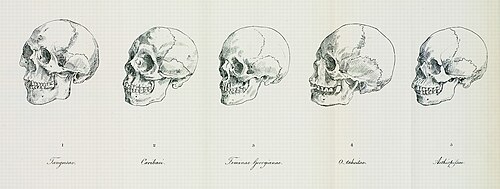
Blumenbach argued that these differences were not inherent or fixed but were induced by climate, diet, and lifestyle. He proposed a "degenerative hypothesis," suggesting that the Caucasian form was the original "primitive" (ancestral) state and that other varieties emerged through "degeneration"—a term that, in the 18th century, simply meant a change or adaptation to a new environment.
Crucially, Blumenbach opposed the racist ideologies of his time. He sharply criticized those who claimed Africans were intellectually inferior and strongly opposed slavery. He maintained that no "savage nation" had shown more capacity for scientific culture and perfectibility than the "Negro." While he did not believe in a hierarchy of races, some of his classifications were later misappropriated by proponents of scientific racism.
The Concept of Bildungstrieb
In the realm of biological theory, Blumenbach introduced the concept of Bildungstrieb, or the "formative drive." This was proposed as an inborn, non-mechanical force within an organism that allows it to create, maintain, and repair its physical shape.
Blumenbach believed this drive was active in all living things, from humans to mold, ensuring that an organism attains the definite form of its species. He compared the mystery of the Bildungstrieb to the mystery of gravity: while the exact cause might be hidden, the effects are undeniable and observable in nature.
This theory had a significant impact on other thinkers. Immanuel Kant praised the concept of the formative force, and it influenced the work of Johann Gottfried Herder and the broader movement of German natural philosophy.
Legacy and Influence on Biology
Blumenbach was a mentor to a generation of scientists who would shape modern biology. His influence extended to the famous explorer Alexander von Humboldt, who shared Blumenbach's belief in the unity of the human species and rejected the notion of superior or inferior races.
By combining medical knowledge with natural history, Blumenbach helped establish the foundations of physical anthropology and comparative anatomy, leaving a legacy of rigorous observation and a commitment to the biological unity of mankind.
Summary of Johann Friedrich Blumenbach's Contributions
| Field | Key Contribution | Significance |
|---|---|---|
| Anthropology | Five-part racial classification | Established early scientific frameworks for human variety. |
| Zoology | Naming of Elephas primigenius and Pan troglodytes | Advanced the taxonomy of mammoths and primates. |
| Physiology | Institutiones Physiologicae | Created a standard textbook for animal functions. |
| Biological Theory | Bildungstrieb (Formative Drive) | Proposed an internal force for biological growth and repair. |
| Anatomy | Comparative Anatomy Manual | Promoted the study of anatomical similarities across species. |
Frequently Asked Questions
Did Blumenbach believe some races were superior to others?
No. Blumenbach was a monogenist who believed all humans belonged to one species. He explicitly argued against the idea of inferior races, praised the intellectual capacities of Africans, and opposed the practice of slavery.
What does "degeneration" mean in the context of Blumenbach's work?
In the 18th century, "degeneration" did not have the negative connotation it has today. For Blumenbach, it referred to the process of biological change where a population adapted to a new environment, climate, or diet, moving away from the ancestral form.
What is the Bildungstrieb?
The Bildungstrieb, or formative drive, is a theory Blumenbach proposed to explain how organisms grow and heal. He viewed it as an inherent, non-physical force that directs the development and maintenance of a species' specific anatomical structure.
How did Blumenbach contribute to the naming of animals?
Blumenbach provided the first scientific name for the woolly mammoth (Elephas primigenius) and correctly identified the chimpanzee as a distinct species, leading to the scientific name Pan troglodytes. He also named the platypus Ornithorhynchus paradoxus.
Why is Blumenbach associated with scientific racism?
Although Blumenbach himself was anti-racist and believed in human unity, his system of dividing humans into five distinct "races" based on physical characteristics was later used by other scientists to justify racial hierarchies and scientific racism.