Total Solar Eclipse of 1919: The Event That Proved Einstein Right
On Thursday, May 29, 1919, the world witnessed a celestial event that would forever change our understanding of the universe. A total solar eclipse—which occurs when the Moon passes directly between the Earth and the Sun, completely obscuring the solar disk—swept across South America and Africa. While such events are always awe-inspiring, this particular eclipse served as the ultimate laboratory for one of the most famous predictions in scientific history.
Because the Moon was only 19 hours past its perigee (the point in its orbit closest to Earth), its apparent diameter was larger than the Sun's. This resulted in a profound period of darkness, turning day into night along a narrow path of totality.
Key Facts
- Date: May 29, 1919
- Maximum Duration of Totality: 6 minutes 51 seconds (411 seconds)
- Magnitude: 1.0719
- Scientific Significance: Provided the first empirical evidence for Einstein's General Theory of Relativity.
- Saros Series: 136 (member 32 of 71)
- Path of Totality: Spanned from southeastern Peru and Brazil across to western Africa and the Comoros.
The Eddington Experiment and General Relativity
The 1919 eclipse is most famous for its connection to Albert Einstein. His general theory of relativity predicted that the gravity of a massive object, like the Sun, would bend the path of light from distant stars. Under normal conditions, this effect is impossible to observe because the Sun's overwhelming glare drowns out the light of nearby stars.
A total solar eclipse provides the only natural window to test this. By blocking the Sun, astronomers can photograph stars appearing very close to the solar limb and compare their positions to where they would be if the Sun were not there.
Under the direction of Sir Dyson, two British expeditions were launched to capture this evidence. Sir Arthur Eddington led a team to the island of Príncipe off the west coast of Africa, while Andrew Claude de la Cherois Crommelin and Charles Rundle Davidson traveled to Sobral, Brazil. Both teams focused their observations on the Hyades star cluster in the constellation Taurus.
The mission nearly failed due to severe weather. Thunderstorms and heavy cloud cover plagued the morning of May 29. It was only thirty minutes before totality that the clouds began to break, allowing the astronomers to snap photos through narrow gaps in the overcast sky.
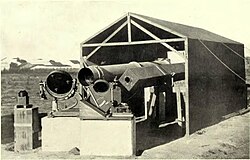
The resulting photographs confirmed that the Sun's mass did indeed shift the light of the stars. Sir Dyson later stated, "After a careful study of the plates, I am prepared to say that they confirm Einstein's prediction," noting that the deflection matched the exact amount demanded by the general theory of relativity.
Observational Details and the Night Sky
The 1919 eclipse was remarkably long, lasting 6 minutes 50.75 seconds at its maximum—the longest total eclipse since 1416. This extended darkness allowed for significant astronomical observations.
In Bolivia, where the Sun was low in the east, observers could see the planets Mars and Mercury. In western Africa, the sky was even more spectacular; the Winter Hexagon was visible, along with brilliant displays from Venus, Jupiter, and Saturn. Several first-magnitude stars, including Deneb, Altair, Fomalhaut, and Achernar, were also clear of the horizon.
Geographic Reach of the Eclipse
The path of totality was vast, covering:
- South America: Southeastern Peru, northern Chile, much of Bolivia, and central Brazil.
- Africa: Southern Liberia, southern Ivory Coast, Príncipe, Río Muni (Equatorial Guinea), Gabon, Republic of the Congo, Democratic Republic of the Congo, northern Zambia, Tanzania, northern Malawi, northern Mozambique, and the western Comoros.
Technical Eclipse Data
The following table summarizes the primary physical and temporal parameters of the May 29, 1919, event.
| Parameter | Value |
|---|---|
| Eclipse Magnitude | 1.07186 |
| Gamma | −0.29549 |
| Maximum Duration | 411 seconds |
| Greatest Eclipse (UTC) | 13:08:55 |
| Max Width of Band | 244 km (152 mi) |
| Moon Semi-Diameter | 16'38.3" |
| Sun Semi-Diameter | 15'46.6" |
The Broader Cycle: Saros 136
This eclipse was part of Solar Saros 136, a series of 71 eclipses that repeat every 18 years and 11 days. This specific series is known for producing some of the longest total eclipses in history, including the record-breaking event of June 20, 1955, which lasted 7 minutes and 7.74 seconds.
The 1919 event also fits into other astronomical cycles, such as the Metonic series (repeating every 19 years), the Tritos cycle (repeating every 11 years minus 1 month), and the Inex cycle (repeating every 29 years minus 20 days).
Frequently Asked Questions
Why was the 1919 eclipse more important than others?
It provided the first empirical evidence that gravity can bend light, confirming Albert Einstein's general theory of relativity and overturning previous Newtonian concepts of physics.
Who were the primary scientists involved in the observations?
The expeditions were organized under Sir Dyson and led by Sir Arthur Eddington (in Príncipe, Africa) and Andrew Claude de la Cherois Crommelin and Charles Rundle Davidson (in Sobral, Brazil).
What nearly prevented the 1919 experiment from succeeding?
Unexpected thunderstorms and heavy cloud cover almost blocked the view of the eclipse. The astronomers were only able to take photos through small gaps in the clouds just before totality.
How long did the total darkness last?
At the point of maximum eclipse, the duration of totality was approximately 6 minutes and 51 seconds, making it one of the longest eclipses of the era.
What is a Saros series?
A Saros is a period of approximately 18 years, 11 days, and 8 hours that can be used to predict eclipses of the Sun and Moon. Eclipses in the same Saros series share similar geometries.