Torsion Tensor in Differential Geometry
In the realm of differential geometry, the torsion tensor is a fundamental object associated with any affine connection. Intuitively, it describes the displacement that occurs when a tangent space is "rolled" or developed along an infinitesimal parallelogram. While curvature describes how a vector changes its direction when transported around a loop, torsion describes the failure of that loop to close.
Torsion is a bilinear map of two input vectors that produces an output vector. It is skew-symmetric, meaning that traversing a path in the opposite direction produces an opposite displacement—much like how a screw moves in opposite directions depending on the direction of the twist.
Key Facts
- Definition: A vector-valued 2-form that measures the displacement in a tangent space during development.
- Symmetry: The torsion tensor is skew-symmetric in its inputs.
- Geodesics: Torsion represents the ambiguity in classifying connections that share the same geodesic spray.
- Relation to Curvature: Torsion and curvature are linked through the Bianchi identities.
- Physical Application: Implemented in relativity via the Einstein–Cartan theory and used in fluid dynamics to study vortex lines.
Mathematical Definition and Components
Let M be a manifold with an affine connection (also known as a covariant derivative) denoted by $\nabla$. The torsion tensor $T$ of $\nabla$ is defined for vector fields $X$ and $Y$ as:
$$T(X, Y) = \nabla_X Y - \nabla_Y X - [X, Y]$$
Here, $[X, Y]$ represents the Lie bracket of the two vector fields. Because $T$ satisfies the Leibniz rule, it is considered tensorial; it provides a 2-form on tangent vectors regardless of the first-order differential nature of the covariant derivative.
Local Components
In a local basis $(e_1, \dots, e_n)$, the components of the torsion tensor are derived using the connection coefficients and the commutator coefficients $\gamma_{ij}^k$ (where $[e_i, e_j] = \gamma_{ij}^k e_k$). If the basis is holonomic, the Lie brackets vanish, and the torsion is simply the antisymmetric part of the connection coefficients. This highlights a critical distinction: while geodesic equations determine the symmetric part of a connection, the torsion tensor determines the antisymmetric part.
The Torsion Form and Frame Bundles
An alternative characterization of torsion is the torsion form $\Theta$, which applies to the frame bundle $F M$ of the manifold. This principal bundle uses a connection form $\omega$ and a canonical one-form $\theta$ (the solder form). The torsion form is defined as the exterior covariant derivative of the solder form: $\Theta = D\theta$.
The torsion form is a horizontal tensorial form with values in $\mathbb{R}^n$. When expressed in a specific frame, it transforms tensorially, confirming that the torsion is a tensor of type (1, 2), possessing one contravariant and two covariant indices.
Geometric Interpretations and Development
Torsion can be visualized as the amount of "slipping" or "twisting" that occurs when a plane rolls along a surface. For instance, rolling a plane along a circle on a sphere without slipping will result in a closed curve in the plane, though the plane itself may rotate due to curvature. However, if torsion is present, the path traced on the plane may not close.
This is formally described as the development of a curve. If a closed loop is developed into a tangent space in the presence of non-zero torsion, the resulting curve may not be closed. The gap between the start and end points is a translation vector, analogous to the Burgers vector used in crystallography to describe screw dislocations.
Example: Flat Euclidean Space
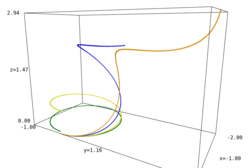
Consider a flat Euclidean space $\mathbb{R}^3$ with a connection defined by the cross product. Parallel transporting a vector along an axis in this space results in the vector twisting around the direction of motion, tracing out a helix. This demonstrates how torsion induces a twisting effect on the frame during transport.
Curvature and the Bianchi Identities
The curvature tensor and torsion tensor are not independent; they are related by the Bianchi identities. These identities ensure the geometric consistency of the manifold. The first identity relates the cyclic sum of the curvature to the torsion, while the second identity describes the covariant derivative of the curvature.
| Feature | Torsion Tensor | Curvature Tensor |
|---|---|---|
| Geometric Effect | Failure of infinitesimal parallelograms to close | Rotation of a vector after parallel transport |
| Connection Part | Antisymmetric part | Related to the second derivative of the connection |
| Analogy | Screw dislocation / Slipping | Bending / Rotation |
| Key Identity | First Bianchi Identity | Second Bianchi Identity |
Geodesics and Torsion Absorption
A significant application of torsion is in the study of geodesics (the shortest paths between points). Two different connections can produce the exact same set of affinely parametrized geodesics if they differ only by their torsion. This leads to the concept of absorption of torsion: for any affine connection, there exists a unique torsion-free connection that shares the same geodesics.
The difference between a connection with torsion and its torsion-free counterpart is known as the contorsion tensor. This process is a vital step in Cartan's equivalence method and generalizes the fundamental theorem of Riemannian geometry to non-metric situations, such as Finsler geometry.
Frequently Asked Questions
What is the difference between the torsion of a connection and the torsion of a curve?
The torsion of a connection measures the dislocation of a developed curve out of its plane (the failure of a loop to close), whereas the torsion of a curve (as seen in Frenet-Serret formulas) measures the dislocation of the curve out of its osculating plane.
How does torsion relate to the Einstein-Cartan theory?
In Einstein-Cartan theory, torsion is introduced into the framework of general relativity to account for the intrinsic angular momentum (spin) of matter, extending the standard torsion-free Levi-Civita connection used in General Relativity.
What is a contorsion tensor?
The contorsion tensor is the tensor that represents the difference between a connection that has torsion and a corresponding connection that is torsion-free but shares the same geodesics.
What happens to a developed loop if the torsion is zero?
If the torsion is zero, a piecewise smooth closed loop developed into the tangent space will also be a closed loop, meaning the starting and ending points coincide.
How is torsion used in fluid dynamics?
In fluid dynamics, torsion is naturally associated with vortex lines. The Bianchi identities can be used to derive equations for equilibrium continuous media with moment density.