Riemann Curvature Tensor: The Mathematics of Curved Space
In the realm of differential geometry, the Riemann curvature tensor (also known as the Riemann–Christoffel tensor) serves as the primary mathematical tool for describing the curvature of Riemannian manifolds. Named after Bernhard Riemann and Elwin Bruno Christoffel, this tensor field assigns a specific value to every point on a manifold, acting as a local invariant of Riemannian metrics.
At its core, the Riemann curvature tensor measures the failure of second covariant derivatives to commute. In simpler terms, it identifies whether a space is "flat" or "curved." A Riemannian manifold is considered flat—meaning it is locally isometric to Euclidean space—if and only if its curvature is zero. While primarily associated with Riemannian manifolds, this tensor can also be applied to pseudo-Riemannian manifolds or any manifold equipped with an affine connection.
Beyond pure mathematics, this tensor is a cornerstone of general relativity, the modern theory of gravity. In this context, the curvature of spacetime is not just a theoretical construct but an observable phenomenon. Through the geodesic deviation equation and the Jacobi equation, the curvature tensor represents the tidal forces experienced by a rigid body moving along a geodesic (the shortest path between two points in curved space).
Key Facts
- Purpose: Measures the intrinsic curvature of a manifold and the noncommutativity of covariant derivatives.
- Flat Space: A manifold has zero curvature if it is locally identical to Euclidean space.
- Physics Application: Essential for general relativity to describe gravity as spacetime curvature.
- Geometric Indicator: Quantifies the change in a vector's direction after parallel transport around a closed loop.
- Key Components: Related to the Ricci curvature tensor and the scalar curvature.
Geometric Meaning
Intuitive Understanding
To visualize curvature, imagine walking on a flat tennis court. If you hold a racket pointing north and walk around the perimeter of the court, keeping the racket parallel to its previous position at every step, it will still point north when you return to the start. This happens because the surface is flat.
Now, imagine the same process on the surface of the Earth. Start at the equator pointing north. Walk to the North Pole, then walk sideways along a line of latitude, then head back down to the equator, and finally return to your starting point. Despite never turning the racket, you will find it now points west. This deflection occurs because the Earth's surface is curved. This process is known as parallel transport, and the difference between the initial and final orientation identifies the intrinsic curvature of the surface.
It is important to note that mathematical curvature differs from everyday language. For instance, a cylinder is considered "flat" in this context because its curvature around the circumference is cancelled by its flatness along its length—a concept related to Gaussian curvature and Gauss's Theorema Egregium.
Formal Definition
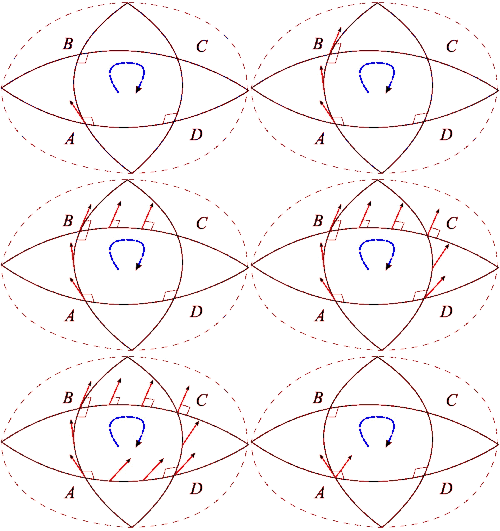
Formally, the Riemann curvature tensor measures the non-holonomy of a manifold. In Euclidean space, parallel transporting a vector around a loop always returns the vector to its original direction. In a general Riemannian manifold, this is not the case.
If we take two commuting vector fields and parallel transport a vector around an infinitesimal quadrilateral formed by these fields, the difference between the final and initial vectors is determined by the Riemann curvature tensor. This demonstrates that the tensor captures the failure of parallel transport to return a vector to its original position in the tangent space.
Mathematical Definition and Expressions
The Riemann curvature tensor is defined as a map using the Levi-Civita connection (the unique torsion-free connection that preserves the metric). It is expressed as the commutator of differential operators:
The tensor measures the noncommutativity of the second covariant derivative. In abstract index notation, this is often referred to as the Ricci identity, which provides the commutator for the covariant derivative of an arbitrary covector.
Coordinate Expression
When expressed in tensor index notation using coordinate vector fields, the Riemann curvature tensor is calculated using Christoffel symbols, which describe how the coordinate system changes from point to point.
Symmetries and Identities
The Riemann curvature tensor obeys several critical symmetries and identities that reduce the number of its independent components:
- Skew symmetry: Antisymmetry in the first two and last two indices.
- First (Algebraic) Bianchi Identity: A cyclic symmetry discovered by Ricci.
- Interchange symmetry: Symmetry when swapping the first pair of indices with the second pair.
- Second (Differential) Bianchi Identity: A relationship involving the covariant derivative of the tensor.
Special Cases and Related Tensors
Ricci Curvature
The Ricci curvature tensor is a simplified version of the Riemann tensor, created by the contraction of the first and third indices. It provides a measure of how the volume of a geodesic ball in a curved space deviates from that of a ball in Euclidean space.
Two-Dimensional Surfaces
For a 2D surface, the Riemann tensor is much simpler. It has only one independent component, meaning the Gaussian curvature (or scalar curvature) completely determines the curvature of the surface.
Space Forms
A Riemannian manifold is called a space form if its sectional curvature is constant everywhere. In these cases, the Riemann tensor takes a specific, simplified form based on that constant value.
| Term | Definition/Role | Key Characteristic |
|---|---|---|
| Riemann Tensor | Full description of manifold curvature | Measures noncommutativity of covariant derivatives |
| Ricci Tensor | Contraction of the Riemann tensor | Used in the Einstein field equations |
| Gaussian Curvature | Curvature of a 2D surface | Determines the full Riemann tensor in 2D |
| Space Form | Manifold with constant sectional curvature | Highly symmetric geometry |
Frequently Asked Questions
What does the Riemann curvature tensor actually measure?
It measures the intrinsic curvature of a Riemannian manifold. Specifically, it quantifies the extent to which the second covariant derivatives fail to commute and the degree to which a vector changes direction when parallel transported around a closed loop.
How is the Riemann tensor used in physics?
It is central to general relativity, where it describes the curvature of spacetime. This curvature is interpreted as gravity, and the tensor is used to calculate tidal forces via the geodesic deviation equation.
What is the difference between a flat and a curved manifold?
A flat manifold is locally isometric to Euclidean space, meaning its Riemann curvature tensor is zero everywhere. A curved manifold has a non-zero tensor, indicating that "straight lines" (geodesics) behave differently than they do in flat space.
Why is a cylinder considered flat in differential geometry?
Because its intrinsic curvature is zero. You can unroll a cylinder into a flat sheet without stretching or tearing it, meaning the parallel transport of a vector around its surface (considering the total geometry) results in no net change that wouldn't occur in a flat plane.
What are the Bianchi identities?
These are fundamental algebraic and differential symmetries of the Riemann curvature tensor. The first (algebraic) identity involves a cyclic sum of the tensor's components, while the second (differential) identity relates the covariant derivatives of the tensor.