Geodesics: The Geometry of Shortest Paths in Curved Space
In the simplest terms, a geodesic is the generalization of a straight line to curved spaces. While we typically think of the shortest distance between two points as a straight line on a flat sheet of paper, the reality of our universe—from the curvature of the Earth to the warping of spacetime—requires a more sophisticated mathematical approach. Whether it is a plane flying from New York to London or a photon traveling through a gravitational field, the path taken is a geodesic.
The term originates from geodesy, the science of measuring the Earth's size and shape. In its original context, a geodesic was the shortest route between two points on the Earth's surface. On a perfect sphere, this path is a segment of a great circle—a circle whose center coincides with the center of the sphere.
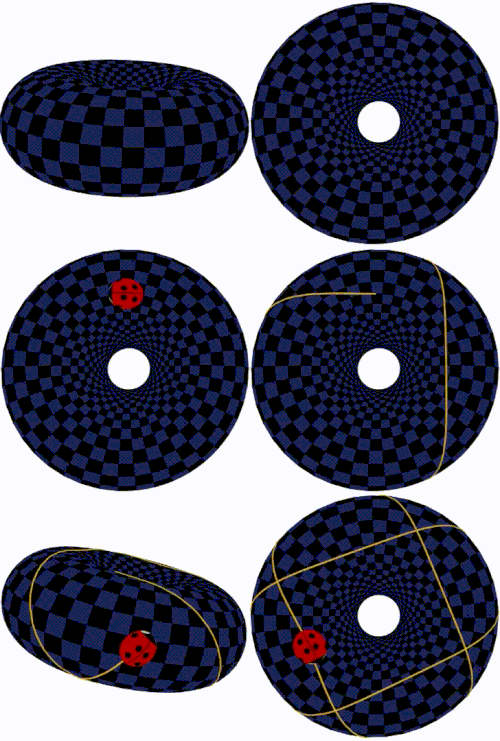
Key Facts
- Definition: A curve that represents the locally shortest path between two points on a surface or Riemannian manifold.
- Constant Speed: Mathematically, geodesics are parameterized with constant velocity.
- Local vs. Global: A geodesic is always the shortest path locally, but not necessarily the shortest path globally (e.g., taking the long way around a sphere).
- Physics Application: In general relativity, timelike geodesics describe the motion of particles in free fall.
- Curvature: Geodesics are characterized by having vanishing geodesic curvature.
Foundational Concepts of Geodesics
To understand geodesics, one must look at the Riemannian manifold—a mathematical space that allows for the measurement of distances and angles. In such a space, a geodesic is defined as a curve that minimizes the distance between two points. This is often calculated using the calculus of variations, a method used to find the minimum or maximum of a functional.
An intuitive way to visualize this is by imagining an elastic band stretched between two points on a curved surface. The band will naturally contract to minimize its energy, and the resulting shape it takes is a geodesic.
The Distinction Between Geodesics and Shortest Paths
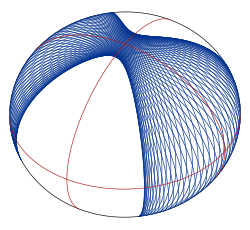
It is a common misconception that a geodesic is always the shortest path. While every shortest path is a geodesic, not every geodesic is the shortest path. For example, if you travel from one point on a sphere to another by going the "long way around" the great circle, you are still following a geodesic, but you have not taken the shortest possible route.
Mathematical Formalism
Metric and Riemannian Geometry
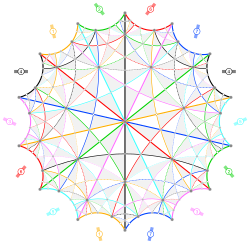
In metric geometry, a geodesic is a curve that is everywhere locally a distance minimizer. In the more specific realm of Riemannian geometry, geodesics are defined using a metric tensor, which allows for the calculation of the length of a continuously differentiable curve. The geodesic equation uses Christoffel symbols to describe how the curve evolves in local coordinates.
Affine Connections and Parallel Transport
Beyond distance, geodesics can be defined through an affine connection. In this context, a geodesic is a curve whose tangent vectors remain parallel as they are transported along the curve. This means the curve does not "bend" relative to the space it inhabits.
Geodesic Triangles and Curvature
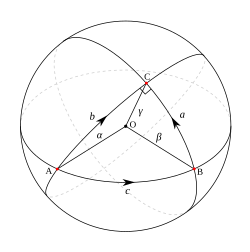
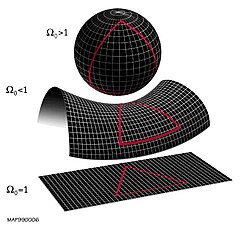
A geodesic triangle is formed by connecting three points on a surface with geodesic segments. The properties of these triangles reveal the curvature of the space:
- Positive Curvature: On a sphere, the sum of the angles of a geodesic triangle is greater than 180 degrees.
- Zero Curvature: In flat Euclidean space, the sum is exactly 180 degrees.
- Negative Curvature: In hyperbolic space, the sum is less than 180 degrees.
Applications Across Sciences
| Field | Application |
|---|---|
| Physics | General relativity models spacetime as a Lorentzian manifold where light follows Lorentzian geodesics. |
| Chemistry | Calculating the intrinsic reaction coordinate between local minima and saddle points on potential energy surfaces. |
| Biology | Measuring the length of signal propagation paths in neurons. |
| Engineering | Designing geodesic airframes, UV mapping for 3D rendering, and robot motion planning. |
| Machine Learning | Optimal transport is viewed as finding geodesic paths in spaces of measures. |
Frequently Asked Questions
Is a straight line a geodesic?
Yes. In flat Euclidean space, the geodesic is exactly what we define as a straight line.
Can there be more than one geodesic between two points?
Yes. For example, between two diametrically opposite points (antipodes) on a sphere, there are infinitely many geodesics of equal length.
How does general relativity use geodesics?
General relativity posits that gravity is not a force but a curvature of spacetime. Objects in free fall, including planets and light, follow geodesics through this curved four-dimensional spacetime.
What is the difference between a geodesic and a minimizing geodesic?
A geodesic is locally the shortest path and is parameterized with constant speed. A minimizing geodesic is a specific type of geodesic that is the absolute shortest path between two points across the entire interval.
What is the "ribbon test" in computational geodesics?
The ribbon test is a physical approximation method. If a ribbon is adjusted to touch a surface entirely without sticking out, it approximates a geodesic path on that surface.