Curvature in Geometry: From Simple Curves to Complex Surfaces
In the realm of mathematics, curvature is a fundamental concept used to measure how much a geometric object deviates from being "flat." Intuitively, it describes the degree to which a curve bends away from a straight line or how a surface curves away from a flat plane. Depending on the context, curvature can be defined extrinsically—relative to a larger ambient space—or intrinsically, where the curvature is determined without any reference to an external space.
For a simple curve, curvature indicates the sharpness of the bend. For instance, a small circle bends more sharply than a large one, meaning it possesses a higher curvature. Mathematically, this is measured by observing how the tangent line (the line that just touches the curve at a specific point) changes direction as one moves along the curve.
Key Facts
- Definition: Curvature measures the deviation of a curve from a straight line or a surface from a plane.
- Circles: The curvature of a circle is constant and equal to the reciprocal of its radius (1/R).
- Intrinsic vs. Extrinsic: Intrinsic curvature (like Gaussian curvature) can be detected by an observer living on the surface, while extrinsic curvature (like mean curvature) depends on how the surface is embedded in space.
- Osculating Circle: The circle that best approximates a curve at a specific point is called the osculating circle; its radius is the radius of curvature.
- Gaussian Curvature: The product of the two principal curvatures of a surface.
The Evolution of Curvature
The study of curvature dates back to the ancient Greeks, who distinguished between straight and circular lines. Later, the 14th-century mathematician Nicole Oresme proposed that curvature is a measure of departure from straightness, noting that for circles, it is inversely proportional to the radius.
The invention of calculus by Newton and Leibniz in the 17th century provided the rigorous tools needed to calculate curvature systematically. Leonhard Euler extended these studies to surfaces, and Carl Friedrich Gauss later introduced the revolutionary concept of intrinsic curvature. This work was further generalized by Bernhard Riemann, who expanded the theory to higher-dimensional spaces known as Riemannian manifolds.
Curvature of Curves
Arc-Length and Parametrization
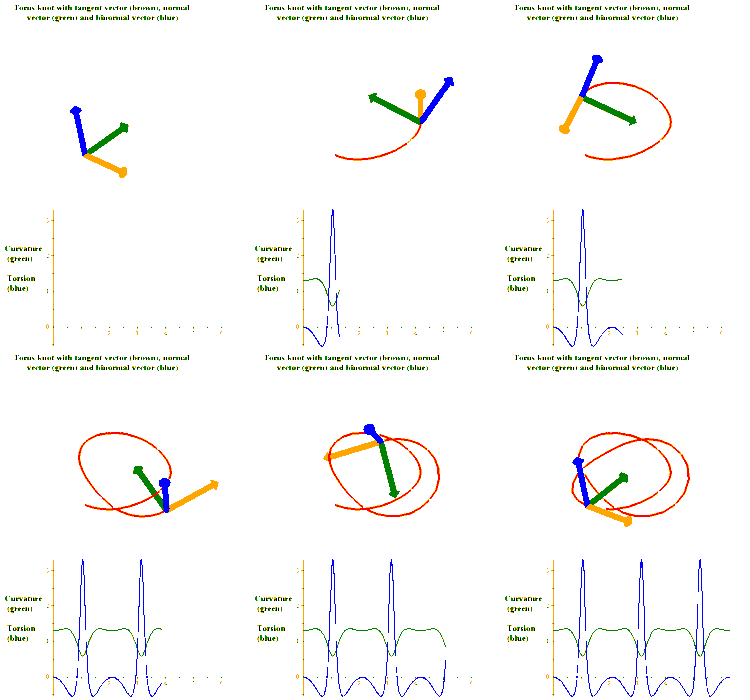
To analyze a curve mathematically, we often use arc-length parametrization. If a curve is differentiable, its first derivative is the unit tangent vector T. If it is twice differentiable, the second derivative is the curvature vector K. The magnitude of this vector is the curvature (κ).
When a curve is not parametrized by arc length, it can be re-parametrized provided the derivative is never zero. This ensures that the curvature remains a differential-geometric property of the path itself, independent of how the curve is traced.

The Curvature Vector and Osculating Circle
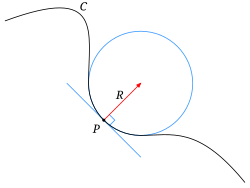
The curvature vector K points toward the center of the bend and is always perpendicular to the unit tangent vector T. The osculating circle is the circle that most closely matches the curve at a given point. The radius of this circle, R, is the reciprocal of the curvature (R = 1/κ).
Examples: Circles and Parabolas
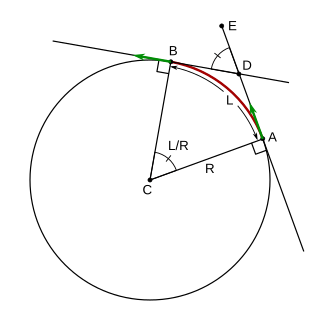
For a circle of radius R, the curvature is a constant 1/R at every point. This is because the ratio of the change in the tangent angle to the arc length remains constant regardless of the segment chosen.
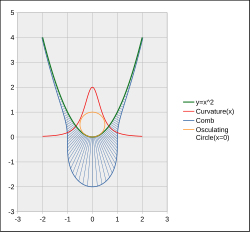
In the case of a parabola (y = ax² + bx + c), the curvature varies. It reaches its maximum value at the vertex (the stationary point), where the bend is sharpest. If the coefficient a is zero, the curvature becomes zero everywhere, and the parabola becomes a straight line.
Curvature Combs and Continuity
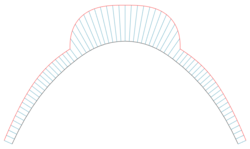
In design and engineering, curvature combs are used to visualize how curvature changes along a path. This helps in defining continuity levels (G0 through G3), ensuring that transitions between different curve segments are smooth and aesthetically pleasing.
Curvature of Surfaces
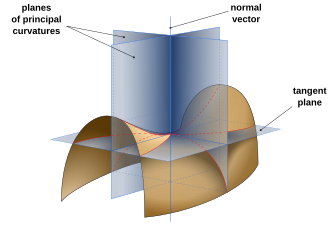
Surfaces are more complex than curves because they can bend in multiple directions simultaneously. At any point on a surface, the maximum and minimum values of the normal curvature are known as the principal curvatures (k₁ and k₂).
Gaussian Curvature (Intrinsic)
Gaussian curvature is the product of the principal curvatures (K = k₁ × k₂). Because it is an intrinsic property, it can be determined by measurements made entirely within the surface. For example, on a sphere (positive curvature), the interior angles of a triangle sum to more than 180 degrees. On a cylinder, the Gaussian curvature is zero, making it locally isometric to a flat plane.
Mean Curvature (Extrinsic)
Mean curvature is the average of the principal curvatures (H = (k₁ + k₂)/2). Unlike Gaussian curvature, mean curvature is extrinsic. A soap film, for example, is a minimal surface with a mean curvature of zero, while a soap bubble has a constant mean curvature.
Holonomy and Space
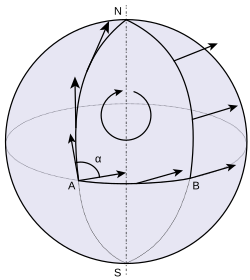
In curved spaces, moving a vector along a closed loop (parallel transport) may result in the vector returning in a different orientation. This phenomenon is called holonomy. The angle of deviation is a direct measure of the total curvature enclosed by the loop.
Summary of Curvature Types
| Type | Dimension | Nature | Key Characteristic |
|---|---|---|---|
| Curve Curvature (κ) | 1D | Extrinsic | Reciprocal of the osculating circle radius (1/R). |
| Gaussian Curvature (K) | 2D | Intrinsic | Product of principal curvatures (k₁ × k₂). |
| Mean Curvature (H) | 2D | Extrinsic | Average of principal curvatures ((k₁ + k₂)/2). |
| Riemannian Curvature | nD | Intrinsic | Generalization to higher-dimensional manifolds. |
Frequently Asked Questions
What is the difference between intrinsic and extrinsic curvature?
Intrinsic curvature can be measured by an observer living on the surface without needing to see the surface from the outside (e.g., measuring triangle angles). Extrinsic curvature describes how the surface is bent within a higher-dimensional space (e.g., a cylinder is extrinsically curved but intrinsically flat).
Why is the curvature of a circle 1/R?
Curvature is defined as the rate of change of the tangent direction per unit of distance. For a circle, the tangent rotates by 2π radians over a circumference of 2πR. The ratio is (2π) / (2πR), which simplifies to 1/R.
What is an osculating circle?
The osculating circle is the "kissing circle" that best approximates a curve at a specific point. It shares the same tangent and the same curvature as the curve at that point.
What happens to curvature when a curve becomes a straight line?
A straight line does not bend; therefore, its tangent direction never changes. This results in a curvature value of zero.
How does Gaussian curvature describe the shape of a surface?
Positive Gaussian curvature indicates a locally convex shape (like a sphere), negative Gaussian curvature indicates a saddle-shaped surface (like a hyperboloid), and zero Gaussian curvature indicates a flat or developable surface (like a plane or cylinder).