Tonkawa Tribe: A History of Migration, Resilience, and Recovery
The Tonkawa people possess a storied history defined by movement, strategic alliances, and an enduring spirit of survival. Originally inhabiting the regions of what is now northwestern Oklahoma, the Tonkawa were a collection of related bands who lived a nomadic lifestyle supplemented by horticulture—the practice of garden cultivation.
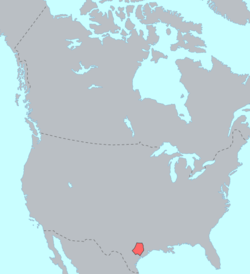
While long considered prehistoric residents of Texas, modern historical perspectives suggest the Tonkawa migrated into the state during the late 17th century, arriving in Central Texas just before or during the early period of European contact.
Key Facts
- Origins: Originally located in northwestern Oklahoma before migrating to Texas in the late 17th century.
- Population Shifts: Declined from approximately 1,900 members in the 16th century to just 34 by 1921, before recovering to nearly 950 by 2023.
- Major Conflicts: Involved in the Battle of Plum Creek (1840) and the Battle of Little Robe Creek (1858).
- Forced Removal: Moved to Indian Territory in 1859 and eventually settled in present-day Kay County, Oklahoma.
- Cultural Landmark: Recently reclaimed Sugarloaf Mountain ("Red Mountain") in Milam County, Texas.
The 18th Century: Migration and Conflict
The early 1700s were a period of instability for the Tonkawa. Pressure from the Apache and Wichita peoples pushed the tribe south toward the Red River, the current border between Oklahoma and Texas. This era saw a decline in population, dropping from 1,900 in the 16th century to roughly 1,600 by the late 17th century, caused by conflict with the Apache and the introduction of European diseases.
By the 1740s, some Tonkawa settled in the San Gabriel Missions along the San Gabriel River in Texas, associating with the Yojuanes. The tribe also engaged in significant military action; in 1758, the Tonkawa joined a coalition including the Bidais, Caddos, Wichitas, Comanches, and Yojuanes to destroy Mission Santa Cruz de San Sabá during an attack on the Lipan Apache.
Following these events, the tribe continued migrating south into Texas and northern Mexico, where they eventually formed an alliance with the Lipan Apache.
The 19th Century: Alliances and Forced Removals
Relations with Texas Settlers
The Tonkawa's relationship with Texas colonists was complex. While they often allied with Texans, tensions occasionally flared. In 1824, a conflict arose in San Felipe after the Tonkawa were accused of stealing corn and hogs. Stephen F. Austin intervened, demanding the return of the thieves and their punishment by flogging to resolve the dispute.
Despite such frictions, the Tonkawa proved to be vital allies. They fought alongside the Texas Rangers against the Comanche at the Battle of Plum Creek in 1840 and the Battle of Little Robe Creek in 1858. During the Mexican invasion of 1842, the Tonkawa and Lipans were mustered to support the Republic of Texas near Corpus Christi.
Life in Bastrop and Forced Migration
By 1838, the primary Tonkawa camp was established near Bastrop, Texas, on the east side of the Colorado River. Accounts from English ethnologist William Bollaert in 1843 describe a confident people trading with local residents and engaging in buffalo hunts. However, this stability was short-lived.
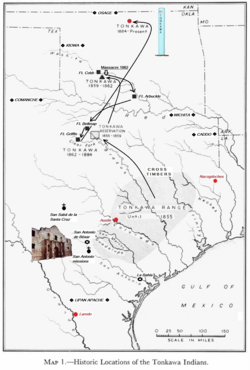
In 1859, the United States government forcibly removed the Tonkawa and other Texas tribes to the Wichita Agency in Indian Territory, placing them under the protection of Fort Cobb.
The Civil War and the Tonkawa Massacre
During the American Civil War, the Tonkawa allied with the Confederacy. When federal troops abandoned Fort Cobb to move to Kansas, the Tonkawa were left unprotected. This vulnerability led to the Tonkawa Massacre on October 24, 1862, where pro-Union tribes—including the Delaware, Shawnee, and Osage—decimated the Tonkawa population.
Survivors fled back to Central Texas, finding refuge in the fortified city of Austin. Following the war, Union forces escorted 135 Tonkawa back north in 1867 to a reservation near Fort Griffin. In 1884, they were forced to move once more, eventually arriving at Fort Oakland in present-day Kay County, Oklahoma, on June 30, 1885.
Modern Era: Recovery and Reclamation
The turn of the 20th century marked the lowest point for the tribe's population, with only 34 members remaining by 1921. However, the tribe began a steady recovery, incorporating under the Oklahoma Indian Welfare Act in 1938. By 2023, the population had grown to nearly 950 members.
In a significant act of cultural reclamation, the Tonkawa Tribe purchased Sugarloaf Mountain (known to them as "Red Mountain") in Milam County, Texas, on December 12, 2023. This site is central to their origin story and is located along the El Camino Real de los Tejas National Historic Trail. The tribe plans to transform the area into a historic park in partnership with the trail association.
| Period/Event | Key Location | Significant Outcome |
|---|---|---|
| Late 17th Century | Central Texas | Migration from Oklahoma to Texas |
| 1758 | Mission Santa Cruz de San Sabá | Destruction of the mission in alliance with other tribes |
| 1840 & 1858 | Texas | Allied with Texas Rangers against the Comanche |
| 1862 | Wichita Agency | The Tonkawa Massacre by pro-Union tribes |
| 1885 | Kay County, Oklahoma | Final resettlement at Fort Oakland |
| 2023 | Milam County, Texas | Purchase of Sugarloaf Mountain ("Red Mountain") |
Frequently Asked Questions
Where did the Tonkawa people originally live?
The Tonkawa originally lived in what is now northwestern Oklahoma before migrating into Central Texas during the late 17th century.
What was the Tonkawa Massacre?
The Tonkawa Massacre occurred on October 24, 1862, during the American Civil War. Pro-Union tribes, including the Delaware, Shawnee, and Osage, attacked the Tonkawa after federal protection was withdrawn from the Wichita Agency.
How did the Tonkawa population change over time?
The population fluctuated significantly, starting at around 1,900 in the 16th century, dropping to a low of 34 members by 1921, and increasing to nearly 950 by 2023.
What is the significance of Sugarloaf Mountain to the Tonkawa?
Known as "Red Mountain," Sugarloaf Mountain is a central part of the Tonkawa origin story. The tribe purchased the land in 2023 to establish a historic park.
Did the Tonkawa ally with the Republic of Texas?
Yes, the Tonkawa frequently allied with Texans, notably fighting alongside the Texas Rangers against the Comanche and supporting the Republic of Texas during the Mexican invasion of 1842.