Time Dilation: How Velocity and Gravity Warp Time
Time is not a universal constant. While we experience it as a steady flow, physics reveals that time can stretch or contract depending on how fast you are moving or how strong the gravity is around you. This phenomenon is known as time dilation: the difference in elapsed time as measured by two different clocks.
Time dilation occurs in two primary forms. The first is a consequence of special relativity, where relative velocity causes time to slow down. The second is gravitational time dilation, where a difference in gravitational potential—such as being closer to a massive planet—affects the passage of time. While these effects are imperceptible in our daily lives, they are critical for the precision of modern technology, including GPS and Galileo satellite navigation systems.
Key Facts
- Velocity Effect: As an object's speed approaches the speed of light (299,792,458 m/s), time for that object slows down relative to a stationary observer.
- Gravitational Effect: Time passes more slowly in stronger gravitational fields (closer to a massive body).
- Reciprocity: In special relativity, two observers moving relative to each other both perceive the other's clock as ticking more slowly.
- Practical Application: GPS satellites must correct for both velocity and gravity to remain synchronized with clocks on Earth.
- Experimental Proof: Confirmed through muon decay observations and atomic clock flights.
The History of Time Dilation
The mathematical foundation for time dilation began at the turn of the 20th century. In 1897, Joseph Larmor noted that electrons orbiting a nucleus described their orbits in shorter times relative to the rest system. By 1904, Emil Cohn specifically linked these formulas to the rate of clocks.
In 1905, Albert Einstein revolutionized the concept by demonstrating that this effect is a fundamental property of time itself. He introduced the idea of reciprocity—that the effect is symmetrical between observers. Later, in 1907, Hermann Minkowski introduced proper time (the time measured by a clock at rest relative to itself), which provided the necessary clarity to fully understand how time dilates across different frames of reference.
Time Dilation and Relative Velocity
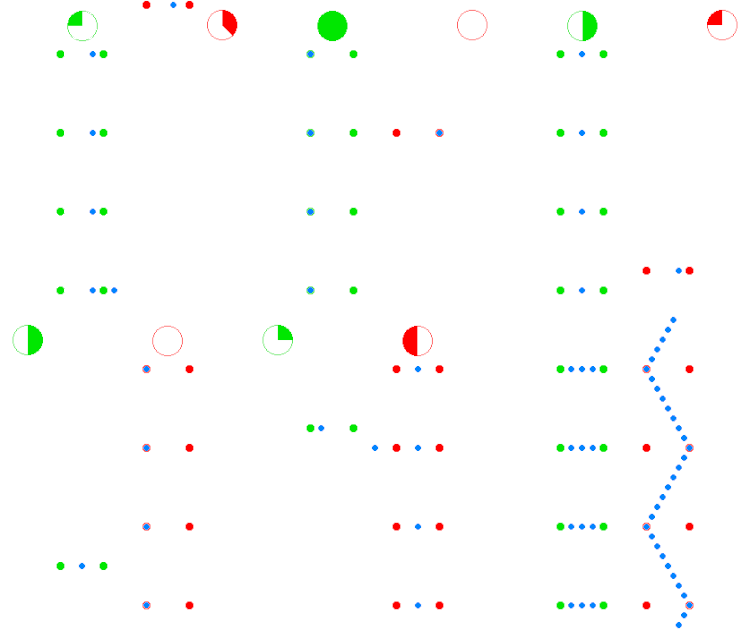
According to special relativity, if you are in an inertial frame of reference (a state of constant motion or rest), any clock moving relative to you will be measured to tick more slowly than a clock at rest in your own frame. This is known as special relativistic time dilation.
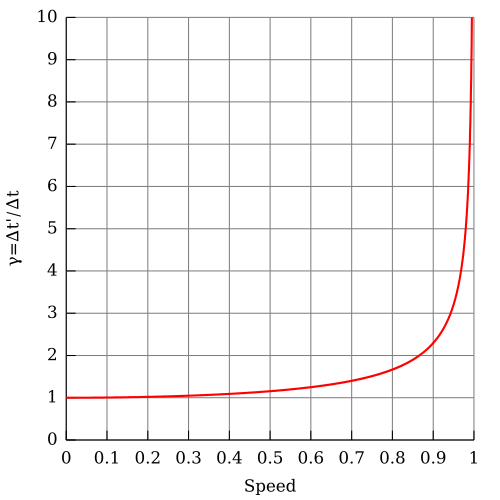
The magnitude of this effect is determined by the Lorentz factor. At low speeds, the difference is negligible. However, as velocity increases, the dilation becomes more pronounced, theoretically stopping time entirely as an object reaches the speed of light.
![From the local frame of reference of the blue clock, the red clock, being in motion, is measured as ticking slower.[9]](/images/91/d4/91d4c20caea974fede032de02f867d034b2647fa89a18d117f6670ae5606f101.gif)
The Light Clock Thought Experiment
A simple way to visualize this is through a "light clock," where a pulse of light bounces between two mirrors. For an observer at rest, the light travels a straight vertical path. However, for an observer watching the clock move horizontally, the light must travel a longer, diagonal path to reach the mirrors. Since the speed of light is constant, the longer distance means it takes more time for the pulse to complete a tick.
![Light ClockLeft: Observer at rest measures time 2L/c between co-local events of light signal generation at A and arrival at A.Right: Events according to an observer watching as the mirror setup moves to the right: bottom mirror A when signal is generated at time t'=0, top mirror B when signal gets reflected at time t'=D/c, bottom mirror A when signal returns at time t'=2D/c[14]](/images/a5/32/a532cd9c40e715279c7ea4025754d92bc41dd6603ad668d6a13170644459f1d5.webp)
Reciprocity and the Lorentz Factor
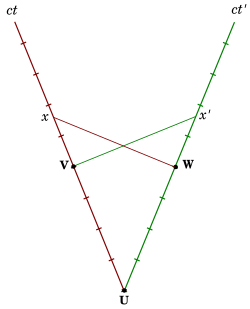
One of the most counterintuitive aspects of special relativity is reciprocity. If Observer A sees Observer B moving, A perceives B's clock as slow. Simultaneously, Observer B perceives Observer A's clock as slow. This symmetry exists because both are in their own inertial frames.
Experimental Evidence
Time dilation is not just a theoretical curiosity; it has been proven through rigorous experimentation.
Moving Particles and Muons
Muons are unstable particles created by cosmic rays in the atmosphere. At rest, a muon has a very short lifetime of approximately 2.197 microseconds. However, cosmic-ray muons travel at roughly 98% of the speed of light. Because of time dilation, their lifetimes are extended by about five times, allowing them to reach the Earth's surface before decaying—a fact confirmed by Rossi and Hall in 1941.
Similar results are seen in particle accelerators. At CERN, muons circulating in a storage ring with a high Lorentz factor (γ = 29.327) showed a dilated lifetime of 64.378 microseconds, confirming the theory with extreme precision.
Gravitational Testing
General relativity predicts that gravity also warps time. In 1959, Robert Pound and Glen Rebka measured the gravitational redshift of light, finding that light emitted from a lower height (where gravity is stronger) shifted in frequency. Subsequent tests in 1964 by Pound and Snider brought the results within 1% of the predicted value.
Combined Effects: The Hafele-Keating Experiment
In 1971, physicists Joseph Hafele and Richard Keating conducted a landmark experiment using caesium atomic clocks flown on commercial airliners around the world. They tested two competing effects:
- Velocity: The speed of the planes should make the clocks age more slowly.
- Gravity: The higher altitude (weaker gravity) should make the clocks age more quickly.
The results varied by direction: clocks flying eastward (moving faster relative to Earth's center) lost time, while those flying westward gained time. The findings closely matched the predictions of relativity.
![Time dilation explains why two working clocks will report different times after different accelerations. For example, time goes slower at the ISS, lagging approximately 0.01 seconds for every 12 Earth months passed. For GPS satellites to work, they must adjust for similar bending of spacetime to coordinate properly with systems on Earth.[1]](/images/15/0d/150d228c81bb8ca28a2f442c41b85eb3b9231e658ce3c84576ec4c91d2efaa09.jpg)
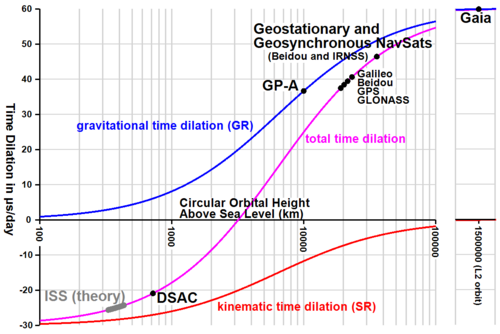
![Daily time dilation (gain or loss if negative) in microseconds as a function of (circular) orbit radius r = rs/re, where rs is satellite orbit radius and re is the equatorial Earth radius, calculated using the Schwarzschild metric. At r ≈ 1.497[Note 1] there is no time dilation. Here the effects of motion and reduced gravity cancel. ISS astronauts fly below, whereas GPS and geostationary satellites fly above.[1]](/images/86/f0/86f03aa701c4e42c07917b68b45b21a0bfee88da73566f9c2c9f6a5cff12bcf4.png)
Summary of Time Dilation Effects
| Type of Dilation | Cause | Effect on Time | Example |
|---|---|---|---|
| Special Relativistic | High Relative Velocity | Slows down as speed increases | Fast-moving muons |
| Gravitational | Stronger Gravity | Slows down near massive bodies | Clocks at sea level vs. mountains |
| Combined | Velocity + Gravity | Net gain or loss depending on orbit | GPS Satellites |
Frequently Asked Questions
Do we experience time dilation in everyday life?
Yes, but the effect is so infinitesimally small that it is undetectable without atomic clocks. For most human activities, the relative speeds are too low and the changes in gravity too slight to notice.
Why is time dilation important for GPS?
GPS satellites move at high speeds and are located far from Earth's mass. They experience both special relativistic slowing and gravitational speeding up. Without adjusting for these differences, GPS coordinates would drift significantly, becoming useless within a short time.
What happens to time at the speed of light?
According to the equations of special relativity, as an object's velocity approaches the speed of light, time dilation increases toward infinity. Theoretically, for an object traveling at the speed of light, time would appear to stop entirely relative to a stationary observer.
Is time dilation the same as time travel?
In a sense, yes. Time dilation allows for a form of "forward" time travel. An astronaut traveling at near-light speeds for a few years would return to Earth to find that many more years had passed for those they left behind.