Length Contraction: The Physics of Lorentz-FitzGerald Contraction
Imagine an object traveling at a significant fraction of the speed of light. To a stationary observer, that object would appear shorter than it actually is. This phenomenon is known as length contraction, also referred to as Lorentz contraction or Lorentz–FitzGerald contraction. It is a fundamental prediction of special relativity, describing how the measurement of an object's length changes depending on the relative velocity between the observer and the object.
Crucially, this effect only occurs in the direction of the object's motion. For objects moving at everyday speeds, the contraction is so minuscule that it is entirely negligible. However, as an object approaches the speed of light, the effect becomes prominent and physically significant.

Key Facts
- Directional: Contraction only occurs along the line of motion.
- Proper Length: The length of an object measured in its own rest frame is the maximum possible length.
- Velocity Dependent: The effect only becomes noticeable at substantial fractions of the speed of light.
- Symmetrical: According to the principle of relativity, both observers in relative motion perceive the other as contracted.
- Physical Reality: It is not a visual illusion but a physical consequence of the structure of spacetime.
Historical Development
Length contraction was first postulated independently by George FitzGerald in 1889 and Hendrik Antoon Lorentz in 1892. Their goal was to explain the negative results of the Michelson–Morley experiment and preserve the hypothesis of a stationary aether (a medium once thought to carry light waves). At the time, this was considered an ad hoc hypothesis—a solution added to a theory to save it from being proven wrong—because there was no deep theoretical reason why objects should contract.
In 1897, Joseph Larmor attempted to explain this via electromagnetic origin, and Henri Poincaré later introduced "Poincaré stresses" to ensure electron stability. However, it was Albert Einstein who revolutionized the concept in 1905. Einstein declared the aether superfluous and integrated length contraction into his theory of special relativity, showing it was a natural consequence of the laws of physics rather than a mechanical quirk of the aether.
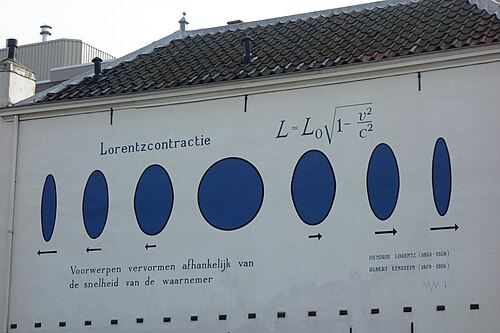
Later, Hermann Minkowski provided a geometrical interpretation, framing these relativistic effects within a four-dimensional construct known as spacetime.

The Basis in Relativity
To understand length contraction, we must distinguish between two types of measurement. The proper length is the length of an object measured by an observer who is at rest relative to that object. Any observer moving relative to the object will measure a shorter length.
The relationship is defined by the Lorentz factor. As velocity increases, the measured length decreases. For example, at a speed of 13,400,000 m/s (approximately 0.0447c), the contracted length is 99.9% of the proper length. At 42,300,000 m/s (0.141c), it is 99%. As the velocity approaches the speed of light (c), the contraction becomes extreme.
Symmetry and Spacetime
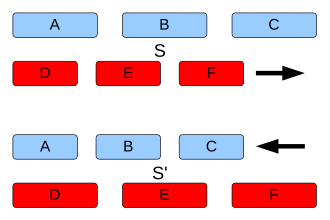
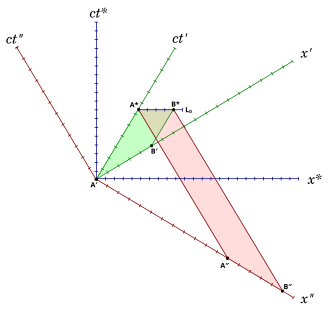
The principle of relativity dictates that the laws of nature are the same for all inertial reference frames. This means length contraction is symmetrical. If Observer A sees Observer B's rod as contracted, Observer B simultaneously sees Observer A's rod as contracted. This is best visualized using Minkowski diagrams, where the Lorentz transformation acts as a rotation in four-dimensional spacetime.
Physical Applications and Evidence
Magnetic Forces
Length contraction explains the nature of magnetic attraction between parallel wires. In the frame of the electrons, the moving wire contracts, increasing the local density of protons. This creates a local charge imbalance, resulting in the electrostatic attraction we perceive as a magnetic force. Even though electron drift velocity is slow (roughly a meter per hour), the immense force between protons and electrons makes this relativistic effect significant.
Experimental Verification
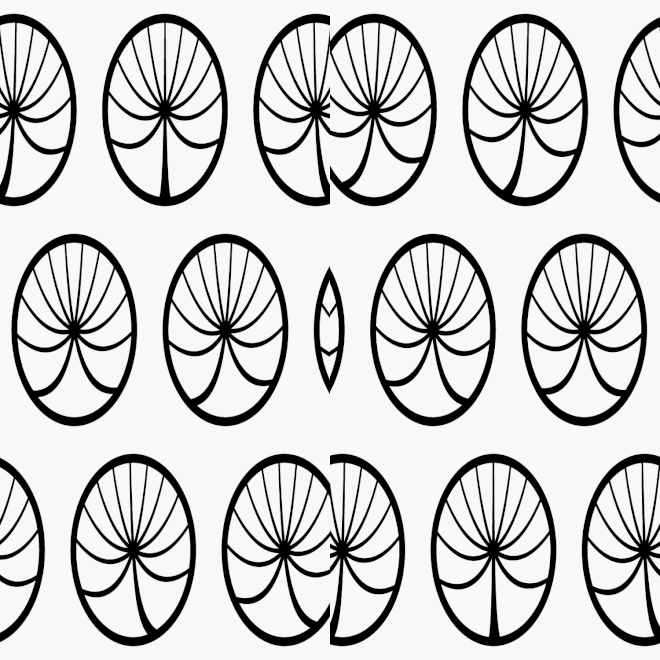
While direct measurement of a moving rod is difficult, indirect evidence is found in particle physics. Heavy ions, which are spherical at rest, behave as flat disks (or "pancakes") when traveling near the speed of light. The results of high-energy particle collisions can only be explained by accounting for the increased nucleon density caused by length contraction.
Summary of Relativistic Length
| Measurement Type | Reference Frame | Observed Length | Condition |
|---|---|---|---|
| Proper Length | Rest Frame | Maximum (L0) | Relative velocity = 0 |
| Contracted Length | Moving Frame | Shorter (L) | Relative velocity > 0 |
| Extreme Contraction | Ultra-relativistic | Approaching 0 | Velocity approaches c |
Frequently Asked Questions
Is length contraction just an optical illusion?
No. It is a physical reality of spacetime. While the visual appearance of an object (what you would see in a photograph) is affected by the finite speed of light—a phenomenon known as Terrell rotation—the actual measured length of the object in the moving frame is physically shorter.
Does the object feel "squashed"?
No. From the perspective of the object (its own rest frame), nothing has changed. The object still measures its own proper length. The contraction is only observed by an external observer moving relative to the object.
Does length contraction happen in all directions?
No. Length contraction occurs exclusively along the axis of motion. Dimensions perpendicular to the direction of travel remain unchanged.
How does time dilation relate to length contraction?
They are two sides of the same coin. Because the speed of light is constant for all observers, a change in the measurement of time (time dilation) must be accompanied by a change in the measurement of space (length contraction) to keep the speed of light consistent.
Can we see this happening in daily life?
Not with the naked eye. The velocities required to make length contraction noticeable are millions of meters per second, far exceeding any human-made vehicle's speed. It is only observable in high-energy physics experiments, such as those involving particle accelerators.