Thrace: The Historical and Geographical Crossroads of Southeast Europe
Thrace is a significant geographical and historical region located in Southeast Europe. Today, its territory is divided among three modern nations: Bulgaria, Greece, and Turkey. Historically, it has served as a vital bridge between Europe and Asia, shaped by a succession of powerful empires and diverse indigenous tribes.
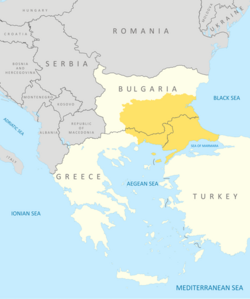
Geographically, the region is defined by the Balkan Mountains to the north, the Aegean Sea to the south, and the Black Sea to the east. In modern terms, this encompasses southeastern Bulgaria (Northern Thrace), northeastern Greece (Western Thrace), and the European portion of Turkey (East Thrace).
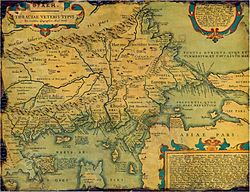
Key Facts
- Modern Distribution: Shared between Bulgaria, Greece, and Turkey.
- Ancient Inhabitants: Home to the Thracians, a collection of tribes known for their warrior traditions.
- Etymology: The name Europe originally referred to this region before expanding to its current continental meaning.
- Major Cities: Includes global hubs like Istanbul, as well as Plovdiv, Edirne, and Burgas.
- Historical Significance: Transitioned from a Persian satrapy to a Roman province and later a Byzantine theme.
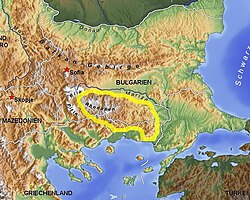
Geography and Etymology
The term Thrace derives from the ancient Greek Thrake, referring to the Thracians. Interestingly, the geographer Stephanus of Byzantium noted that before the Greeks used the name Thrace, the region was known as Aria and Perke. In Turkish, the region is often called Rumeli, meaning "Land of the Romans," a term used by the Ottomans to describe the Byzantine Empire and its Orthodox Christian subjects.
The boundaries of Thrace have shifted throughout history. Ancient Greeks viewed it as a broad area north of Thessaly with no definite borders. Later, it was more strictly defined as the land between the Danube River to the north and the northern border of Macedonia to the south. During the Roman era, it became a formal province, though later administrative reforms split it into six smaller provinces under the Diocese of Thrace.
Ancient History and Mythology
In Greek mythology, Thrace is the birthplace of the legendary musician Orpheus and is named after the sorceress Thrace, daughter of Oceanus. The Thracians appear in Homer's Iliad as allies of Troy, led by kings such as Acamas and Peiros.
The Classical Period
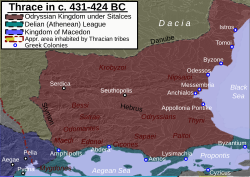
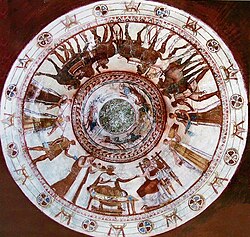
The indigenous Thracians were not a single unified state but a collection of tribes. While those in the plains were generally more peaceable, the mountain tribes maintained a fierce warrior tradition. In the late 6th century BC, the Achaemenid Persians incorporated the region as the Satrapy of Skudra.
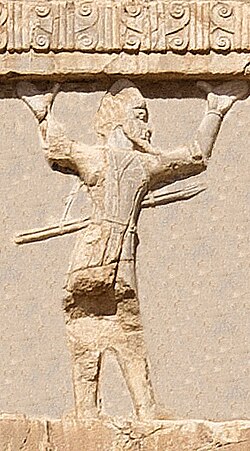
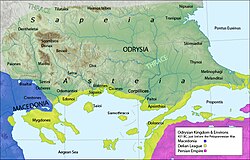
By the 4th century BC, the Odrysian Kingdom emerged as the first lasting political organization among the Thracians. This state eventually fell under the influence of Philip II of Macedon and Alexander the Great, whose armies included Thracian troops during the invasion of the Persian Empire.
The Roman and Byzantine Eras
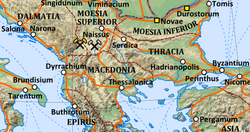
After a period as a client kingdom, Thrace became a formal Roman province in 46 AD. Under Roman rule, many Thracians, especially the urban aristocracy, gained civitas Romana (Roman citizenship). By 212 AD, Emperor Caracalla granted citizenship to all free inhabitants of the empire.
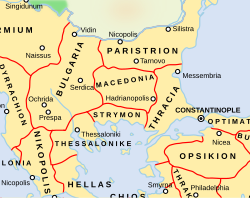
Following the collapse of the Western Roman Empire, Thrace became a contested battleground. The Byzantine Empire maintained control of the region until the 7th century, when the First Bulgarian Empire seized the northern half. For the next several centuries, the territory shifted between Bulgarian and Byzantine control, enduring raids from the Golden Horde and the Catalan Company.
The Ottoman Period and Modern Era
The Ottoman Turks first entered Thrace in 1352, capturing Gallipoli in 1354. They established their capital at Edirne before the fall of Constantinople in 1453, which then became the heart of the Ottoman Empire. During the Greek War of Independence, several Thracian cities, including Samothraki and Callipolis, rebelled against Ottoman rule.
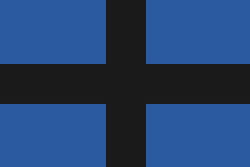
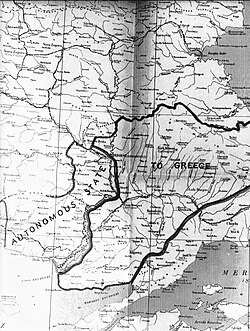
The modern borders were established following the Congress of Berlin in 1878 and the aftermath of World War I and the Greco-Turkish War. This resulted in the current division between Bulgaria, Greece, and Turkey.
Notable Figures from Thrace
Thrace has produced some of history's most influential thinkers and leaders:
- Democritus: A mathematician and philosopher from Abdera who proposed the atomic theory of matter.
- Protagoras: The first sophist, known for the claim that "man is the measure of all things."
- Spartacus: A Thracian who led a massive slave uprising against the Roman Republic in the Third Servile War.
- Herodicus: A physician regarded as the founder of sports medicine.
Regional Summary
| Category | Details |
|---|---|
| Modern Countries | Bulgaria, Greece, Turkey |
| Major Water Bodies | Black Sea, Aegean Sea |
| Key Ancient State | Odrysian Kingdom |
| Primary Religions | Orthodox Christianity, Sunni Islam |
| Key Historical Cities | Istanbul, Edirne, Plovdiv |
Frequently Asked Questions
Which modern countries share the region of Thrace?
Thrace is currently divided among Bulgaria (Northern Thrace), Greece (Western Thrace), and Turkey (East Thrace).
Who were the ancient Thracians?
The Thracians were a group of indigenous tribes in Southeast Europe known for their warrior culture and distinct national identity, eventually forming the Odrysian Kingdom before being conquered by Macedon and Rome.
What is the significance of the name "Rumeli"?
Rumeli is the Turkish term for Thrace, meaning "Land of the Romans," reflecting the region's history under the Byzantine (Eastern Roman) Empire.
Which famous philosophers came from Thrace?
The region was home to Democritus, who developed the atomic theory, and Protagoras, who is considered the first sophist.
How did Thrace become a Roman province?
After serving as a client kingdom under Roman influence, Thrace was officially converted into a Roman province (Romana provincia Thracia) in 46 AD.