Théorie Élémentaire de la Botanique and the Birth of Taxonomy
In the early 19th century, the study of plants underwent a fundamental shift in how species were organized and understood. At the center of this transformation was the Swiss botanist Augustin Pyramus de Candolle, whose seminal work, Théorie Élémentaire de la Botanique, redefined the scientific approach to plant classification. First published in 1813, this text moved beyond simple physical descriptions to explore the deeper relationships between plant species.
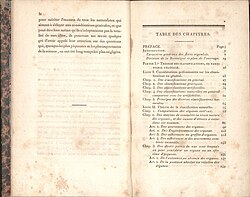
Before the publication of this work, botanical classification often relied on linear models, most notably those of Carl Linnaeus. De Candolle challenged this approach, proposing instead a discrete model of classifying plant taxa (groups of one or more populations of an organism). His vision emphasized evolutionary relationships—the ancestral connections between plants—rather than relying solely on shared morphological characteristics, which are the physical forms and structures of the organisms.
Key Facts
- Author: Augustin Pyramus de Candolle, a Swiss botanist and professor at the University of Montpellier.
- Publication: First published in 1813 (French), with a new edition in 1819 and an English translation in 1821.
- Major Contribution: Introduced the term taxonomy to describe the science of botanical classification.
- Core Philosophy: Shifted plant grouping from shared physical traits to evolutionary relationships.
- Legacy: Laid the groundwork for natural systematics and the comprehensive Prodromus Systematis Naturalis Regni Vegetabilis.
The Academic Journey of De Candolle
De Candolle's path to botanical leadership began at the Geneva Academy, where he studied both science and law. His formal career took flight in 1798 when he worked at the herbarium of Charles Louis L’Hèritier de Brutelle. By 1799, he had established his first discovered genus, Senebiera, and published Plantarum Historia Succulentarum.
His influence grew under the mentorship of Jean-Baptiste Lamarck, who tasked de Candolle with writing the introduction to Principes Élémentaire de Botanique and editing the third edition of Flore Française. These experiences culminated in his appointment as the first Chair of Botany in the medical faculty at the University of Montpellier in 1807, providing the platform for him to publish his masterwork in 1813.
Structure and Content of the Work
Théorie Élémentaire de la Botanique is an exhaustive guide to scientific botany, divided into three specialized sections that cover the essential pillars of the field.
Part I: Theory of Classifications (Plant Taxonomy)
This section introduces the principles of natural classification. It is here that de Candolle coined the term taxonomy, deriving it from the Greek words taxis (arrangement) and nomos (rules or law). This part of the book argues that plants should be grouped based on their evolutionary history.
Part II: Theory of Descriptive Botany (Phytography)
Focusing on phytography—the science of describing plants—this section provides a methodology for observing and recording plant characteristics. De Candolle emphasized the use of essential tools, including microscopes and herbariums, to ensure accuracy in description.
Part III: Knowledge of the Terms (Botanical Glossology)
The final section, dedicated to botanical glossology, serves as a detailed analysis of plant families. It explores the physiology of plants, detailing the structure and function of various plant organs and their specific characteristics.
| Section | Focus Area | Key Concepts |
|---|---|---|
| Part I | Plant Taxonomy | Natural classification, evolutionary relationships, rules of arrangement. |
| Part II | Phytography | Descriptive botany, observation techniques, use of microscopes. |
| Part III | Botanical Glossology | Plant family analysis, physiology, organ structure and function. |
Reception and Scientific Controversy
The book was widely praised and translated into German by Kurt Sprengel and later into English in 1821. Figures such as Jean-Baptiste Say and William Whewell lauded de Candolle's philosophical approach to science. However, the work was not without controversy. Proponents of intelligent design criticized de Candolle for his discussion of "useless organs" in plants, fearing his theories suggested the world was a product of chance.
In the 1819 edition, de Candolle attempted to reconcile this by suggesting these organs were created to achieve symmetry. This specific argument was later ridiculed by Charles Darwin, who viewed such "useless organs" as remnants of inheritance rather than intentional designs. Interestingly, a 1844 edition published by de Candolle's son, Alphonse, revealed that the elder de Candolle had crossed out these arguments in his own notes, suggesting a change of heart.
Later Works and Lasting Impact
De Candolle spent the remainder of his life refining his classification system. In 1824, he began the Prodromus Systematis Naturalis Regni Vegetabilis, an ambitious attempt to summarize every known plant type, including their taxonomy and biogeography. Although he only completed the first seven of seventeen volumes before his death in 1841, he characterized over 100 plant families, creating a foundation for general botany. His son, Alphonse, eventually completed the collection in 1873.
Frequently Asked Questions
What is the significance of the term "taxonomy" in this book?
Augustin Pyramus de Candolle introduced the word "taxonomy" in this work to describe the practice and rules of botanical classification, combining the Greek words for arrangement (taxis) and law (nomos).
How did de Candolle's classification differ from Carl Linnaeus'?
While Linnaeus used a linear model of classification, de Candolle proposed a discrete model that prioritized evolutionary relationships over shared physical (morphological) characteristics.
What are phytography and botanical glossology?
Phytography is the science of describing and studying plant characteristics using tools like microscopes. Botanical glossology is the detailed study of plant families, their characteristics, and their physiology.
Why did Charles Darwin criticize de Candolle?
Darwin disagreed with de Candolle's earlier claim that useless plant organs were specially created by an "Omnipotent hand" to complete the scheme of nature, arguing instead that they were remnants retained through inheritance.
What was the Prodromus Systematis Naturalis Regni Vegetabilis?
It was a massive multi-volume collection started by de Candolle in 1824 to summarize all known plant types, their taxonomy, evolutionary history, and biogeography.