Augustin Pyramus de Candolle: Pioneer of Plant Taxonomy and Chronobiology
Augustin Pyramus de Candolle was a towering figure in 19th-century science, whose work fundamentally reshaped how we categorize the plant kingdom. A Swiss botanist of immense intellectual curiosity, de Candolle moved beyond simple identification to develop a comprehensive natural classification system, shifting the scientific paradigm from artificial groupings to those reflecting biological reality.
His influence extended far beyond the herbarium, touching upon agronomy, paleontology, and the emerging field of chronobiology. By viewing nature as a dynamic system of competition and internal rhythms, de Candolle provided early conceptual building blocks that would later influence some of the most significant theories in evolutionary biology.
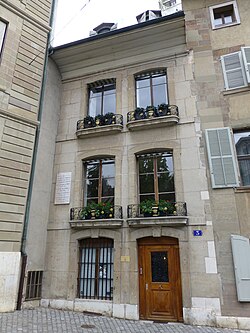
Key Facts
- Primary Contribution: Coined the term taxonomy and developed a natural method of plant classification.
- Scientific Concept: Proposed the idea of "Nature's War," describing species competing for space and resources.
- Chronobiology: Discovered that the Mimosa pudica plant has an endogenous (internal) biological clock.
- Academic Legacy: Established a four-generation dynasty of botanists, including his son Alphonse and grandson Casimir.
- Major Work: Authored the 17-volume Prodromus systematis naturalis regni vegetabilis.
Early Life and Education
Born on February 4, 1778, in Geneva, Republic of Geneva, Augustin Pyramus de Candolle came from a family that had relocated from Provence in the 16th century to escape religious persecution. His childhood was marked by a severe case of hydrocephalus at age seven, yet he demonstrated an exceptional aptitude for learning, excelling in classical literature and poetry.
In 1794, he entered the Collège de Genève. It was here, under the mentorship of Jean Pierre Étienne Vaucher, that de Candolle discovered his lifelong passion for botanical science. Although he studied law to satisfy his father's wishes, his trajectory was firmly set toward the natural sciences.
A Career of Botanical Innovation
De Candolle's professional journey began in Paris in 1798, facilitated by René Louiche Desfontaines. Working in the herbarium of Charles Louis L'Héritier de Brutelle, he quickly made his mark, establishing his first genus, Senebiera, in 1799. His early publications caught the attention of leading scientists Georges Cuvier and Jean-Baptiste Lamarck.
The Shift to Natural Classification
One of de Candolle's most significant contributions was his challenge to the Linnaean method. While the Linnaean system was "artificial"—relying on a few specific traits—de Candolle proposed a natural method. He argued that taxa (groups of one or more populations of an organism) are discrete rather than continuous, and should be classified based on a holistic set of characteristics.
This philosophy was detailed in the third edition of Flore française (1805–1815). Although published under the name of Lamarck, the work was primarily de Candolle's. He later formalized these ideas in his 1813 work, Théorie élémentaire de la botanique, where he introduced the term taxonomy to describe the science of classification.
Academic Leadership and Research
De Candolle's career was marked by prestigious appointments, including serving as the first chair of botany at the University of Montpellier starting in 1810. He was known for his rigorous teaching style, leading field classes that lasted from 5:00 am to 7:00 pm. In 1817, he returned to Geneva to fill the newly created chair of natural history.
| Category | Details |
|---|---|
| Lifespan | 1778 – 1841 |
| Nationality | Swiss |
| Key Fields | Botany, Agronomy, Phytogeography, Chronobiology |
| Notable Award | Royal Medal (1833) |
| Author Abbreviation | DC. |
Legacy and Scientific Influence
Nature's War and Darwin
De Candolle conceptualized "Nature's War," the idea that plants are in constant competition for resources and space. This concept of inter-species struggle was a precursor to the theory of natural selection. Charles Darwin studied de Candolle's natural system in 1826 and later discussed these ideas with de Candolle during a visit to Britain in 1839.
Foundations of Chronobiology
De Candolle made a groundbreaking discovery in 1832 regarding chronobiology (the study of biological rhythms). He observed that the Mimosa pudica plant continued to open and close its leaves in a cycle of 22–23 hours even under constant light. Because this rhythm did not match the Earth's 24-hour cycle, he concluded the clock was endogenous—meaning it originated from within the organism rather than being triggered by external environmental cues.
Frequently Asked Questions
What is the difference between the Linnaean and de Candolle's classification systems?
The Linnaean system was an artificial classification based on a limited number of characteristics. De Candolle's natural system looked at the organism as a whole, treating taxa as discrete groups based on a broader range of similarities.
How did de Candolle influence Charles Darwin?
De Candolle's concept of "Nature's War"—the struggle between species for resources—provided a conceptual framework that Darwin later integrated into his theory of natural selection.
What was de Candolle's contribution to chronobiology?
He proved that biological rhythms could be endogenous. By observing Mimosa pudica in constant light, he showed the plant maintained its own internal clock independent of the 24-hour day-night cycle.
Who were the other members of the de Candolle botanical dynasty?
The dynasty included his son Alphonse Pyramus de Candolle, his grandson Casimir de Candolle, and his great-grandson Richard Émile Augustin de Candolle, all of whom were accomplished botanists.