The Sunset Strip: A History of Music, Glamour, and Counterculture
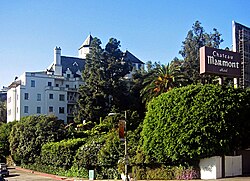
The Sunset Strip is a legendary 1.7-mile (2.7 km) stretch of Sunset Boulevard located in West Hollywood, California. Stretching from the eastern border of Los Angeles near Marmont Lane to the western border of Beverly Hills at Phyllis Street, this iconic corridor is world-renowned for its vibrant mix of boutiques, restaurants, nightclubs, and towering, colorful billboards.
For nearly a century, the Strip has served as a cultural barometer for Los Angeles, evolving from a Prohibition-era haven for movie stars into the global epicenter of rock and roll and heavy metal.
Key Facts
- Location: A 1.7-mile stretch of Sunset Boulevard in West Hollywood, CA.
- Legal Status: Formerly an unincorporated area of LA County, which allowed for looser regulation before West Hollywood's incorporation in 1984.
- Musical Legacy: Birthplace of the "West Coast Metal Explosion" and a hub for 1960s counterculture.
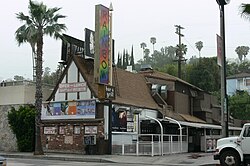
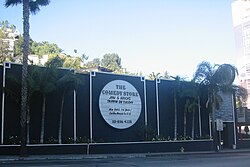
- Famous Venues: Home to the Whisky a Go Go, The Roxy, and The Comedy Store.
Early Years: Prohibition and Hollywood Glamour
Before West Hollywood became an incorporated city in 1984, the Sunset Strip existed as an unincorporated area of Los Angeles County. This distinction was crucial; because it fell outside the jurisdiction of the Los Angeles Police Department, the area became known for being loosely regulated.
During the 1920s, this lack of oversight made the Strip an attractive location for casinos and nightclubs. While gambling was illegal within the city limits of Los Angeles, it remained legal in the unincorporated county. This fostered a wild nightlife that attracted the movie industry elite, with alcohol frequently served in secret back rooms during the Prohibition era.
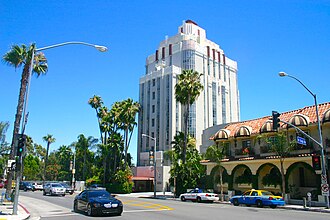
By the 1930s and 1940s, the Strip was the primary playground for cinema professionals. Establishments such as Ciro's, Sherry's, the Mocambo, and the Trocadero became staples of the scene. The area also attracted literary figures; the Garden of Allah apartments housed writers like F. Scott Fitzgerald, Dorothy Parker, and Robert Benchley, while Schwab's Pharmacy served as a local landmark.
The 1960s: Counterculture and the Rise of Rock
While the movie elite began to drift away by the early 1960s, the Strip found a new identity as a gathering place for the counterculture—the social movement that rejected conventional societal norms. This era was marked by tension, culminating in the Sunset Strip curfew riots of November 1966, where young club-goers clashed with police. These events famously inspired the song "For What It's Worth" by Buffalo Springfield.
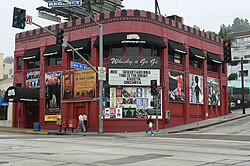
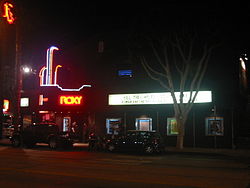
The 1960s also saw the Strip become a sanctuary for rock musicians. Legendary acts including Led Zeppelin, the Doors, Frank Zappa, the Byrds, Love, and the Seeds performed at venues like the Whisky a Go Go, the Roxy, Gazzarri's, Pandora's Box, and the London Fog. In July 1965, the introduction of Go-Go dancers added a new visual element to the nightlife, and the Hyatt West Hollywood (now the Andaz West Hollywood) became a preferred hotel for visitors.
The 1970s: Glam Rock and New Wave
In 1972, Rodney Bingenheimer opened English Disco, bringing the influence of Britain's glam rock movement to Los Angeles. The club became a hub for artists like the New York Dolls and the Stooges. During this period, the Strip was notorious for its lax age restrictions; teenage musicians and fans often entered clubs without IDs, allowing young talent to perform and socialize alongside adults.
By the late 1970s, the area shifted its focus toward punk rock and new wave music, maintaining its status as a center for musical experimentation. The nightlife of this era was captured in the 1979 song "Sunset People" by Donna Summer.
The 1980s: The West Coast Metal Explosion
The late 1970s and 1980s marked the era of glam metal, a style characterized by heavy guitar riffs and flamboyant fashion. The Sunset Strip became the epicenter of the "West Coast Metal Explosion," with the Whisky a Go Go and The Roxy serving as the primary stages for bands such as Mötley Crüe, Van Halen, Guns N' Roses, Poison, Ratt, Dokken, W.A.S.P., and Quiet Riot.
The rise of the scene was accelerated by Quiet Riot's 1983 album Metal Health, which signaled to major record labels that the Strip's hard rock scene was commercially viable. However, the era eventually declined as clubs adopted "pay to play" policies, charging bands a fee to perform, which shifted the venues from artist incubators to industry showcases.
Evolution and Popular Culture
In November 1984, West Hollywood officially incorporated as an independent city. Over the following decades, the western end of the Strip transitioned toward office buildings and hotels catering to the entertainment industry. By the 1990s, the center of alternative music in Los Angeles shifted east toward Silver Lake, Echo Park, and Los Feliz.
The Strip's influence extends deep into popular culture, appearing in the TV series 77 Sunset Strip and Entourage, as well as the stage production and film Rock of Ages, which is set in 1987. Artist Edward Ruscha also documented the area in his 1966 book Every Building on the Sunset Strip.
| Era | Primary Influence | Key Characteristics |
|---|---|---|
| 1920s-1940s | Hollywood Elite | Prohibition-era clubs, movie stars, and literary figures. |
| 1960s | Counterculture | Rock and roll, curfew riots, and the rise of Go-Go dancing. |
| 1970s | Glam & Punk | British glam rock influence, New Wave, and teenage hangouts. |
| 1980s | Heavy Metal | The West Coast Metal Explosion and glam metal fashion. |
Frequently Asked Questions
Why was the Sunset Strip less regulated in its early years?
Before 1984, the Strip was in an unincorporated area of Los Angeles County, meaning it was not under the jurisdiction of the Los Angeles Police Department, allowing for a more permissive environment for nightlife and gambling.
Which bands were central to the 1980s metal scene?
Key bands included Mötley Crüe, Ratt, Quiet Riot, W.A.S.P., Dokken, Poison, and Guns N' Roses, many of whom performed at the Whisky a Go Go and The Roxy.
What were the Sunset Strip curfew riots?
Occurring in November 1966, these were clashes between police and young club-goers that became a symbol of the 1960s counterculture and inspired the song "For What It's Worth" by Buffalo Springfield.
What is "pay to play" and how did it affect the Strip?
Pay to play is a policy where bands are charged a fee to perform at a venue. This diminished the Strip's appeal to emerging bands, turning clubs into industry showcases rather than organic discovery spots.
Where is the Sunset Strip located exactly?
It is a 1.7-mile stretch of Sunset Boulevard in West Hollywood, extending from the Los Angeles border near Marmont Lane to the Beverly Hills border at Phyllis Street.