The Rime of the Ancient Mariner: Coleridge's Masterpiece of Romanticism
Written between 1797 and 1798, The Rime of the Ancient Mariner (originally titled The Rime of the Ancyent Marinere) stands as one of the most influential works in English literature. Penned by Samuel Taylor Coleridge and first published in the seminal collection Lyrical Ballads in 1798, this long-form ballad is widely regarded as a pivotal shift toward modern poetry and the dawn of British Romantic literature.
The poem utilizes a ballad form—a narrative poem typically characterized by simple language and a rhythmic structure—specifically employing iambic tetrameter and iambic trimeter with an abcb rhyme scheme. Through the use of personification and repetition, Coleridge weaves a haunting tale of fate, doom, and the supernatural.

Key Facts
- Author: Samuel Taylor Coleridge
- First Published: 1798 in Lyrical Ballads
- Form: Ballad (625 lines)
- Core Themes: Fate, superstition, seafaring, and the violation of nature
- Legacy: Created the common English idiom "an albatross around one's neck"
Narrative Synopsis
The story begins when an old, grey-bearded sailor—the Mariner—stops a guest on his way to a wedding. Though the Wedding-Guest is initially reluctant, he is captivated by the Mariner's "glittering eye" and is forced to listen to a harrowing tale of a voyage to the Antarctic.
During the voyage, the Mariner commits a senseless act of violence by shooting an Albatross with his crossbow. While the crew initially supports the act when the weather clears, they soon face the wrath of supernatural spirits. The ship becomes becalmed near the equator, leaving the crew to suffer from extreme thirst and the sight of "slimy things" crawling upon the rotting sea.
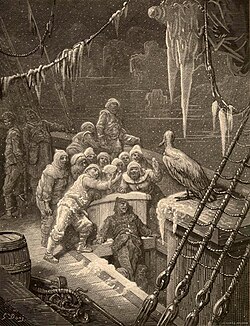
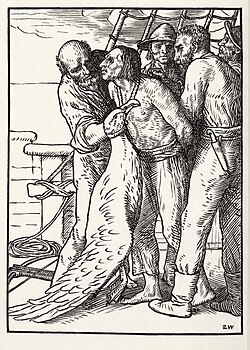
As punishment and a symbol of his guilt, the crew forces the Mariner to wear the dead albatross around his neck. This burden remains until the Mariner experiences a spiritual awakening; upon observing the beauty of the sea creatures he once despised, he blesses them unaware. This act of love breaks the curse, allowing the albatross to fall from his neck and rain to finally fall.
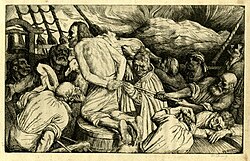
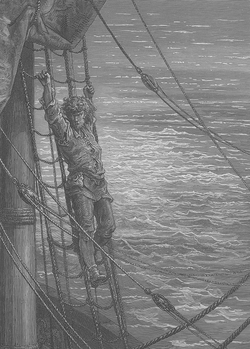
Though the Mariner eventually returns home, his penance is lifelong. He is driven by an internal agony to wander the earth, recounting his story to specific individuals to teach them a lesson about the sanctity of nature. The Wedding-Guest, after hearing the tale, returns home the next morning "a sadder and a wiser man."
![Commemorative statue at Watchet, Somerset: the albatross hangs on a rope looped around the ancient mariner's neck. "Ah! well a-day! what evil looks Had I from old and young! Instead of the cross, the Albatross About my neck was hung."[4]: lines 139–142](/images/ed/4b/ed4b6513f155bcb316d8af839ec002a6f97fc3ecd9f5e5f3c7310cfa59e1985f.jpg)
Inspirations and Origins
Coleridge drew from a variety of sources to construct this atmospheric narrative. Historians and critics suggest several primary influences:
- Exploration Voyages: The poem may have been inspired by James Cook's second voyage (1772–1775) to the South Seas, as Coleridge's tutor, William Wales, was an astronomer on Cook's flagship. Some also point to Thomas James's Arctic voyages.
- Personal Accounts: William Wordsworth noted that the poem was inspired during a walking tour of the Quantock Hills in Somerset, following a discussion about a 1719 privateering voyage where a sailor named Simon Hatley shot a black albatross.
- Literary Legends: The theme of eternal wandering mirrors the legend of the Wandering Jew and the Flying Dutchman.
- Local Lore: The harbor at Watchet, Somerset, is cited as a primary inspiration, influenced in part by a dream told to Coleridge by local acquaintance John Cruikshank regarding a skeleton ship.
Evolution and Critical Reception
The poem underwent significant changes throughout Coleridge's life, with at least eighteen different versions produced. The 1798 original used archaic spellings to evoke an older feel, which some early critics found obscure. In 1800, Coleridge modernized much of the language.
A major revision appeared in the 1817 collection Sibylline Leaves. This version introduced a gloss—marginal notes that interpret the verses, similar to those found in the Bible. While some readers found the gloss helpful, critics like Charles Lamb argued it distanced the audience from the emotional core of the narrative.
Interpretations and Legacy
Beyond the surface plot, the poem is interpreted in various ways. Some see it as a salvation story focusing on the psychological effects of violating nature. Others, such as George Whalley, view the Mariner as an autobiographical reflection of Coleridge's own feelings of loneliness. Psychoanalytic critics, including Camille Paglia, suggest the characters represent different fragmented aspects of the author's own persona.
The poem's most enduring contribution to the English language is the idiom "an albatross around one's neck," which describes a heavy burden of guilt that hinders success.
| Feature | Details |
|---|---|
| Original Title | The Rime of the Ancyent Marinere |
| Publication Date | 1798 (First Edition) |
| Key Symbol | The Albatross (representing nature and guilt) |
| Structure | 625 lines; Ballad form |
| Major Versions | 1798, 1800, 1817 (with gloss), 1834 |
Frequently Asked Questions
What does the albatross symbolize in the poem?
The albatross initially symbolizes a connection to nature and good fortune. After it is killed, it becomes a physical manifestation of the Mariner's guilt and the burden of his sin against the natural world.
What is a "gloss" in the context of this poem?
A gloss refers to the marginal notes added by Coleridge in the 1817 version of the poem. These notes act as a commentary to help the reader interpret the narrative and the archaic language used in the verses.
Why is the poem considered a shift toward modern poetry?
It is seen as a signal shift because of its focus on psychological depth, the use of the supernatural to explore human emotion, and its role in launching the British Romantic movement.
What is the meaning of the phrase "an albatross around one's neck"?
Derived from the poem, this idiom refers to a heavy burden of guilt or a persistent problem that prevents a person from achieving success or moving forward in life.
How did the Wedding-Guest change by the end of the story?
The Wedding-Guest begins the poem as an amused and impatient observer, but after hearing the Mariner's tale, he is transformed into "a sadder and a wiser man," having gained a deeper understanding of life and nature.