The J. Paul Getty Museum: A Legacy of Art and Architecture
The J. Paul Getty Museum, widely known as the Getty, stands as one of the most prestigious and wealthiest art institutions in the world. Operated by the J. Paul Getty Trust, this American museum is unique for its presence across two distinct campuses in Los Angeles, California: the Getty Center and the Getty Villa. Together, they house a vast array of human creativity, ranging from the ancient civilizations of the Mediterranean to the cutting-edge photography of the modern era.
The Two Campuses of the Getty
The museum is divided into two specialized locations, each offering a different atmospheric and artistic experience.
The Getty Center
Perched on a cliff overlooking the Sepulveda Pass in the Brentwood neighborhood, the Getty Center is a marvel of modern design. Its collections are expansive, featuring pre-20th-century European paintings, drawings, sculpture, and decorative arts. It also houses a significant collection of illuminated manuscripts and a comprehensive photography archive that spans from the medium's inception to the present day.
![The Getty attracts approximately 1.8 million visitors a year.[17]](/images/0d/76/0d7638974916e95e6d9e4222c56bb98079ec5931a872ce5172614f368c146aed.jpg)
The architecture of the Center is as much an attraction as the art. Architect Richard Meier utilized specific materials to blend the structure with its environment, creating a seamless transition between the galleries and the surrounding landscape.
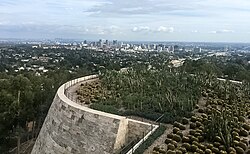
![Architect Richard Meier chose beige-colored Italian travertine panels to cover the retaining walls and to serve as paving stones for the arrival plaza and museum courtyard.[18]](/images/a2/b4/a2b4490234196bd9d9e1d03fa369a6fdb0ec2a377d73f33da2f9e7fd36cafb41.jpg)
The Getty Villa
Located in the Pacific Palisades overlooking the Pacific Ocean, the Getty Villa serves as the museum's original home. This site is a meticulous re-creation of the Villa of the Papyri from Herculaneum. The Villa focuses specifically on the art of Ancient Greece, Rome, and Etruria, providing visitors with an immersive experience of classical antiquity.
Key Facts
- Established: 1974
- Locations: Getty Center (Brentwood) and Getty Villa (Pacific Palisades), Los Angeles.
- Annual Visitors: Approximately 1.8 million (with 2,023,467 recorded in 2016).
- Wealth: Became the world's richest museum in 1982 after inheriting US$1.2 billion.
- Current Director: Timothy Potts.
History and Evolution
The museum began in 1974 when Jean Paul Getty opened a facility in Malibu. Over the following decades, the institution grew rapidly in both wealth and collection size. A notable acquisition occurred in 1983, when the museum purchased 144 illuminated medieval manuscripts from the Ludwig Collection in Aachen, Germany.
In 1997, the primary museum operations moved to the current Getty Center in Brentwood. The original Malibu site was subsequently renovated and reopened as the Getty Villa in 2006. In recent years, the museum has embraced digital engagement, most notably during the COVID-19 pandemic with the "Getty Museum Challenge," which encouraged the public to recreate artworks using household objects.
The institution also remains proactive regarding environmental threats. Following the Southern California wildfires of 2025, the Getty sold $500 million in bonds in April 2025 to enhance fire protection for its priceless collections.
Provenance and Repatriation Controversies
The Getty has faced significant scrutiny regarding the provenance (the chronology of ownership) of its antiquities. During the 1970s and 1980s, curator Jiří Frel was involved in schemes to acquire artifacts of dubious origin, including some that were later considered fakes, such as the Getty kouros.
These practices led to long-term legal battles with Italy and Greece. Former curator Marion True was indicted in Italy in 2005 on charges related to the trafficking of stolen antiquities. While True claimed these practices were condoned by the board, the museum eventually began returning disputed items.
Significant repatriations include:
- Italy: Dozens of artifacts, including a 5th-century BC statue of Aphrodite and the terracotta head of the Greek god Hades (returned in 2016).
- Greece: A 2,500-year-old funerary wreath, a 6th-century BC statue of a kore, and a black limestone stele.
Museum Highlights
The Getty's collection is renowned for its breadth and quality. Below is a summary of some of the most notable works housed at the Getty Center.
| Category | Notable Works / Artists | Period/Date |
|---|---|---|
| European Paintings | Vincent van Gogh, Claude Monet, Paul Cézanne, Titian, El Greco | 15th - 19th Century |
| Photography | Alfred Stieglitz, Julia Margaret Cameron, Eugène Atget | 1851 - 1921 |
| Sculpture & Objects | Michelangelo (Study of a Mourning Woman) | 1500–1505 |
| Manuscripts | Lieven van Lathem (Roman de Gillion de Trazegnies) | 1471 |
Frequently Asked Questions
What is the difference between the Getty Center and the Getty Villa?
The Getty Center is a modern complex in Brentwood focusing on a broad range of European art and global photography. The Getty Villa is a classical re-creation in Pacific Palisades dedicated specifically to art from Ancient Greece, Rome, and Etruria.
Why is the Getty considered the wealthiest art institution?
The museum's financial standing increased dramatically in 1982 when it inherited US$1.2 billion, allowing it to acquire some of the world's most important private art collections.
What is the "Getty Museum Challenge"?
Launched during the COVID-19 pandemic, it was a social media campaign that invited people to use everyday household objects to recreate famous works of art from the museum's collection.
Has the Getty returned stolen art?
Yes. Following investigations into the provenance of its antiquities, the Getty has returned numerous artifacts to Italy and Greece, including the statue of Aphrodite and the head of Hades.
How is the museum protecting its art from wildfires?
In April 2025, the Getty Trust sold $500 million in bonds specifically to fund and improve fire protection measures for its collections following the Southern California wildfires.