Museum of Fine Arts, Houston: A History of Its World-Class Collection
With a vast repository of approximately 80,000 works of art, the Museum of Fine Arts, Houston (MFAH) stands as one of the top ten most-visited art museums in the United States. Its encyclopedic collection—a comprehensive assembly of art from diverse cultures and eras—spans Italian Renaissance and Baroque painting, French Impressionism, photography, and decorative arts from America and Europe. The museum also houses significant collections of African and pre-Columbian gold, as well as post-1945 painting and sculpture.
While its foundations are rooted in European and American traditions, the MFAH continues to evolve, strengthening its diversity through emerging interests in Asian, Islamic, and modern Latin American art, including the contributions of Texas Latino artists.
Key Facts
- Total Collection: Approximately 80,000 works of art.
- National Standing: Ranks among the top ten U.S. art museums in attendance.
- Major Milestones: Permanent building opened in 1924; ICAA established in 2001.
- Financial Strength: Held the sixth-largest art museum endowment in the U.S. as of 2011.
- Specialized Centers: Home to the International Center for the Arts of the Americas (ICAA).
Collection Beginnings
The museum's growth began even before its permanent home opened in 1924. Early momentum was driven by the bequest of George M. Dickson, who provided the first significant American and European oil paintings. During the 1930s, the collection expanded through the donation of antiquities by Annette Finnigan and avant-garde European prints and drawings from philanthropist Ima Hogg. Hogg further enriched the museum in the 1940s with her Frederic Remington and Southwest Native American collections.
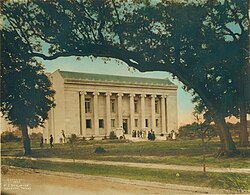
Between 1940 and 1960, the MFAH benefited from the generosity of prominent Houston families and foundations, including Alice N. Hanzsen, Dominique de Menil, Sarah Campbell Blaffer, and the Samuel H. Kress Foundation. These contributions focused on contemporary sculpture and painting, African, Oceanic, and Pre-Columbian art, and European works from the 15th to 20th centuries. By 1970, the permanent collection had grown to 12,000 objects.
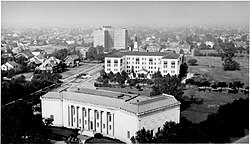
The Evolution of European Paintings
The trajectory of the European collection changed fundamentally in 1944 with a bequest from New York collectors Edith and Percy S. Straus. This gift of 83 Renaissance paintings, sculptures, and works on paper served as the collection's cornerstone, increasing the holdings from just twelve paintings to a world-class assembly. Percy S. Straus is recognized for assembling one of the finest private collections in the U.S. during the 1920s and 30s, featuring masters such as Sandro Botticelli, Fra Angelico, Giovanni Bellini, Peter Paul Rubens, and Anthony van Dyck.
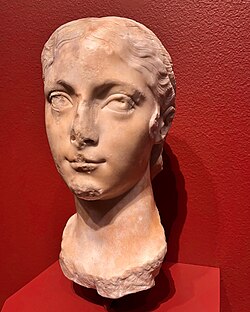
The collection expanded rapidly between 1970 and 1989 through corporate giving and accession endowments. A pivotal moment occurred in 1974 when John and Audrey Jones Beck placed 50 Impressionist and Post-Impressionist masterpieces on long-term loan. These works formally became part of the museum's permanent holdings in 1998 and are now displayed in the building named in Audrey Jones Beck's honor.
Financial growth was further accelerated by the Cullen Foundation's 1970 accessions endowment and a 20-year challenge grant launched by the Brown Foundation, Inc. in 1976. Additionally, the museum's photography collection was established in 1976 via a corporate grant from Target Stores.
Modern Latin America and Latino Art
In 2001, the MFAH launched the International Center for the Arts of the Americas (ICAA), a premier research institute dedicated to 20th-century Latin American and Latino art. The ICAA focuses on the artistic production of Latinx communities across Mexico, Central and South America, the Caribbean, and the United States.
The acquisition of Latin American art was significantly boosted by a 2007 gift of over $400 million from Caroline Wiess Law and the construction of the Kinder building. This new facility expanded the space for 20th-century art from 1,200 square feet to nearly 150,000 square feet. Within the Kinder building, Latin American and Latino works comprise 24 percent of the displayed art.
The collection features South American artists such as Joaquín Torres-García, Lygia Clark, and Gego, as well as Venezuelan abstract artists. A notable highlight is a monumental, multi-sensory crochet installation by Brazilian artist Ernesto Neto. The museum also promotes this heritage through the ¡Aquí Estamos!: Latinx Art at the Museum of Fine Arts, Houston initiative and collaborations with Google Arts & Culture.
African American Art and Inclusivity
The MFAH has worked to address a complex history regarding African American artists. A notable example of past exclusion occurred in 1950, when artist John Biggers was barred from attending his own award ceremony because it was a white-only event. In response, the museum has implemented diversity and inclusivity efforts.
Former curator Alvia Wardlaw helped advance this mission by mounting exhibitions for artists such as Thornton Dial, Kermit Oliver, and Roy DeCarvera, as well as showcasing Gee's Bend quilts. Recent exhibitions, such as Soul of a Nation: Art in the Age of Black Power (2020) and Statements: African American Art from the Museum’s Collection (2016), explore themes of racial injustice, civil rights, and the generational impact of slavery. Works by Kara Walker and Kehinde Wiley further examine these themes of oppression.
Islamic Art
The museum's reach into Islamic art was significantly expanded in 2019 with the arrival of the Hossein Afshar Collection. As one of the world's most distinguished private collections of Persian art, it is currently on loan to the MFAH, which has organized two dedicated exhibitions to showcase its works.
| Collection Area | Key Contributors / Artists | Notable Features |
|---|---|---|
| European Renaissance | Percy S. Straus, Botticelli, Rubens | Cornerstone bequest of 83 works in 1944 |
| Impressionism | Audrey Jones Beck | 50 masterpieces housed in the Beck Building |
| Latin American & Latino | Caroline Wiess Law, Ernesto Neto | Managed by the ICAA; 24% of Kinder building art |
| African American | Thornton Dial, Kehinde Wiley | Focus on civil rights and racial identity |
| Islamic Art | Hossein Afshar | Distinguished private collection of Persian art |
Frequently Asked Questions
How many works of art are in the MFAH collection?
The museum houses approximately 80,000 works of art across various genres and eras.
What is the ICAA?
The International Center for the Arts of the Americas (ICAA) is a leading research institute established in 2001 that focuses on the exhibition, research, and promotion of 20th-century Latin American and Latino art.
Who provided the cornerstone for the European collection?
The 1944 bequest from New York collectors Edith and Percy S. Straus, consisting of 83 Renaissance works, fundamentally expanded the scope of the European collection.
How has the museum addressed its history with African American artists?
The MFAH has implemented diversity and inclusivity efforts, including permanent exhibitions and shows like "Soul of a Nation," and by commissioning local artists to showcase work in galleries within African American communities in Houston.
What is the significance of the Kinder building?
The Kinder building vastly increased the museum's capacity for 20th-century art, expanding the dedicated space from 1,200 to nearly 150,000 square feet and providing a home for a significant portion of the Latin American and Latino collection.