The Hole Argument and Einstein's Struggle with General Covariance
In the pursuit of a complete theory of gravity, Albert Einstein encountered a conceptual paradox that nearly derailed the development of general relativity. Known as the hole argument, this theoretical challenge forced Einstein to reconsider the very nature of spacetime and the meaning of coordinates in physics.
At its core, the hole argument questions whether the laws of physics can uniquely determine the geometry of the universe if those laws are generally covariant—meaning they maintain the same mathematical form regardless of the coordinate system used.
Key Facts
- Origin: Developed by Albert Einstein around 1913 during his struggle with the meaning of coordinates.
- The Paradox: General covariance seemed to imply that a single distribution of matter could result in multiple, mathematically distinct spacetime geometries.
- The Resolution: Einstein realized that two geometries related by an active diffeomorphism are physically identical.
- Philosophical Shift: The argument led to the conclusion that spacetime points have no inherent physical meaning outside of the coincidences of matter and fields.
- Modern Impact: This concept is central to the debate over background independence in quantum gravity theories.
The Mechanics of the Paradox
To understand the hole argument, one must first understand how field equations typically work. In classical electromagnetism, Maxwell's equations use sources (like charge density) and boundary conditions to determine electric and magnetic fields. While the vector potential may vary based on a choice of gauge, the physical fields remain unique.
Einstein noticed a problem when applying this logic to gravity. If the equations of gravity are generally covariant, the metric (the mathematical object describing the geometry of spacetime) cannot be uniquely determined by its sources as a function of coordinates.
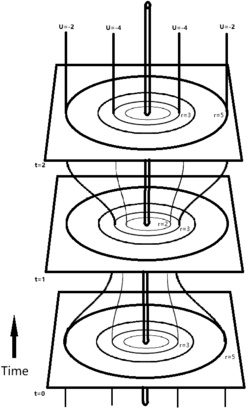
Imagine a gravitational source, such as the Sun, with a metric g(r). If we perform a coordinate transformation that leaves the interior of the Sun unchanged but alters the coordinates outside the Sun, we create a new metric g'. Because of general covariance, this new metric is also a valid solution to the field equations. This suggests that one source (the Sun) could produce multiple different metrics, seemingly destroying determinism in physics.
Passive vs. Active Diffeomorphisms
The confusion stems from the difference between two types of transformations. A passive diffeomorphism is a mere change of coordinates—like switching from Cartesian to polar coordinates—which does not change the physical system. An active diffeomorphism, however, involves "dragging" the metric function across the spacetime manifold, effectively changing the geometry relative to the manifold's points.
Einstein's Resolution: The Point-Coincidence Argument
For three years, Einstein searched for non-generally covariant equations to avoid this paradox. However, in 1915, he reached a breakthrough: he realized the problem lay in the assumption that spacetime points have an independent physical existence.
Einstein concluded that the only meaningful way to define a location in spacetime is through spacetime coincidences—the meeting of two or more material points or fields. If the metric and the matter are both "dragged" by an active diffeomorphism, their relative coincidences remain unchanged. Therefore, the two mathematically different solutions are physically identical.
This insight shifted the view of spacetime from a fixed "container" or stage to an active participant in the physics. As physicist Carlo Rovelli described it, the stage disappears and becomes one of the actors.
Summary of Concepts
| Concept | Passive Diffeomorphism | Active Diffeomorphism |
|---|---|---|
| Nature | Change of coordinate labels | Physical shifting of the field on the manifold |
| Geometry | Remains the same | Mathematically altered |
| Physicality | Physically equivalent | Physically equivalent (per Einstein's resolution) |
| Key Result | Coordinate invariance | Gauge invariance |
Implications for Quantum Gravity
The resolution of the hole argument established the principle of background independence—the idea that a theory should not rely on a fixed, pre-existing geometry. This remains a dividing line in modern theoretical physics:
- Loop Quantum Gravity (LQG): Treats background independence as a core tenet. By viewing small and large distances as gauge equivalent via active diffeomorphisms, LQG achieves UV-finiteness (the avoidance of infinite values at very small scales).
- String Theory: Often formulated using a background (such as in perturbative versions), though some sectors, like the AdS/CFT correspondence, exhibit manifest background independence.
Frequently Asked Questions
What exactly is the "hole" in the hole argument?
The "hole" refers to a closed region of spacetime that is devoid of matter. Einstein imagined this region to test whether the field equations and boundary conditions outside the hole could uniquely determine the metric inside it.
Why did the hole argument delay general relativity?
Einstein feared that general covariance led to a loss of determinism, where the same initial conditions could lead to different physical outcomes. This led him to spend several years searching for equations that were not generally covariant.
What is a diffeomorphism in this context?
A diffeomorphism is a differentiable map between manifolds. In general relativity, it represents a transformation of the spacetime coordinates or the fields residing on that spacetime.
How does the point-coincidence argument solve the paradox?
It argues that spacetime points have no physical meaning on their own. Physical reality is defined only by how fields and particles coincide. Since an active diffeomorphism moves everything together, the coincidences remain the same, making the different mathematical solutions physically indistinguishable.
What is the relationship between the hole argument and gauge invariance?
The resolution of the hole argument was one of the first clear statements of gauge invariance. It established that certain mathematical transformations (like active diffeomorphisms) do not change the underlying physical state of the system.