The Great Chain of Being: History, Hierarchy, and Scientific Evolution
The Great Chain of Being, known in Latin as scala naturae (the ladder of being), is a hierarchical structure encompassing all matter and life. Historically championed by medieval Christianity and the medieval Islamic world, this concept posits that the universe is organized in a strict, God-decreed order. From the divine heights of the creator to the simplest minerals of the earth, every element of existence has a specific, immutable place.
The origins of this idea are rooted in the philosophies of Plato, Plotinus, and Proclus, as well as Aristotle's Historia Animalium. While it began as a philosophical inquiry into the nature of existence, it evolved during the Middle Ages and reached its peak expression in early modern Neoplatonism.
![1579 drawing of the Great Chain of Being from Didacus Valades [es], Rhetorica Christiana](/images/c9/e4/c9e4086bf8392c6d320b19cbcd52965e0320707a78ec14cf26687227c8940015.png)
Key Facts
- Definition: A hierarchical ladder of all existence, ranging from God at the top to minerals at the bottom.
- Core Principle: Higher beings possess all the attributes of those below them, plus additional spiritual or intellectual qualities.
- Philosophical Roots: Derived from Plato and Aristotle, later expanded by Neoplatonists and medieval theologians.
- Scientific Legacy: Influenced Carl Linnaeus's biological kingdoms and the early conceptualization of evolutionary "missing links."
- Political Impact: Used to justify absolute monarchy by equating the King's authority with divine order.
The Hierarchy of Existence
The chain is structured so that as one ascends, the amount of spirit increases and material dependence decreases. Those at the top are unchangeable and purely spiritual, while those at the bottom are purely material.
God
At the absolute summit is God, the model of perfection. In Judaism and Christianity, God is the creator of the universe, possessing unique attributes of omniscience (all-knowing), omnipresence (present everywhere), and omnipotence (all-powerful).
Angelic Beings
Below God are the angels, who are entirely spirit and lack material bodies. The New Testament mentions various entities such as Thrones, Dominions, Sovereignties, and Powers. In the 5th and 6th centuries, Pseudo-Dionysius the Areopagite detailed a complex nine-tier hierarchy:
- Angels of Presence: Seraphim (love), Cherubim (harmony), and Thrones (universal laws).
- Angels of Government: Dominions (wisdom), Virtues (free will), and Powers (form and space).
- Angels of Revelation: Principalities (time/personality), Archangels (superior power), and Angels (nature spirits).
Humanity
Humans occupy a unique middle ground. They share spiritual attributes—such as language and love—with the angels, but possess material bodies with physical needs (hunger, thirst) and sensations (pain, lust) shared with animals. Because they are composed of both spirit and matter, humans are impermanent and subject to death.
Animals
Animals are characterized by their senses, movement, and physical appetites. Within this group, a further hierarchy exists: apex predators like lions, with keen sight and smell, are ranked higher than sessile organisms, such as oysters, which remain attached to the seabed. All animals, however, share the basic senses of taste and touch.
Plants
Plants lack sense organs and the ability to move, but they possess the capacity to grow and reproduce. The hierarchy here ranges from "higher" plants with healing properties in their flowers and leaves to "lower" plants like mosses and fungi.
Minerals
At the base of the chain are minerals. They cannot move, sense, grow, or reproduce. Their primary attributes are strength and solidity, though gemstones were believed to possess magic, with the diamond regarded as the king of gems.

The Transition to Natural Science
From Aristotle to Linnaeus
The ranking of organisms began with Aristotle, who graded animals based on reproductive modes (live birth being "higher" than eggs) and the possession of blood. This non-religious framework was later adopted by Scholastic philosophers to create the Scala Naturae. By the Northern Renaissance, this shifted toward biology, influencing Carl Linnaeus's 1737 Systema Naturæ, which divided the physical world into the three kingdoms: minerals, plants, and animals.
Alchemy and Transformation
Alchemy viewed the Great Chain as evidence of a fundamental unity of matter. Alchemists believed that because all matter was linked, it might be possible to transform a substance from one level of the chain to another. This led to the pursuit of the philosopher's stone, a substance thought to concentrate the universal spirit and enable the transmutation of base metals, like lead, into noble metals, like gold.
Evolution and the "Missing Link"
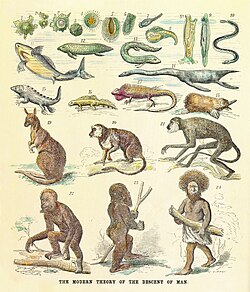
By the 18th century, the idea of fixed species began to fade. Jean-Baptiste Lamarck proposed a progression of life from simple to complex forms. This concept of ordering organisms paved the way for the theory of transmutation of species, leading to Charles Darwin's theory of evolution.
In 1851, geologist Charles Lyell used the chain as a metaphor for the geological column, introducing the term "missing links" to describe gaps in the continuum. While this term later referred to transitional fossils between humans and other animals, the linear "chain" was eventually replaced in the 20th century by the evolutionary tree and complex web structures involving horizontal gene transfer.
Political and Modern Implications
The Great Chain of Being had profound social effects. Some historians suggest it maintained peace in Europe by making rebellion unthinkable; to defy a King was to defy the divine order. King James I reinforced this, claiming monarchs were God's lieutenants on earth.
In modern times, the concept persists in transpersonal psychology. Philosopher Ken Wilber describes a "Great Nest of Being," and economist E. F. Schumacher proposed a hierarchy where humans are uniquely capable of perceiving the "eternal now."
| Level | Composition | Key Attributes | Example/Status |
|---|---|---|---|
| God | Pure Spirit | Omnipotence, Omniscience, Omnipresence | The Model of Perfection |
| Angels | Pure Spirit | Immutability, Spiritual Power | Seraphim, Archangels |
| Humans | Spirit & Matter | Language, Love, Physical Sensation | Impermanent/Mortal |
| Animals | Matter | Senses, Movement, Appetite | Lions (High) to Oysters (Low) |
| Plants | Matter | Growth, Reproduction | Healing Plants to Mosses |
| Minerals | Matter | Solidity, Strength | Diamonds (High) to Base Metals |
Frequently Asked Questions
What is the main difference between humans and angels in the chain?
Angels are composed entirely of spirit and are therefore unchangeable and immortal. Humans are a hybrid of spirit and matter, which makes them subject to change, physical needs, and death.
How did the Great Chain of Being influence early biology?
It provided a framework for classification. Aristotle's rankings of animals based on blood and reproduction evolved into the Scholastic Scala Naturae, which eventually informed Carl Linnaeus's division of nature into the kingdoms of animals, plants, and minerals.
What is the "missing link" in the context of this theory?
Originally a metaphor used by Charles Lyell to describe gaps in the geological column, the "missing link" came to represent transitional fossils that bridge the evolutionary gap between different species, particularly between humans and their ancestors.
Did the Great Chain of Being have any political use?
Yes. It was used to justify the divine right of kings. Because the chain was seen as a God-given order, challenging the monarch was viewed as an act of rebellion against God himself.
How does alchemy relate to the Great Chain of Being?
Alchemy assumed a fundamental unity of all matter within the chain. This led to the belief that substances could be moved up the chain—such as turning lead into gold—using a catalyst like the philosopher's stone.