Ernst Mayr: Architect of the Modern Evolutionary Synthesis
Ernst Walter Mayr (1904–2005) was a towering figure in 20th-century science, serving as a bridge between the classical natural history of the 19th century and the rigorous genetic science of the modern era. A German-American evolutionary biologist, Mayr's multidisciplinary expertise spanned systematics (the study of the diversification of biological lineages), ornithology, and the philosophy of biology.
Mayr is most celebrated for his pivotal role in the modern evolutionary synthesis. This conceptual revolution unified Mendelian genetics, systematics, and Darwinian evolution into a single, cohesive framework, fundamentally changing how scientists understand the origin of species.
Key Facts
- Lifespan: July 5, 1904 – February 3, 2005 (aged 100).
- Major Contribution: Developed the biological species concept and helped lead the modern evolutionary synthesis.
- Field Expertise: Renowned as a taxonomist, tropical explorer, and historian of science.
- Academic Tenure: Faculty member at Harvard University and Director of the Museum of Comparative Zoology (1961–1970).
- Discovery Record: Named 38 new bird species and 38 new orchid species during his career.
- Top Honors: Recipient of the "Triple Crown in Biology" (Balzan Prize, Crafoord Prize, and International Prize for Biology).
Early Life and Tropical Exploration
Born in Kempten, Bavaria, Mayr pursued his early education at the University of Greifswald and the Humboldt University of Berlin. His career took a definitive turn in 1927 when he was introduced to the naturalist Walter Rothschild. This connection led to a landmark expedition to New Guinea, funded by Rothschild and the American Museum of Natural History (AMNH).
During his time in New Guinea, Mayr demonstrated an extraordinary aptitude for field collection, gathering thousands of bird skins. His work in the region extended to botany, where he identified numerous orchid species. He also participated in the Whitney South Sea Expedition to the Solomon Islands. Beyond specimen collection, Mayr used his time in the Finschhafen district to debunk inaccuracies in Hermann Detzner's travelogue, Four Years among Cannibals: New Guinea, by consulting with local missionaries.
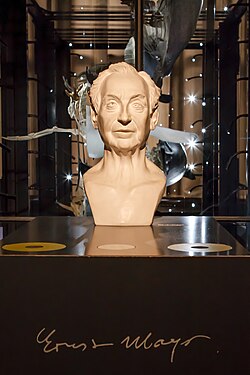
Academic Career and the Modern Synthesis
After returning to Germany in 1930 and eventually moving to the United States, Mayr's intellectual focus shifted toward the theoretical foundations of evolution. He joined the faculty of Harvard University in 1953, where he spent decades shaping the next generation of biologists. From 1961 to 1970, he led the Museum of Comparative Zoology.
Mayr's most enduring legacy is the biological species concept, which defines a species not just by physical appearance, but by reproductive isolation. He argued that species are groups of actually or potentially interbreeding natural populations. This shift moved biology away from "beanbag genetics"—the idea that evolution is merely a collection of independent gene changes—and toward a view of evolution as a process occurring within populations.
Philosophical Contributions
Mayr did not limit himself to data collection; he explored the philosophy of biology. He introduced the term teleonomy to describe the quality of being directed toward a goal (such as an organism's survival) through a program encoded in its genetic makeup, distinguishing it from the metaphysical concept of teleology.
Legacy and Recognition
Mayr's influence is immortalized in the naming of various taxa, including the pseudoscorpion genus Ernstmayria and several species of spiders, damselflies, and earwigs. In 1995, Harvard University honored him by renaming the Library of the Museum of Comparative Zoology the Ernst Mayr Library.
While Mayr never received a Nobel Prize—noting that no such prize exists for biology or evolutionary biology—he received the Crafoord Prize in 1999, which recognizes basic research in fields overlooked by the Nobel committee.
| Category | Details |
|---|---|
| Primary Fields | Evolutionary Biology, Systematics, Ornithology, Philosophy of Biology |
| Key Institutions | Harvard University, American Museum of Natural History |
| Major Awards | National Medal of Science, Balzan Prize, Crafoord Prize, Linnean Medal |
| Notable Works | Systematics and the Origin of Species, Animal Species and Evolution |
| Taxonomic Impact | 38 new bird species; 38 new orchid species |
Frequently Asked Questions
What was Ernst Mayr's role in the modern evolutionary synthesis?
Mayr helped integrate Mendelian genetics and systematics with Darwinian natural selection. He shifted the focus of evolutionary study from individual genes to populations, providing a theoretical basis for how new species arise.
What is the biological species concept?
It is the definition of a species as a group of populations whose members have the potential to interbreed in nature and produce viable, fertile offspring, but are reproductively isolated from other such groups.
Why didn't Ernst Mayr win a Nobel Prize?
Mayr pointed out that there is no Nobel Prize category for biology or evolutionary biology. However, he received the Crafoord Prize, which is administered by the same organization and honors research in fields not covered by the Nobel Prizes.
What is the "Triple Crown in Biology"?
The "Triple Crown" refers to winning the Balzan Prize, the Crafoord Prize, and the International Prize for Biology, an achievement Mayr accomplished during his career.
What is teleonomy?
Teleonomy is a term Mayr used to describe the goal-directedness of biological systems (like the development of an embryo) that results from an evolutionary program rather than a predetermined cosmic purpose.