The Bat in Heraldry: Symbolism of the Crown of Aragon
In the world of heraldry, the bat—historically referred to as the reremouse, reermouse, or rearmouse—serves as a distinctive charge and crest. While it appears in various global contexts, its most prominent use is found within the municipal arms of the former Crown of Aragon, specifically across Valencia, Catalonia, and the Balearic Islands.
Once viewed as a sign of bad luck, the bat evolved into a symbol of good fortune and civic pride, eventually migrating from royal helmets to the crests of cities and the badges of modern sports teams.
Key Facts
- Origin: Derived from the cimera reial (royal dragon) crest of the Kings of Aragon.
- Regional Focus: Primarily used in the former territories of the Crown of Aragon in eastern Spain.
- Evolution: The winged dragon (víbria) appearing under Peter IV of Aragon was later transformed into a bat by various municipalities.
- Global Presence: Found in Spain, France, Germany, the UK, and Colombia.
- Modern Use: Featured on the badges of several Spanish football clubs, including Valencia CF and Levante UD.
Origins and Legends
The heraldic bat is fundamentally linked to the cimera reial, the royal crest of the Kings of Aragon. The original royal helmet featured a víbria—a traditional Catalan dragon—emerging from a crown. While often associated with King James I of Aragon (1208–1276), historical records indicate the winged dragon did not appear on the helmet until the reign of Peter IV (1319–1387). Over time, municipalities adapted this dragon crest into the image of a bat.
Beyond official records, several legends explain the bat's presence. One account claims a bat landed on King James I's flag in 1238 before a decisive victory against the Saracens during the conquest of Valencia. Another story suggests a bat alerted the king to a surprise night raid by the Saracens. A third version posits that the bat's nocturnal habits inspired James I to launch a night attack. Despite these tales, original documents suggest the animal depicted in early accounts was actually a swallow.
Other theories suggest a practical origin: because bats consume mosquitoes—a significant pest in eastern Spain—some authors believe the symbol honors the animal's ecological role in the local food chain.
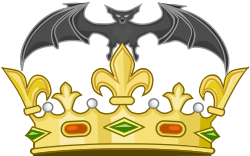
Alternative Origins
Not all heraldic bats share this royal lineage. For example, the bat found in the arms of Albacete originated from the gradual visual transformation of "winged hands," which were the emblem of the lords of Villena.
The Bat in Civic Heraldry
The bat is a recurring element in the coats of arms of eastern Spanish cities, including Valencia, Palma de Mallorca, and Fraga, as well as smaller towns like Catarroja and Novallas. In Teruel, the bat commemorates the city's role in the conquest of Valencia; while it once surmounted the crown, it now rests just below it in the city's seal.
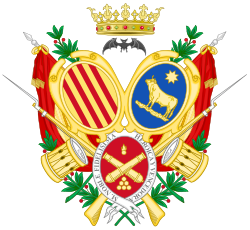
Historically, Barcelona's coat of arms also featured a crowning bat, though it was removed in the early 20th century for reasons that remain unknown.
International Occurrences
While concentrated in the former Crown of Aragon, the bat appears in other European and American heraldry:
- Europe: Montchauvet (France), Fiefbergen (Germany), and the former Borough of Brecknock and county of Brecknockshire (Wales, UK).
- Americas: Santa Fe de Antioquia (Colombia), granted in 1545 by Charles I of Castile and Aragon and Joanna of Castile.
- Other: Gmina Piątnica (Poland).
Modern Cultural and Commercial Use
The civic symbol has transitioned into the sporting world. Several Spanish football clubs, including Albacete Balompié, CD Alcoyano, Levante UD, and Valencia CF, incorporate the bat into their badges. Valencia CF has used the symbol since its foundation in 1919. This usage led to legal disputes in 2013 and 2019 when DC Comics claimed the logo was too similar to Batman; however, these claims were unsuccessful.
Other notable uses include:
- Maritime: The burgee of the Royal Valencia Yacht Club features a bat on a golden field.
- Political: Lo Rat Penat, a political organization founded in Valencia in 1878 to foster a movement similar to the Catalan Renaixença.
- Military: The No. 9 Squadron RAF adopted a bat badge in 1917 with the motto Per Noctem Volamus ("We fly through the night").
Summary of Bat Heraldry
| Category | Primary Examples | Origin/Meaning |
|---|---|---|
| Royal Origin | Kings of Aragon | Evolution of the víbria (winged dragon) |
| Civic (Spain) | Valencia, Palma, Teruel | Regional identity and conquest of Valencia |
| Civic (International) | Santa Fe de Antioquia, Brecknockshire | Colonial grants or local emblems |
| Sports | Valencia CF, Levante UD | Derived from city coats of arms |
| Military | No. 9 Squadron RAF | Night flight capabilities |
Frequently Asked Questions
Did the bat symbol originate with King James I?
While legends link the bat to King James I's conquest of Valencia in 1238, historical evidence shows the winged dragon (the precursor to the bat) did not appear on the royal helmet until the reign of Peter IV of Aragon.
Is the bat in Albacete's coat of arms related to the Crown of Aragon?
No. The bat in Albacete's heraldry evolved from "winged hands," which were the emblem of the lords of Villena, rather than the royal dragon of Aragon.
Why did DC Comics sue Valencia CF?
DC Comics filed suits in 2013 and 2019 claiming that the bat on Valencia CF's badge was too similar to the Batman logo. The European Union Intellectual Property Office did not rule in favor of DC Comics.
What is the meaning of the bat in Teruel's seal?
In Teruel, the bat serves as a commemoration of the city's specific role during the conquest of Valencia.
What is the "víbria"?
The víbria is a traditional Catalan winged dragon that originally served as the royal crest (cimera reial) on the helmet of the Kings of Aragon before being adapted into the bat symbol by various cities.