Tells: The Ancient Artificial Mounds of the Near East and Europe
In the field of archaeology, a tell (derived from the Arabic word tall, meaning "mound" or "small hill") is an artificial topographical feature. Unlike natural hills, a tell is a mound created by the accumulated and stratified debris of successive human settlements built upon the same site over generations. These mounds are composed of cultural refuse, collapsed building materials, and natural sediments that build up over centuries.
While most famously associated with the ancient Near East, tells are also found in North Africa and parts of Southern and Central Europe, including Spain, Greece, Bulgaria, and Hungary. These sites provide a vertical timeline of human history, preserving the remains of the Neolithic, Chalcolithic, Bronze, and Iron Ages.
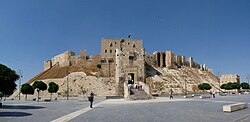
Key Facts
- Composition: Formed from organic refuse, collapsed mudbricks, water-laid sediments, and wind-blown (aeolian) deposits.
- Geography: Concentrated in less arid regions of Upper Mesopotamia, Anatolia, Iran, and the Southern Levant.
- Dimensions: Can reach heights of over 43 meters (141 feet).
- Timeline: Eurasian tells span from the Neolithic period through the Iron Age.
- Formation: Occurs only when man-made and natural materials accumulate faster than erosion can remove them.
Etymology and Terminology
The term "tell" first appeared in English in 1840 via the Journal of the Royal Geographical Society. It is rooted in the Arabic tall, with similar cognates in other Semitic languages, such as the Akkadian tīlu(m). In Hebrew, the word tel appears in biblical texts like Deuteronomy, Joshua, and Jeremiah to describe a heap or small mound.
Different cultures use various terms for this geophysical phenomenon. In Turkish and Persian, the terms tepe, tappeh, hüyük, or höyük are used, while Persian also uses chogha. In Egyptian Arabic, the term is kom. Additionally, the Arabic word khirbet (meaning "ruin") often appears in the names of these sites, such as Khirbet et-Tell.
How a Tell Forms
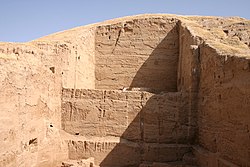
A tell does not begin as a mound; it starts as a flat site. The transformation into a tell requires a critical period of continuous reoccupation. As people build houses—often using mudbricks—and then abandon or rebuild them, the debris remains. Over generations, the nucleation of households and the accumulation of house daub (plaster) and refuse cause the ground level to rise.
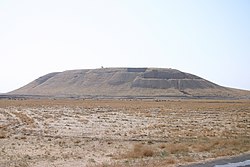
The resulting structure typically resembles a low, truncated cone with sloping sides and a flat, mesa-like top. This process is only possible in specific environments where the rate of deposition exceeds the rate of erosion or human truncation.
Regional Occurrences
Southwest Asia
The Southern Levant contains over 5,000 detected tells across Israel, Palestine, and Jordan. One of the earliest known examples is Tell es-Sultan (Jericho) in the West Bank, featuring a 10-meter-high mound dating to the proto-Neolithic period. In Syria, tells are abundant in Upper Mesopotamia along the Euphrates river, including sites like Tell Bazi and Tell Banat—the latter of which is believed to house the "White Monument," one of the oldest war memorials from the 3rd millennium BCE.
Europe
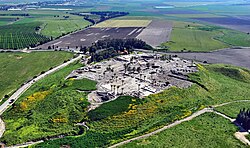
In Europe, tells are found in countries such as Romania, Bulgaria, North Macedonia, Spain, and Hungary. Northeastern Bulgaria is particularly noted for its Eneolithic tells (4900–3800 BCE). In Neolithic Greece, tells are found in the northern Thessalian plain (known locally as Magoulas) and Macedonia (known as Toumbas).
Archaeologists have proposed different models for these European sites. John Chapman suggests they represent nucleated communal societies, while Paul Halstead argues they arose from individual household structures. Thessalian tells typically reflect small hamlets with populations between 40 and 80 people.
Summary of Tell Characteristics
| Feature | Near East / Southwest Asia | Europe (Greece/Bulgaria) |
|---|---|---|
| Common Local Names | Tell, Tel, Tepe, Chogha | Toumbas, Magoulas |
| Primary Materials | Mudbrick, organic refuse, sediment | House daub, cultural debris |
| Key Time Periods | Neolithic to Iron Age (ending with Hellenistic period in Levant) | Neolithic and Eneolithic (5th millennium BCE) |
| Typical Scale | Up to 43m+ height; large bases (e.g., 37 hectares) | Often smaller hamlets (40–80 people) |
Frequently Asked Questions
What is the difference between a tell and a natural hill?
A tell is an artificial mound created by human activity—specifically the accumulation of debris from successive settlements—whereas a natural hill is formed by geological processes.
Why are tells more common in the Near East?
Tells occur in regions where continuous settlement patterns and specific building materials (like mudbrick) allowed debris to accumulate faster than it could be eroded, particularly in the less arid regions of Mesopotamia, Anatolia, and the Levant.
When did tell formation end in the Southern Levant?
The era of tell formation in the Southern Levant generally ended with the conquest by Alexander the Great, which introduced the Hellenistic period and different patterns of settlement building.
What materials make up a tell?
Tells are composed of a mix of organic and cultural refuse, collapsed mudbricks, water-laid sediments, aeolian (wind-blown) sediment, and residues from geochemical processes.
Are tells still used today?
Yes, many tells across the Near East continue to be occupied or utilized in the modern era.