Teck Cominco Smelter: A History of Industrial Power and Environmental Law
Located in Trail, British Columbia, the Teck Cominco smelter stands as one of the world's largest facilities for lead and zinc smelting. For over a century, it has served as the economic and cultural heartbeat of the community, providing high-paying industrial employment for generations of residents. Today, it remains the largest employer in Trail, supporting 1,400 jobs in a town of approximately 7,800 people.
The facility's legacy is a complex blend of pioneering industrial achievement and landmark legal battles that have shaped how the world handles transnational pollution.
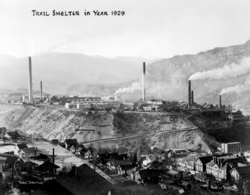
The Early Years and Industrial Expansion
The story of the smelter began in February 1896, when Fritz Augustus Heinze established the British Columbia Smelting and Refining Company. The plant was designed to process ore transported from Rossland via the Columbia and Western Railway. While initial capacity grew from 150 to 400 tons per day, the operation struggled with profitability and produced low-grade copper (50% purity). Furthermore, the release of sulfur dioxide created hazardous yellow clouds of smoke that plagued the region.
A turning point occurred in February 1898, when the Canadian Pacific Railway (CP) purchased the railway and the smelter for a combined $800,000. Under the new entity, Canadian Smelting Works, the plant benefited from cheap coal via the Crowsnest Pass branch and electricity from the Bonnington Falls dam. Efficiency improved with the installation of new blast furnaces and taller chimneys designed to disperse toxic smoke higher into the atmosphere.
Technological Breakthroughs
By 1901, the facility had expanded to include two lead furnaces. In 1902, Trail achieved a global milestone by opening the world's first commercial electrolytic refining process—a method using electrical current to purify metals. This allowed the plant to produce high-purity lead, copper, gold, and silver on-site.
In 1906, the Consolidated Mining and Smelting Company of Canada (CM&S) was formed as a consortium of the smelter and Red Mountain mines, with CP holding a 54% stake. By 1925, the plant had grown to 250 acres, employing 2,100 men and operating a diverse array of refineries and chemical plants, including facilities for sulfuric acid and bluestone (Copper(II) sulfate).
Key Facts
- Global Scale: One of the largest lead and zinc smelters in the world.
- Economic Impact: Employs 1,400 people in a town of 7,800.
- Innovation: Established the first commercial electrolytic refining process in 1902.
- Legal Legacy: The Trail Smelter arbitration helped establish the "polluter pays" principle.
- Environmental Action: Ongoing soil remediation programs for residential yards in Trail.
Environmental Impact and Legal Landmarks
The industrial success of the smelter came with a heavy environmental cost. By the end of World War I, smoke pollution had devastated the surrounding district. This led to the Trail Smelter arbitration (1938–1942), a landmark case in international environmental law. The arbitration established that no state has the right to use its territory in a manner that causes injury by fumes in or to the territory of another.
In 1966, the company rebranded as Cominco. Despite investing millions in pollution control, 1975 tests revealed that soils in parts of Trail were contaminated with heavy metals, including arsenic, cadmium, zinc, and lead, exceeding regulatory limits. While lead levels in local children's blood were high in 1975, they dropped to insignificant levels 30 years later.
Modern Remediation and Litigation
To address legacy contamination—which the company attributes to activities prior to the adoption of new technologies in 1997—a free testing and topsoil removal program was launched in 2007, prioritizing families with young children.
However, legal challenges continued regarding the smelter's impact on the United States. Located 16 km north of the border, the facility discharged an estimated 10 to 20 million tons of byproducts containing mercury, arsenic, and lead into the Columbia River and Franklin D. Roosevelt Lake. This resulted in a citizen lawsuit under the Comprehensive Environmental Response, Compensation, and Liability Act (CERCLA). In 2018 and 2019, the U.S. Supreme Court rejected appeals from Teck Metals, ruling in favor of the litigants, including the Confederated Tribes of the Colville Reservation.
Smelter Production and Scale (1925)
| Material | Amount Processed/Recovered |
|---|---|
| Total Ores and Concentrates | 380,000 tons |
| Lead | 117,500 tons |
| Zinc | Almost 50,000 tons |
| Copper | 9,500 tons |
| Silver | Nearly 4.5 million ounces |
| Gold | 21,352 ounces |
Frequently Asked Questions
What is the "polluter pays" principle?
Established in part by the Trail Smelter arbitration, this principle asserts that those who produce pollution should bear the costs of managing it to prevent damage to human health or the environment.
What was the significance of the 1902 refining process?
Trail opened the first commercial electrolytic refining process in the world, which allowed the facility to produce pure lead, copper, gold, and silver without needing to send concentrates to the United States for refining.
How has the company addressed soil contamination in Trail?
Since 2007, Teck has funded a free testing program and the removal of contaminated topsoil from residential yards, specifically focusing on households with young children.
What was the outcome of the Pakootas v. Teck Cominco Metals case?
The U.S. Supreme Court rejected Teck's appeals in 2018 and 2019, finding in favor of the litigants regarding the discharge of smelting byproducts into the Columbia River and Franklin D. Roosevelt Lake.
What can visitors see at the Teck Cominco Interpretive Centre?
The centre offers a history of the smelting operations through displays, a mini-science centre, videos, and hands-on exhibits, as well as a 2.5-hour industrial tour of the smelter.