Tangut Script: The Complex Logographic Legacy of the Western Xia Dynasty
The Tangut script is a sophisticated logographic writing system—a method where characters represent words or morphemes rather than individual sounds—that once served the extinct Tangut language. Developed during the height of the Western Xia dynasty, this script is a testament to the cultural and intellectual ambitions of a civilization that flourished in Central Asia before falling into obscurity.
While the script bears a striking visual resemblance to Chinese characters, its internal logic and construction methods are profoundly different. Today, the study of Tangut remains a vital field for historians and linguists seeking to reconstruct the lost history of the Tanguts.
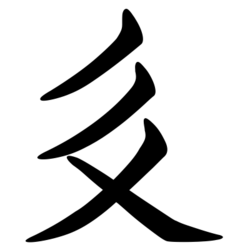
Key Facts
- Creator: Designed by the high-ranking official Yeli Renrong in 1036.
- Script Type: Logographic (constructed script inspired by Chinese).
- Character Count: Approximately 5,863 known characters.
- Historical Period: Used from 1036 until the dynasty's collapse, with usage continuing until at least 1502.
- Writing Direction: Traditionally vertical right-to-left (though modern academia often treats it left-to-right).
The History of the Tangut Script
According to the History of Song (1346), the script was commissioned by Yeli Renrong and implemented with remarkable speed. Once established, the Tangut government integrated the script into the very fabric of society. Government schools were founded specifically to teach the writing system, and it became the standard for official state documents. In diplomatic contexts, bilingual documents were often used to facilitate communication with neighboring powers.
Beyond administration, the script played a massive role in religious life. A vast number of Buddhist scriptures were translated from Tibetan and Chinese into Tangut and subsequently produced via block printing. Although the Western Xia dynasty collapsed in 1227, the script did not vanish immediately. It survived for several more centuries, with the last known recorded use appearing on Tangut dharani pillars in Baoding, Hebei province, erected in 1502.
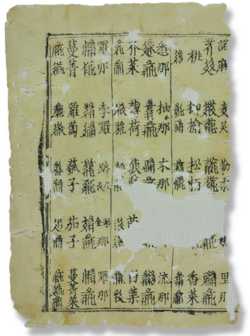
Structural Complexity and Character Formation
The Tangut script is noted for its immense complexity. Unlike Chinese, which includes many pictographic characters (symbols that resemble the object they represent), no Tangut characters are purely pictographic. Instead, the system relies on a massive collection of nearly 5,800 characters that are generally more intricate than their Chinese counterparts. While some simple characters exist, most are composed of many strokes—often reaching nearly twenty per character.
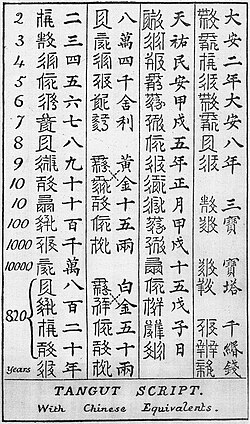
Simple vs. Composite Characters
Tangut characters are categorized into two primary classes:
- Simple characters: These can be either semantic (conveying meaning) or phonetic (conveying sound).
- Composite characters: These are far more numerous and are formed by combining two, three, or even four components.
Composite characters can be semantic-semantic (combining two meanings) or semantic-phonetic (combining a meaning with a sound component). Interestingly, some special composite characters were specifically engineered to transliterate foreign terms from Chinese and Sanskrit.
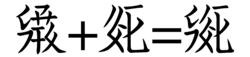
The Logic of Components
One of the most unique aspects of Tangut is how components function. In Chinese, a component typically retains a consistent meaning or sound. In Tangut, however, a component's role can shift. The 12th-century rhyming dictionary, The Sea of Characters (wen hai), reveals that a single component might contribute the meaning or sound of a different character entirely depending on its context.
For example, a specific component might represent "bird" in one character, but convey meanings like "bone," "smoke," "food," or "time" in others. Furthermore, some components change their physical shape depending on whether they are positioned on the left, right, middle, or bottom of a character.
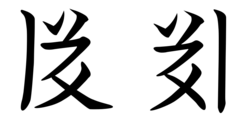
Digital Preservation: Unicode and Modern Study
In the modern era, the Tangut script has been preserved through digital encoding. Since the release of Unicode 9.0 in 2016, thousands of Tangut characters and components have been added to the Unicode Standard. This includes specific blocks for Tangut characters, Tangut components, and Tangut supplements, ensuring that this ancient writing system can be studied and utilized in the digital age.
Summary of Tangut Script Specifications
| Feature | Details |
|---|---|
| ISO 15924 Code | Tang (520) |
| Unicode Range | U+17000–U+187FF (plus supplements) |
| Primary Language | Tangut (extinct) |
| Script Style | Logographic |
| Key Historical Text | The Sea of Characters (12th Century) |
Frequently Asked Questions
Is the Tangut script similar to Chinese?
Visually, they are similar because they use similar stroke types. However, the methods of character formation are significantly different; Tangut lacks pictographic characters and features much higher structural complexity.
How many Tangut characters exist?
As of a 2004 count, there are approximately 5,863 known Tangut characters, excluding variants.
Who invented the Tangut script?
The script was designed by Yeli Renrong, a high-ranking official, in the year 1036.
When did the use of the script end?
While the Western Xia dynasty fell in 1227, the script continued to be used for several centuries. The last known example is from 1502.
What is the "Sea of Characters"?
The Sea of Characters is a 12th-century monolingual Tangut rhyming dictionary that analyzes how characters are derived from one another.