Language Families: Mapping the Genetic Relationships of Human Speech
Every time we speak, we are participating in a lineage that stretches back thousands of years. In the field of historical linguistics, researchers group related languages into language families. Much like a biological family tree, these groupings represent languages that have descended from a single, common ancestor known as a proto-language.
The process of divergence typically occurs through geographical separation. As groups of people move apart, their regional dialects undergo different changes over time. Eventually, these distinct variations become entirely separate languages, yet they remain genetically related through their shared origin.
Key Facts
- A language family is a group of languages descended from a common proto-language.
- The Indo-European family is one of the most well-known, including the Romance languages.
- Language isolates are unique languages that have no known relatives.
- The five largest language families by speaker count account for nearly 83.3% of the world's population.
- Linguists use the comparative method to reconstruct lost proto-languages.
The Structure of Linguistic Lineage
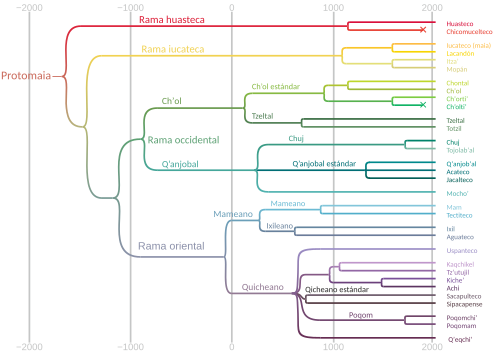
Linguists often use a tree model to visualize these relationships, a concept analogous to phylogenetic trees used in evolutionary biology. Within a large family, languages can be organized into smaller phylogenetic units called subfamilies or branches. For example, the Germanic languages form a subfamily within the broader Indo-European family.
Subfamilies are often identified through shared innovations—specific linguistic features that members of a subfamily share, which were not present in the original, larger proto-language. While some researchers use terms like phylum or stock to describe the largest, top-level families, others use macrofamily or superfamily to suggest groupings that are not yet fully substantiated by standard linguistic methods.
Genetic vs. Genealogical Relationships
When linguists say languages are genetically related, they are referring to a genealogical descent. This means one language evolved from another, or both descended from a common ancestor. To avoid confusion with biological genetics, some scholars prefer the term genealogical relationship.
Major Language Families and Global Distribution
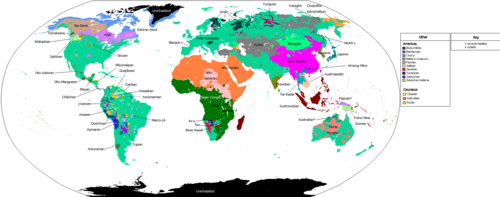
Estimates of the world's linguistic diversity vary. According to Ethnologue, there are approximately 7,151 living languages across 142 families. However, other researchers, such as Lyle Campbell, have identified as many as 406 independent families, including isolates. Because the definition of a "language" versus a "dialect" can be subjective, counts often differ between major linguistic databases.
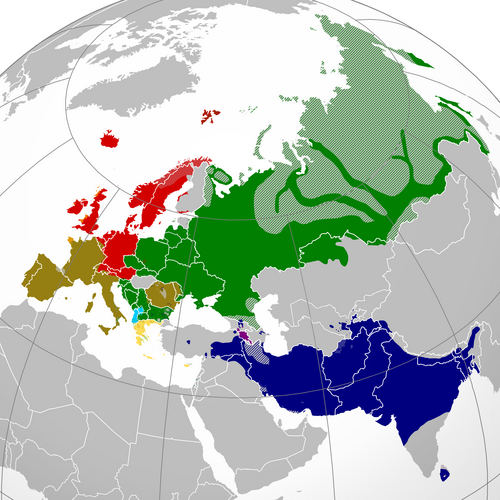
The distribution of these families is vast. While the Indo-European family is prominent in Europe and South Asia, other massive families like the Austronesian family contain over 1,000 languages. Notably, the five largest families—Indo-European, Sino-Tibetan, Afro-Asiatic, Niger-Congo, and Austronesian—represent the vast majority of the global population.
| Language Family | Ethnologue 27 Count | Glottolog 5.3 Count |
|---|---|---|
| Niger–Congo | 1,552 | - |
| Austronesian | 1,256 | 1,276 |
| Indo-European | 454 | 586 |
| Sino-Tibetan | 458 | 519 |
| Afroasiatic | 382 | 381 |
| Trans–New Guinea | 481 | 317 |
Exceptions to the Model: Isolates and Contact Languages
Not all languages fit neatly into a branching tree. Language isolates are languages that cannot be proven to be related to any other known language. Because they stand alone, an isolate is essentially a language family consisting of just one member. A famous example is Basque. It is often assumed that isolates once had relatives, but the time depth is too great for modern linguistic methods to recover them.
Other complexities include:
- Mixed languages, pidgins, and creoles: These do not descend linearly from a single ancestor.
- Sprachbund: A geographic area where languages share similar structures due to contact rather than common origin (e.g., the Indian subcontinent).
Reconstructing the Past: The Comparative Method
Since most proto-languages were spoken before the invention of writing, we have no direct written records of them. To understand these ancient tongues, linguists use the comparative method. This reconstructive procedure allows researchers to compare modern descendant languages to deduce the features of their common ancestor. This is how we know that the Romance languages—such as Spanish, French, and Italian—all descended from Vulgar Latin.
Frequently Asked Questions
What is a proto-language?
A proto-language is the hypothetical, common ancestor of a language family. It is the "mother language" from which all daughter languages in that family stem.
How do linguists prove languages are related?
Linguists use the comparative method to analyze similarities in language structure and vocabulary, allowing them to establish genetic or genealogical relationships even when no written records exist.
What is the difference between a language family and a sprachbund?
A language family is based on shared ancestry (genetic relationship), whereas a sprachbund refers to languages that have become similar because they are spoken in the same geographic area and have influenced one another through contact.
Are sign languages included in these counts?
Most major linguistic databases, such as Ethnologue and Glottolog, do not list sign language families. However, the Francosign family is noted as one of the largest, containing around 70 languages.
Why do different sources list different numbers of languages?
Discrepancies arise because linguists often disagree on whether certain speech varieties are distinct languages or merely dialects of a single language.