Unlocking the History of Words: A Guide to Etymology
Have you ever wondered why the word "candid" sounds so much like "candle," or how the word "bless" might be connected to "blood"? The answers lie in etymology—the scientific study of the origin and evolution of words. By examining the constituent units of sound and meaning across time, etymologists reconstruct a chronological catalogue of how language shifts, grows, and transforms.
In the 21st century, etymology has evolved from simple word histories into a rigorous scientific subfield of linguistics. It sits at the intersection of several disciplines, including historical linguistics (the study of language change over time), philology (the study of language in historical sources), and semiotics (the study of signs and symbols). To build a complete picture of a word's journey, researchers also draw upon morphology (word structure), phonetics (speech sounds), and semantics (meaning).
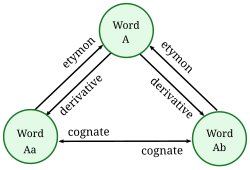
Key Facts
- Etymology is derived from the Ancient Greek etymon (true sense) and logia (the study of).
- An etymon is the original stem or root from which a later word is derived.
- Cognates are words in different languages that share a common ancestor.
- Modern etymology relies heavily on the comparative method to reconstruct lost ancient languages.
- The study of Sanskrit provided the foundational basis for Western historical linguistics.
Foundational Concepts: Roots, Etymons, and Derivatives
To understand etymology, one must first master its specific vocabulary. While many terms are used interchangeably in casual conversation, they have distinct meanings in linguistic study.
Etymon vs. Root
An etymon is the predicate or stem from which a later word or morpheme derives. For instance, the Latin word candidus (meaning "white") serves as the etymon for the English word "candid." In contrast, a root is typically defined as the source of related words within a single language, without crossing a language barrier.
Derivatives and Cognates
When a word is created from a root using morphological constructs—such as adding prefixes (at the beginning) or suffixes (at the end)—it is called a derivative. For example, "unhappy," "happily," and "unhappily" are all derivatives of the root word "happy."
When looking across different languages, we encounter cognates. These are sets of words inherited in direct descent from a common parent language. A more specific type of cognate found within the same language is a doublet (or "etymological twin"). Doublets share the same etymological root but have different sounds or entered the language through different routes.
| Term | Definition | Example |
|---|---|---|
| Etymon | The original stem or ancestor of a word. | Latin candidus $\rightarrow$ English "candid" |
| Derivative | A word formed from a root using prefixes/suffixes. | "Happy" $\rightarrow$ "Unhappily" |
| Cognate | Words in different languages from a common ancestor. | Words from the Indo-European family |
| Doublet | Cognates within the same language with different forms. | Words sharing a root but via different routes |
How Etymologists Work: Methods and Mechanisms
Etymologists use several sophisticated methods to trace the lineage of words, especially when direct evidence is missing.
Research Methodologies
- Philological Research: Using ancient texts to observe how words were used and how their forms changed in the past.
- Dialectological Data: Analyzing variations between different dialects to find clues about a word's history.
- The Comparative Method: Systematically comparing related languages to distinguish between words inherited from a common ancestor and those that were borrowed from neighbors.
- Semantic Change Analysis: Hypothesizing how meanings shift over time and testing those theories against known patterns of linguistic evolution.
How New Words Are Born
Words generally originate through a few primary mechanisms:
- Language Change: Natural evolution of sounds and meanings.
- Borrowing: Adopting loanwords from other languages.
- Word Formation: Processes like derivation (adding affixes) and compounding (joining two words).
- Onomatopoeia: Creating words that imitate sounds, such as "click" or "grunt."
It is important to note that over time, these origins can become obscured. For example, the English word "set" is related to "sit," but the connection is no longer obvious due to sound changes. Similarly, "bless" was originally a derivative meaning "to mark with blood," linking it to the word "blood."
A Brief History of Etymological Study
The search for word origins is ancient, though it has changed significantly in its approach. In antiquity, etymology was often used for witty wordplay or even flattery. The Greek poet Pindar used inventive etymologies to honor patrons, and the 13th-century Golden Legend used fanciful etymologies to begin stories of saints.
Ancient Contributions
The roots of systematic linguistics can be found in ancient India. Sanskrit linguists and grammarians, such as Yāska and Pāṇini, performed comprehensive analyses that later provided the basis for modern Western historical linguistics. In the Greco-Roman tradition, Plato’s dialogue Cratylus explored the origins of words, including the names of gods.
The Islamic Golden Age
Between the 8th and 14th centuries, scholars in the Islamic world laid vital foundations for systematic etymology in Arabic. Al-Khalīl ibn Aḥmad al-Farāhīdī compiled the first Arabic dictionary, organizing entries by root and phonetic properties. Later, Ibn Fāris applied isytiqq (derivation analysis) to trace multi-letter words back to their core roots.
The Modern Era
Modern etymology emerged during the 18th-century Age of Enlightenment. A major turning point occurred in 1782 when William Jones observed the genetic relationship between Greek and Latin, laying the groundwork for Indo-European studies. In the 19th century, the field was further elevated by Rasmus Rask and the Brothers Grimm, whose work on the German language set high standards for Germanic philology.
Frequently Asked Questions
What is the difference between a root and an etymon?
While often used similarly, an etymon refers to the original stem from which a word is derived (often across different languages), whereas a root is the source of related words within a single language.
What are cognates?
Cognates are words in different languages that descended from the same ancestor in a common parent language. For example, many European languages share roots that can be traced back to the Indo-European language family.
Why do some word origins seem so confusing?
Origins often become obscured over centuries due to sound change (how words are pronounced) and semantic change (how the meaning of a word shifts). This can make it difficult to see the connection between words that were once clearly related.
Can etymology be used for things other than linguistics?
Yes. In the 20th century, philosophers like Friedrich Nietzsche and Jacques Derrida used etymological strategies to argue that moral values and philosophical hierarchies have historical origins and changing meanings.
What is the "comparative method"?
The comparative method is a technique where linguists systematically compare related languages to reconstruct information about ancient forms that are too old to have direct written records.