Tadpoles: The Fascinating Larval Stage of Amphibians
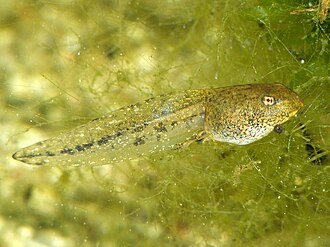
A tadpole, also known as a polliwog or porwigle, represents the larval stage in the biological life cycle of an amphibian. While most are fully aquatic, some species have adapted to terrestrial environments. These creatures possess distinct fish-like features—such as gills, swimming tails, and a lateral line (a sensory organ used to detect movement in water)—that are typically absent in their adult forms.
The journey from a tadpole to an adult is marked by metamorphosis, a profound biological transformation where the organism develops functional lungs for breathing air and undergoes a drastic change in diet.
Key Facts
- Diverse Development: While most amphibians have a free-living larval stage, some (like the Brevicipitidae family) undergo direct development, emerging from eggs as miniature adults called "froglets."
- Dietary Shifts: Frog tadpoles are primarily herbivorous, whereas salamander and caecilian tadpoles are carnivorous.
- Anatomical Changes: During metamorphosis, the tail is absorbed via apoptosis (programmed cell death), and limbs grow, with hind legs appearing before front legs.
- Ancient History: Despite lacking hard skeletons, tadpole fossils dating back to the Middle Jurassic have been discovered.
Etymology and Origins
The terminology used to describe these larvae is rooted in Middle English. The word "tadpole" derives from taddepol, combining tadde (toad) and pol (head). Similarly, "polliwog" and "porwigle" come from polwygle, blending pol (head) with wiglen (to wiggle).
Anatomy and Biology of Anuran Tadpoles
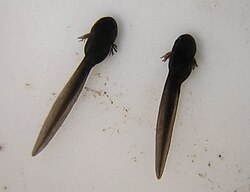
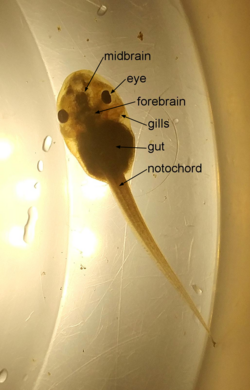
Tadpoles of frogs and toads (Anura) generally have globular bodies and laterally compressed tails used for swimming via lateral undulation. Upon hatching, they possess external gills that are eventually covered by skin, creating an opercular chamber with internal gills vented by spiracles (small respiratory openings). Depending on the species, these spiracles may be located on both sides of the body, on the underside near the vent, or solely on the left side.
Newly hatched tadpoles utilize a cement gland to attach themselves to objects. Their internal structure consists of a cartilaginous skeleton and a notochord, which eventually evolves into a spinal cord.
Diet and Digestion
Most anuran tadpoles are herbivorous, consuming soft decaying plant matter. To process this organic material, they possess long, spiral-shaped guts that are often visible through their translucent bellies. However, there are notable exceptions:
- Carnivores: The Ceratophryidae family features cannibalistic tadpoles with wide mouths. The New Mexico spadefoot toad (Spea multiplicata) can switch to a carnivorous diet, developing larger jaw muscles and a shorter gut if food is scarce.
- Filter Feeders: Genera such as Pipidae and Microhylidae feed on plankton.
- Surface Feeders: Megophrys tadpoles use unique funnel-shaped mouths to feed at the water's surface.
The Process of Metamorphosis
As a tadpole matures, it undergoes a series of dramatic physical changes. Lungs develop as the legs begin to grow, prompting the tadpole to swim to the surface to gulp air. The mouth transforms from a small, enclosed opening into a wide gap spanning the width of the head. Simultaneously, the intestines shorten to accommodate a transition from a plant-based diet to the carnivorous diet of the adult frog.

Environmental Adaptations and Parental Care
While most tadpoles inhabit slow-moving waters like ponds and vernal pools, some have evolved for specialized niches. The Ranixalidae family lives in wet crevices, while Micrixalus herrei is fossorial (adapted for digging), featuring reduced pigment and skin-covered eyes. Some species, such as the Indian purple frog and Western North American tailed frogs, possess strong oral suckers to cling to rocks in fast-flowing streams.
Parental care varies wildly across species:
- Protective Nesting: Afrixalus frogs fold leaves around eggs, and male Emei mustache toads build riverbank nests, sometimes losing 7.3% of their body mass while guarding them.
- Physical Transport: Male midwife toads carry eggs between their legs, and poison dart frogs transport tadpoles to phytotelma (small water-filled cavities in plants).
- Internal/External Brooding: Female Pipa frogs embed eggs in their backs, and marsupial frogs (Hemiphractidae) may carry tadpoles in a pouch until they become froglets.
Fossil Record and Human Interaction
Tadpole fossils are rare due to their soft bodies, but some have been preserved via biofilms (layers of microorganisms). Carbon films have preserved jaws and bones in Upper Miocene strata from Spain, where brain cases were preserved in calcium carbonate. The oldest confirmed fossil is Notobatrachus deguistioi from the Middle Jurassic.
Humans have interacted with tadpoles through cuisine and culture. In China, the large tadpoles of Oreolalax rhodostigmatus are eaten, and in Peru, Telmatobius mayoloi tadpoles are used for food and medicine. Historically, Ancient Egyptians used a tadpole hieroglyph to represent the number 100,000, and the Wa people of China and Myanmar feature tadpoles in their origin myths.
| Feature | Typical Anuran Tadpole | Specialized Tadpoles |
|---|---|---|
| Diet | Herbivorous (decaying plants) | Carnivorous or Filter-feeding |
| Habitat | Still/Slow water (ponds) | Fossorial, Terrestrial, or Fast streams |
| Respiration | Gills $\rightarrow$ Lungs | Varies by species |
| Skeleton | Cartilaginous/Notochord | Cartilaginous/Notochord |
Frequently Asked Questions
Do all amphibians have a tadpole stage?
No. Some amphibians, such as certain members of the Brevicipitidae family, undergo direct development, meaning they skip the free-living tadpole stage and hatch as fully formed froglets.
How do tadpoles breathe?
Initially, tadpoles use external gills, which are later covered by skin to form an opercular chamber with internal gills. As they undergo metamorphosis, they develop lungs to breathe air.
What is the difference between a tadpole and a polliwog?
There is no biological difference; "polliwog" and "porwigle" are simply alternative names for a tadpole, derived from similar Middle English roots meaning "wiggly head."
Can tadpoles live in salt water?
While there are no truly marine tadpoles, some species, such as the crab-eating frog, are capable of coping with brackish water.
How does a tadpole's diet change?
Most frog tadpoles start as herbivores with long, spiral guts to digest plants. During metamorphosis, their guts shorten as they transition to the carnivorous diet of adult frogs.