Caterpillars: Biology, Defenses, and Ecological Impact
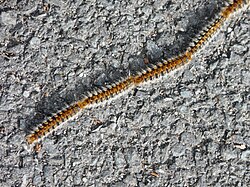
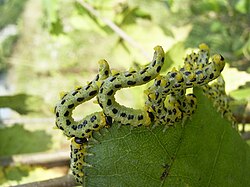
Caterpillars are the larval stage of insects belonging to the order Lepidoptera, which encompasses all butterflies and moths. While the term is most scientifically applied to these insects, it is commonly used in everyday speech to describe any caterpillar-shaped larva, including those of the sawfly. These creatures are primarily known for their voracious appetites and their dramatic transformation into winged adults.
Most caterpillars feed on plant material, particularly leaves, though dietary habits vary across species. Approximately 1% are insectivores, and some exhibit cannibalistic behavior. Specialized feeders exist as well; for instance, clothes moths consume wool, while horn moths feed on the horns and hooves of dead ungulates.

Key Facts
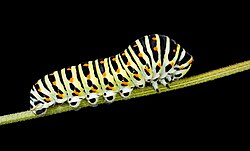
- Classification: Larval stage of Lepidoptera (butterflies and moths).
- Diet: Predominantly herbivorous, though some are carnivorous or scavengers.
- Size: Ranges from 1 millimeter to 14 centimeters.
- Anatomy: Distinguished from sawflies by having a maximum of 5 pairs of prolegs and a frontal suture (inverted Y or V shape) on the head.
- Economic Role: Both significant agricultural pests and valuable sources of silk.
Anatomy and Identification
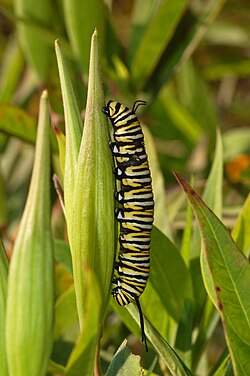
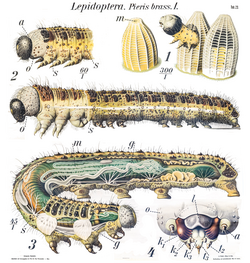
Caterpillars possess soft bodies that allow for rapid growth between moults (the process of shedding the exoskeleton). Their physical characteristics can often be confused with larvae from the order Hymenoptera, specifically sawflies. However, experts use several key markers to differentiate true Lepidopteran caterpillars from sawfly larvae.
Distinguishing Features
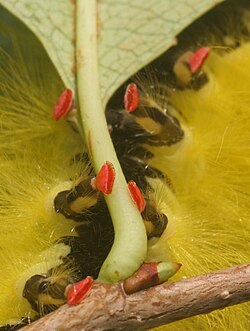
- Prolegs: Caterpillars have a maximum of five pairs of prolegs, whereas sawfly larvae have six or more. Additionally, caterpillars possess crochets (tiny hooks) on their prolegs, which sawflies lack.
- Eyes: Caterpillars typically have twelve stemmata (simple eyes), six on each side of the head, while sawfly larvae have only two ocelli.
- Head Structure: The head capsule of a caterpillar features a frontal suture in the shape of an inverted "Y" or "V," whereas sawfly larvae have smooth head capsules.
Evolutionary History and Fossils
The evolutionary record of caterpillars is preserved in amber. A notable find in 2019 revealed a geometrid moth caterpillar, Eogeometer vadens, preserved in Baltic amber dating back to the Eocene epoch, approximately 44 million years ago. Even older evidence exists, with fossils found in Lebanese amber dating back roughly 125 million years.
![Eogeometer vadens, the earliest known geometrid moth caterpillar found in Baltic amber[8][9][10]](/images/3d/ab/3dab6a3d2d3efc96ddfb2ff562232d6c54146010f75121f5bf0b7f53eae18ab2.jpg)
Defense Mechanisms
Because they are rich in protein, caterpillars are primary targets for many predators, such as the European pied flycatcher and paper wasps. To survive, they have evolved a sophisticated array of defenses.
Chemical and Physical Defenses
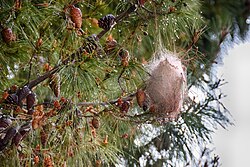
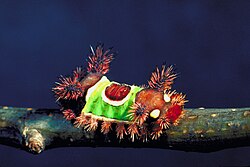
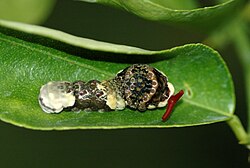
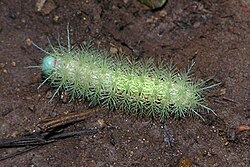
Some species employ chemical warfare, regurgitating acidic digestive juices or emitting foul odors from specialized glands called osmeteria. Others use physical deterrents; for example, the saddleback caterpillar utilizes aposematic coloring (warning colors) and urticating hairs to warn predators of its toxicity.
Behavioral Strategies
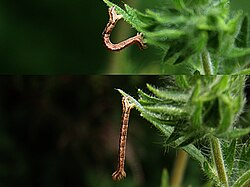
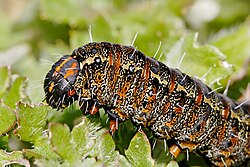
Many caterpillars hide by mining between leaf surfaces, rolling leaves, or living in silk galleries. Some exhibit active defenses, such as thrashing violently, dropping from branches via silk lines, or producing high-pitched whistles, as seen in Amorpha juglandis. Certain species, like those of Lycaenid butterflies, form symbiotic relationships with ants, providing food rewards in exchange for protection.
Economic and Health Impacts
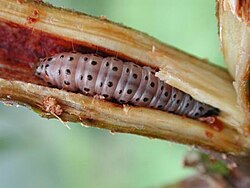
Caterpillars have a dual relationship with humans. Industrially, the silkworm is the foundation of the global silk industry. However, many species are devastating agricultural pests, causing significant damage to fruits and timber, such as Hypsipyla grandela in Brazilian mahogany forests.
Risks to Human Health
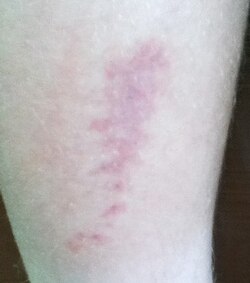
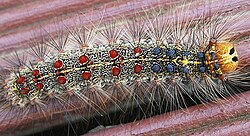
Contact with certain caterpillar hairs can lead to serious medical conditions. Venoms in the hairs of species from about 12 different families can cause urticarial dermatitis, asthma, and in severe cases, kidney failure or brain bleeding. In Brazil, the Lonomia genus is a known cause of envenomation, with lethality rates reaching up to 20% due to intracranial hemorrhage.
Summary of Caterpillar Characteristics
| Feature | Lepidopteran Caterpillar | Sawfly Larva |
|---|---|---|
| Proleg Pairs | Maximum 5 pairs | 6 or more pairs |
| Crochets (Hooks) | Present | Absent |
| Stemmata (Simple Eyes) | Usually 12 (6 per side) | 2 |
| Frontal Suture | Inverted "Y" or "V" shape | Smooth head capsule |
Frequently Asked Questions
![William Blake's illustration of a caterpillar overlooking a child from his illustrated book For Children The Gates of Paradise.[36]](/images/de/da/deda230d5507aaab0595bac717bec24c6f68159693c890a26e7103b740792ca8.jpg)
Are all caterpillar-like larvae actually caterpillars?
No. While many larvae look similar, only those in the order Lepidoptera are true caterpillars. Sawfly larvae, for example, superficially resemble caterpillars but have different proleg counts and head structures.
How do caterpillars protect themselves from predators?
They use a variety of methods including chemical secretions (osmeteria), warning colors, stinging hairs, camouflage, and symbiotic relationships with ants.
Can caterpillars be dangerous to humans?
Yes. Some species possess venomous hairs that can cause skin rashes, respiratory issues, and in extreme cases (such as the Lonomia species), fatal internal bleeding.
What is the economic importance of caterpillars?
They are economically significant both as pests that destroy agricultural crops and as beneficial insects, most notably the silkworm used in silk production.
How old are the oldest known caterpillar fossils?
While a geometrid moth caterpillar in Baltic amber is about 44 million years old, other fossils found in Lebanese amber date back approximately 125 million years.