Superb Lyrebird: The Master Mimic of the Australian Forest
Deep within the forests of southeastern Australia lives one of the most extraordinary avian performers on Earth: the superb lyrebird (Menura novaehollandiae). A member of the family Menuridae, this large passerine—a perching songbird—is world-renowned for its sophisticated vocal abilities and an ornate tail that gives the bird its name. Described by David Attenborough as possessing some of the most complex and beautiful voice skills in the animal kingdom, the superb lyrebird is as much an ecological powerhouse as it is a musical virtuoso.
Key Facts
- Status: Evaluated as Least Concern by the IUCN.
- Specialty: Capable of mimicking other bird species, marsupials, and anthropogenic (human-made) sounds.
- Role: Acts as an ecosystem engineer by disturbing forest soil.
- Distribution: Endemic to southeastern Australia, including a thriving introduced population in southern Tasmania.
- Physicality: One of the world's largest songbirds, with males reaching up to 1 meter in length.
Taxonomy and Origins
The superb lyrebird's scientific name, Menura novaehollandiae, reflects both its appearance and its origin. The genus name Menura is derived from the Ancient Greek words mēnē (moon) and ourá (tail), referring to the transparent lunules (moon-shaped spots) on the outer tail feathers. The specific epithet novaehollandiae comes from the Modern Latin for "New Holland," an early Dutch name for Western Australia.
While Major-General Thomas Davies first described the bird as Menura superba in 1800, the name provided by John Latham in 1801 took priority. These birds are ancient inhabitants of the continent; fossils found at the Riversleigh site indicate that their ancestor, Menura tyawanoides, existed during the early Miocene, roughly 15 million years ago.
Physical Characteristics
The superb lyrebird is a pheasant-sized terrestrial bird. Males are larger, reaching up to 1 meter (39 in) and weighing approximately 1.1 kg (2.4 lb), while females are slightly smaller at 860 mm (34 in) and 0.9 kg (2.0 lb). Their plumage is primarily dark brown on the upper body with greyish-brown underparts and red-tinged flight feathers.
Because they are primarily ground-dwelling, their wings are short and rounded, suited for balance or gliding rather than sustained flight. However, their legs are powerful, allowing them to run quickly and move forest debris—including branches up to 10 cm in diameter—with their strong feet.
The Ornate Tail
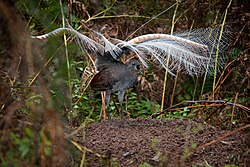
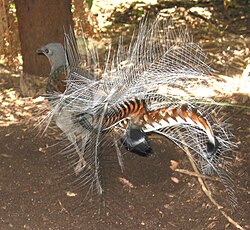
The male's tail is a marvel of nature, reaching up to 70 cm (28 in) and consisting of sixteen feathers. This includes two broad, S-shaped "lyrates" that resemble a lyre, twelve silvery filamentaries (flexible barbs), and two silvery median feathers. Females possess a less ornate tail with shorter lyrates and plain feathers. Juveniles lack these ornaments entirely, developing them through annual moults; males reach maturity in 7–9 years, and females in 6–7 years.
Behavior and Ecology
Superb lyrebirds are generally solitary and territorial. They are not highly mobile and often spend their entire lives within a small area. Their diet consists mainly of invertebrates, such as insects and earthworms, though they are also mycophagists, meaning they consume fungi.
The Ecosystem Engineer
Beyond their songs, lyrebirds play a critical role in forest health. By foraging for food, a single bird can move and bury up to 200 tonnes of leaf litter and soil per hectare annually. This massive soil disturbance accelerates the decomposition of organic matter and increases nutrient cycling. Furthermore, by creating bare patches on the forest floor, they reduce the amount of fuel available for wildfires, potentially lowering the intensity of forest fires.
Vocal Mimicry and Courtship
The most famous trait of the superb lyrebird is its ability to imitate almost any sound it hears. An estimated 70–80% of a male's vocalizations are imitations of other species. This mimicry is so precise that the model species—such as the shrike-thrush—often cannot distinguish the imitation from their own song.
Interestingly, juveniles typically learn these sounds from older lyrebirds rather than the original source. This is evidenced by populations in Victoria's Sherbrooke Forest that mimic the pilotbird, a species that has been absent from the area for over a decade. While males use these skills for courtship, females also produce both lyrebird-specific songs and mimetic calls.
Mimicking the Modern World
In addition to nature, lyrebirds have been observed mimicking anthropogenic sounds. Captive and wild birds have been recorded imitating car alarms, chainsaws, camera shutters, and even electronic shooting games. These recordings are so accurate they have been preserved in the Sounds of Australia registry.
Breeding and Life Cycle
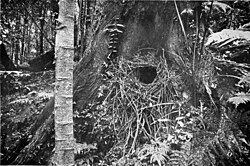
Females breed once a year during the winter, typically laying a single egg in a nest lined with a deep bed of feathers. The female incubates the egg for up to seven weeks and provides extensive parental care for several months after the chick hatches, investing significant energy into feeding and brooding.
| Feature | Male | Female |
|---|---|---|
| Average Length | 1 m (39 in) | 860 mm (34 in) |
| Average Weight | 1.1 kg (2.4 lb) | 0.9 kg (2.0 lb) |
| Tail Ornamentation | Highly ornate (Lyrates & Filamentaries) | Simple/Less ornate |
| Age of Maturity | 7–9 years | 6–7 years |
| Primary Role | Courtship & Territory Defense | Incubation & Chick Rearing |
Frequently Asked Questions
Why is the bird called a lyrebird?
It is named after the lyre, a stringed musical instrument, because the two outer tail feathers of the adult male are S-shaped and resemble the instrument's frame.
Do female lyrebirds also mimic sounds?
Yes, females are capable of vocal mimicry and regularly produce both species-specific songs and imitations of other sounds, though they are not as famous for it as the males.
How do lyrebirds help the environment?
They act as ecosystem engineers by churning the forest floor. This process speeds up nutrient cycling through leaf litter decomposition and reduces the fuel load available for forest fires.
Are superb lyrebirds endangered?
No, they are currently listed as Least Concern on the IUCN Red List. They are common across their range in southeastern Australia and have a thriving population in southern Tasmania.
How do they learn to mimic sounds they've never heard from the original source?
Juvenile lyrebirds often learn mimetic items through transmission from older lyrebirds in their community rather than directly from the model species.