Sunbittern
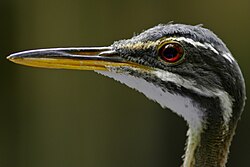
The sunbittern (Eurypyga helias) is a distinctive, bittern-like bird native to the tropical regions of the Americas. As the sole member of both its family, Eurypygidae, and its genus, Eurypyga, it occupies a unique position in the avian world. Known for its striking visual displays and cryptic nature, the sunbittern is a fascinating example of evolutionary specialization in the humid forests of Central and South America.
While it may resemble other wading birds, molecular and morphological evidence suggests a deep evolutionary link to the kagu (Rhynochetos jubatus) of New Caledonia. This connection indicates a Gondwanan origin, placing both species within the clade Eurypygiformes, a lineage that may also include mesites and extinct adzebills.
Key Facts
- Scientific Name: Eurypyga helias
- Conservation Status: Least Concern (IUCN 3.1)
- Distinctive Feature: Large, vivid eye-spots on the wings used for defense and courtship.
- Range: From southern Mexico and Guatemala through to Brazil.
- Unique Behavior: One of only 12 bird species known to use baits or lures to fish.
- Taxonomy: The only living species in the family Eurypygidae.
Taxonomy and Evolutionary History
Historically, the sunbittern was categorized under Gruiformes, though this classification was always considered preliminary. Modern molecular studies have clarified that the sunbittern and the kagu are each other's closest living relatives. Both species share a similar wing display and possess powder down—specialized feathers that crumble into a fine powder used for grooming.
The fossil record suggests the group once had a much broader distribution. An indeterminate eurypygid fossil, found as a full skeleton in the Green River Formation of Wyoming, USA, dates back to the Early Eocene. This specimen, sometimes unofficially referred to as Eoeurypyga olsoni, indicates that these birds once inhabited much more northern regions than they do today.
Subspecies
While previously treated as two separate species, the sunbittern is now recognized as a single species with three allopatric subspecies (populations that occupy separate geographic areas) distinguished by size and plumage:
- E. h. helias (Amazonian sunbittern): Found east of the Andes in lowland tropical South America.
- E. h. meridionalis (Foothill sunbittern): Located along the East Andean slope in south-central Peru.
- E. h. major (Northern sunbittern): Found from southern Guatemala through Central America to western Ecuador.
Distribution and Habitat
The sunbittern thrives in humid Neotropical forests, specifically those with an open understorey. They are almost always found near water sources, including rivers, streams, ponds, and lagoons. Their range is vast, spanning from the Orinoco and Amazon basins and the Pantanal in the east to the Chocó region in the west.
Depending on the subspecies, they inhabit different altitudes. While the Amazonian race stays in the lowlands, the foothill sunbittern is found at elevations between 800 and 1,830 meters (2,620–6,000 ft).
Physical Description
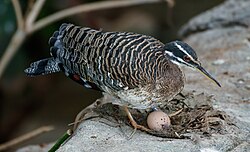
The sunbittern typically possesses subdued coloration, featuring linear patterns of brown, grey, and black that provide excellent camouflage. However, this modesty vanishes when the bird spreads its wings. The remiges (flight feathers) contain vividly colored middle webs that create bright red, yellow, and black eyespots.
These spots serve two primary purposes: attracting mates during courtship and startling predators. Physical differences between males and females are subtle, primarily appearing in the feather patterns of the head and throat. The bird is also characterized by a long, pointed black bill and a short hallux (the hind toe), similar to the anatomy of rails and shorebirds.
Behavior and Ecology
The sunbittern is a cryptic bird, relying on its camouflage to remain unseen. When threatened, it transitions from invisibility to a dramatic display, opening its wings to reveal the eye-spots to intimidate the intruder.
Diet and Tool Use
The sunbittern is an opportunistic carnivore with a diverse diet. Its prey includes:
- Invertebrates: Cockroaches, dragonfly larvae, flies, katydids, water beetles, moths, crabs, spiders, shrimps, and earthworms.
- Vertebrates: Fish, tadpoles, toads, frogs, eels, and lizards.
Remarkably, the sunbittern is one of a very small number of bird species documented to use bait or lures to attract prey. This behavior, which fits the scientific definition of tool use, has been observed primarily in captive individuals.
Breeding and Life Cycle
Breeding begins in the early wet season. Before nesting, the birds perform aerial displays, flying 10–15 meters (33–49 ft) high within the forest canopy. They construct open nests in trees and typically lay two blotched eggs. The chicks are precocial, meaning they are relatively mature and mobile from the moment of hatching, although they remain in the nest for several weeks.
Summary Table: Sunbittern Overview
| Feature | Details |
|---|---|
| Scientific Classification | Order: Eurypygiformes; Family: Eurypygidae |
| Geographic Range | Guatemala to Brazil |
| Primary Habitat | Humid Neotropical forests near water |
| Diet | Omnivorous (Insects, crustaceans, small vertebrates) |
| Key Behavior | Wing eye-spot display and bait fishing |
| Conservation Status | Least Concern |
Frequently Asked Questions
What makes the sunbittern unique among birds?
The sunbittern is the only living species in its family (Eurypygidae) and is one of the very few bird species known to use baits or lures to attract prey, a behavior classified as tool use.
How does the sunbittern protect itself from predators?
It uses a combination of cryptic coloration for camouflage and a startling defense mechanism where it spreads its wings to reveal large, vivid eye-spots that mimic the eyes of a larger animal.
Is the sunbittern related to the heron or bittern?
While it looks similar to bitterns, it is not closely related. Molecular evidence shows its closest living relative is the kagu of New Caledonia, and together they form a distinct Gondwanan lineage.
Where can the sunbittern be found in the wild?
They are found in the humid forests of Central and South America, ranging from southern Mexico and Guatemala through the Amazon basin and Pantanal to Brazil.
What is powder down?
Powder down consists of specialized feathers that break down into a fine powder. The sunbittern, along with the kagu and mesites, uses this powder to help maintain and clean its plumage.