Antbirds: Specialized Insectivores of the Neotropical Rainforest
The antbirds, members of the family Thamnophilidae, are a diverse group of small to medium-sized passerines found throughout the Neotropics. Comprising approximately 63 genera and over 230 species, these birds are master navigators of the dense undergrowth of humid lowland rainforests. While they vary significantly in size and behavior, they are most famous for their complex relationship with raiding army ants.
Key Facts
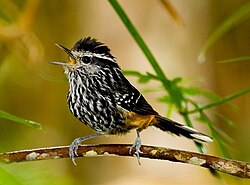
- Diversity: Over 230 species across 63 genera.
- Range: Primarily humid lowland rainforests, with the highest diversity in the Amazon basin.
- Dietary Specialization: Some species are obligate ant-followers, relying on army ant swarms to flush out prey.
- Social Structure: Mostly monogamous with lifelong pair bonds; some species exhibit cooperative clan breeding.
- Conservation Status: Habitat loss and forest fragmentation are the primary threats to their survival.
Morphology and Physical Adaptations
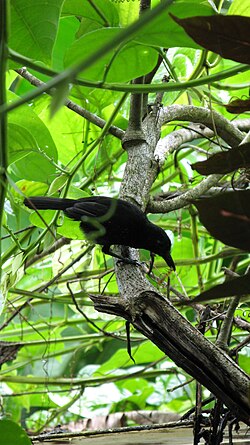
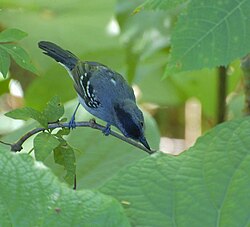
Antbirds exhibit a wide range of sizes, from the tiny pygmy antwren (8 cm, 7 g) to the giant antshrike (45 cm, 150 g). Generally, the family is categorized into three informal groups: the larger-bodied antshrikes, the medium-sized and chunky antvireos, and the smaller antwrens.
Their physical build is perfectly suited for life in thick vegetation. Short, rounded wings allow for high maneuverability in dense foliage. For those that follow army ants, the legs are particularly strong and adapted for gripping vertical stems and saplings rather than horizontal branches. In the bicoloured antbird, leg muscles account for 13% of its total body weight.
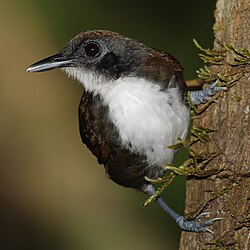
Tarsus length (the lower leg) often reflects a bird's foraging strategy. Species that use perch-gleaning—sitting and leaning forward to snatch insects—typically have longer tarsi, such as the Thamnophilus antshrikes. Conversely, those that catch prey while flying, like Thamnomanes antshrikes, generally have shorter tarsi.
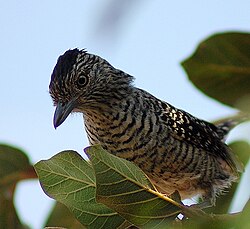
Distribution and Habitat
The vast majority of antbirds inhabit humid lowland rainforests. They are rarely found at high altitudes; less than 10% of species live above 2,000 meters, and almost none exist above 3,000 meters. The Amazon basin is the epicenter of their diversity, with some locations in Brazil, Colombia, Bolivia, and Peru hosting up to 45 different species.
Diversity decreases as one moves toward the edges of their range, with only seven species found in Mexico. Some species are highly specialized to specific microhabitats. For example, the bamboo antshrike is primarily found in bamboo patches, while the Yapacana antbird is restricted to the nutrient-poor white-sand woodlands of the Amazonian caatinga.
The Relationship with Army Ants
The family derives its name from the fascinating symbiotic relationship some species share with army ants, particularly the diurnal surface-raiding species Eciton burchellii. Contrary to early beliefs, antbirds do not primarily eat the ants themselves. Instead, the ants act as "beaters," flushing out insects, arthropods, and small vertebrates that the birds then capture.
This strategy dramatically increases foraging efficiency. For instance, spotted antbirds attempt to capture prey every 32.3 seconds when following a swarm, compared to every 111.8 seconds when foraging alone.
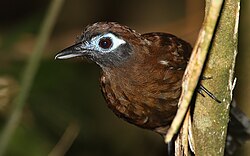
Ant-followers are divided into two main categories:
- Obligate ant-followers: 18 species that obtain most of their diet from swarms and rarely forage elsewhere. They often visit army ant bivouacs (nesting sites) in the morning to locate active raids.
- Opportunistic followers: Species that attend swarms when available but forage independently as well.
Breeding and Social Behavior
Most antbirds are monogamous, forming lifelong pair bonds. Courtship often involves courtship feeding, where the male provides food to the female. In some cases, such as with spotted antbirds, the male may feed the female so extensively that she stops foraging for herself until after copulation.
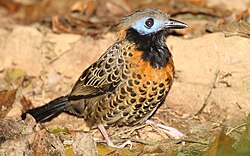
While most defend a standard territory, the ocellated antbird employs a unique social system. A dominant breeding pair may lead a clan of up to eight birds, including male offspring and their mates, who collectively defend the territory.
Typical breeding patterns include:
- Clutch Size: Usually two eggs, though some antshrikes lay three.
- Incubation: Both parents participate, though only the female incubates at night. Hatching typically takes 14–16 days.
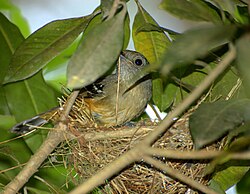
- Care: Chicks are born altricial (naked and blind). Both parents feed them and remove faecal sacs from the nest.
- Fledging: After 8–15 days, chicks leave the nest. Each parent takes exclusive care of the chick they were with during the fledging moment.
Conservation and Ecology
As of 2008, the IUCN listed 38 species as near threatened or worse. The primary driver of decline is habitat loss. Because many antbirds are reluctant to cross open gaps—even small roads—forest fragmentation can lead to local extinctions and prevent the re-establishment of species.
Fragmentation also increases nest predation. This was observed on Barro Colorado Island in Panama, where the isolation of the forest led to the extirpation of several antbird species due to higher predation rates.
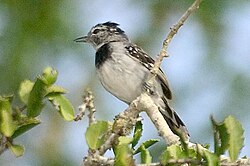
Despite these threats, new species continue to be discovered. The Caatinga antwren (2000), acre antshrike (2004), and sincorá antwren (2007) are recent additions to the scientific record.
| Feature | Details |
|---|---|
| Family | Thamnophilidae |
| Size Range | 8 cm (Pygmy Antwren) to 45 cm (Giant Antshrike) |
| Primary Habitat | Humid lowland rainforests (Amazon basin) |
| Foraging Style | Perch-gleaning, aerial capture, and ant-following |
| Social System | Primarily monogamous; some cooperative clans |
| Main Threat | Forest fragmentation and habitat loss |
Frequently Asked Questions
Do antbirds actually eat ants?
While they may occasionally eat ants, their primary goal when following army ant swarms is to eat the other insects and small vertebrates that the ants flush out of the undergrowth.
What is the difference between an antshrike and an antwren?
These are informal size-based categories: antshrikes are generally larger-bodied, while antwrens are among the smallest species in the family.
Why is forest fragmentation so dangerous for antbirds?
Many species are averse to crossing open spaces like roads. This traps them in small forest fragments where they are more vulnerable to nest predation and cannot easily migrate to new areas.
How do obligate ant-followers find their food?
They often visit the army ant bivouacs in the morning to check for raiding activity. Their calls also serve as signals for other bird species to locate the swarms.
What is unique about the ocellated antbird's social structure?
Unlike most monogamous antbirds, the ocellated antbird forms clans where a dominant pair shares a territory with their male offspring and their respective mates.