The Jaguar: An Overview of the Americas' Apex Predator
The jaguar is one of the most iconic and powerful big cats in the world. As a keystone species—an organism that helps define an entire ecosystem—the jaguar plays a vital role in maintaining the balance of the diverse habitats it inhabits across the Americas. From the dense tropical forests of Central America to the wetlands of South America, this predator is a symbol of strength and biological diversity.
Key Facts
- Scientific Name: Panthera onca
- Conservation Status: Near Threatened (IUCN 3.1)
- Temporal Range: Early Pleistocene to the present (~850,000 years ago)
- CITES Status: Appendix I
- Primary Habitat: Tropical forests, wetlands, and various South American biomes
Taxonomy and Evolution
In biological terms, the jaguar belongs to the genus Panthera and the family Felidae (the cat family). Scientists use taxa—which are specific groups or categories of organisms—to classify the various subspecies of the jaguar. While the current living subspecies is Panthera onca onca, the fossil record shows that other subspecies, such as Panthera onca augusta and Panthera onca mesembrina, once existed but are now extinct.
The evolutionary history of the jaguar is complex. The Panthera lineage is estimated to have diverged from the common ancestor of the Felidae family anywhere between 9.32 and 0.97 million years ago. Genetic studies offer different perspectives on its closest relatives: some analyses suggest the jaguar is a sister species to the lion, while others indicate the lion may be more closely related to the leopard.
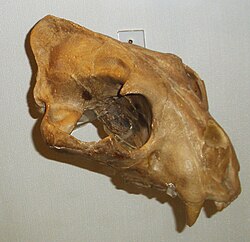
Physical Traits and Hunting Behavior
One of the most remarkable features of the jaguar is its physical strength, particularly its jaw. The jaguar possesses a powerful bite that allows it to pierce the shells of armored prey, a specialized feeding habit that sets it apart from many other large cats.
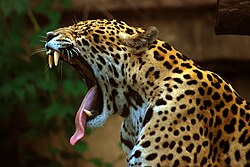
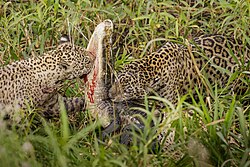
This strength is essential for its survival as a predator. Jaguars are known to hunt a variety of animals, including the yacare caiman, demonstrating their ability to take down formidable prey in their natural environment.
Habitat and Distribution
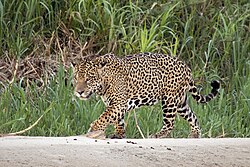
Jaguars are widely distributed across various ecosystems in the Americas. Their range includes the Sierra Madre Occidental and Sierra de Tamaulipas in Mexico, the Selva Maya tropical forests (spanning Mexico, Belize, and Guatemala), and the Chocó–Darién moist forests from Honduras and Panama to Colombia. They are also found in the Venezuelan Llanos, the northern Cerrado and Amazon basin in Brazil, the Tropical Andes in Bolivia and Peru, and the Misiones Province in Argentina.
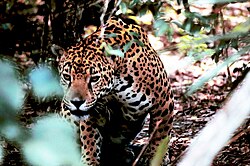
In South America, the Pantanal region serves as a significant habitat for these cats, providing a rich environment for hunting and survival.
Presence in North America
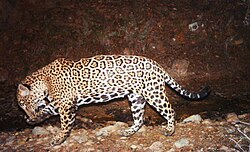
While their primary range is in Central and South America, jaguars have been occasionally sighted in the southwestern United States, including Arizona, New Mexico, and Texas. There were 62 reported accounts in the 20th century, and between 1996 and 2024, eight jaguars were photographed in the region. Notably, a male vagrant jaguar was recorded in 23 different locations within the Santa Rita Mountains between 2012 and 2015.
Reproduction and Life Cycle
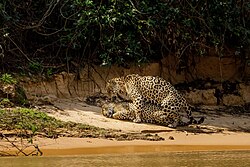
The life cycle of a jaguar involves complex social and reproductive behaviors. In regions like the northern Pantanal, mating behaviors have been observed in the wild, which are critical for the continuation of the species.
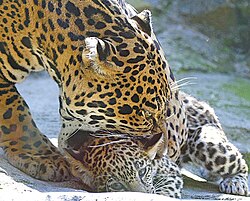
Female jaguars play a vital role in the survival of the next generation. Mothers are known to be protective, often seen picking up their cubs to move them or protect them from potential threats, including adult males.
Historical Context
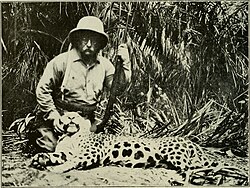
The jaguar has a long history of interaction with humans. Historically, they have been documented in various contexts, including being hunted by famous figures such as Theodore Roosevelt.
Summary of Jaguar Profile
| Feature | Details |
|---|---|
| Scientific Name | Panthera onca |
| Order | Carnivora |
| Conservation Status | Near Threatened |
| CITES Listing | Appendix I |
| Key Habitats | Amazon Basin, Pantanal, Selva Maya, Tropical Andes |
Frequently Asked Questions
What is the scientific name of the jaguar?
The scientific name for the jaguar is Panthera onca.
Where can jaguars be found in the wild?
Jaguars are found throughout much of the Americas, including Mexico, Belize, Guatemala, Colombia, Brazil, Bolivia, Peru, and Argentina. They have also been occasionally sighted in the southwestern United States.
What is the current conservation status of the jaguar?
According to the IUCN 3.1, the jaguar is currently classified as Near Threatened. It is also listed under CITES Appendix I.
How do jaguars hunt their prey?
Jaguars are powerful predators with a bite strong enough to pierce the shells of armored prey, such as caimans and other reptiles.
Are jaguars found in the United States?
Yes, though they are not part of their primary range, jaguars have been recorded in Arizona, New Mexico, and Texas, with specific sightings in the Santa Rita Mountains.