Structural and Cyclical Deficits: Analyzing Government Budget Balances
In the realm of public finance, the health of a nation's economy is often measured by its budget balance. When a government spends more than it collects in revenue, it runs a deficit. However, not all deficits are created equal. To truly understand a country's financial position, economists distinguish between the headline deficit—the total budget deficit—and its two primary components: the structural and cyclical deficits.
The headline deficit is simply the sum of these two parts. By separating them, policymakers can determine whether a budget shortfall is a temporary result of economic conditions or a permanent imbalance in government spending and revenue.
Key Facts
- Headline Deficit: The total budget deficit, calculated as the sum of structural and cyclical components.
- Cyclical Deficit: A temporary shortfall caused by the natural fluctuations of the business cycle.
- Structural Deficit: A permanent imbalance that exists regardless of the economic climate.
- Debt-to-GDP Ratio: A key metric used to assess an economy's health and its ability to repay debts.
- Fiscal Stance: The government's approach to spending and taxation; a structural deficit often indicates an expansionary stance.
The Cyclical Deficit: A Temporary Fluctuation
A cyclical deficit is directly tied to the business cycle—the period an economy takes to move from expansion to contraction and back to expansion. These cycles are unpredictable and can span from several months to many years.
During the low point of a business cycle, business activity drops and unemployment rises. This creates a double-edged sword for government finances: tax revenues decrease while expenditures on social security and other welfare programs increase. While government decisions play a role, the cyclical deficit is primarily driven by national and international economic conditions that are often beyond a government's direct control.
The Structural Deficit: A Permanent Imbalance
Unlike its cyclical counterpart, a structural deficit is permanent. It occurs when there is an underlying imbalance between government revenues and expenditures that persists even during the peak of an economic boom. Even when tax revenues are at their highest, a country with a structural deficit will still spend more than it earns.
Economists view structural deficits through different lenses. Some see them as a sign of poor financial management, while others view them as a deliberate expansionary fiscal stance designed to promote nominal economic growth.
When funded through borrowing, structural deficits can lead to a continuous accumulation of debt. This may result in the deterioration of the debt-to-GDP ratio, which is a fundamental measure of an economy's ability to meet its financial obligations.
Addressing Structural Deficits
Those who argue that structural deficits must be reduced suggest two primary methods: reducing government spending or increasing taxation. Alternatively, countries with fiat money (currency not backed by a physical commodity) may choose to monetise the debt—creating more money to pay off the debt. While this can avoid default, it risks triggering high inflation if not managed with strict fiscal control.
Planned vs. Unintentional Deficits
Structural deficits are not always the result of mismanagement. They can be planned investments in the country's future, such as spending on infrastructure, education, or transport. The goal is to increase the economy's productive potential, eventually yielding long-term gains that resolve the deficit. However, if these investments fail or if the government simply spends to maintain a standard of living it cannot afford, it can lead to a crisis of investor confidence, as seen during the Greek government-debt crisis and the Spanish financial crisis following 2008.
Structural and Cyclical Surpluses
The opposite of a deficit is a surplus. A cyclical surplus occurs at the peak of the business cycle when high revenues and low expenditures result in a budget gain. A structural surplus occurs when the government's fundamental budget is designed to operate with a surplus regardless of the economic cycle.
The Interplay Between Components
The relationship between these two components can be deceptive. For instance, a large cyclical surplus during an economic boom can mask an underlying structural deficit. If the cyclical gain is larger than the structural loss, the headline budget will appear to be in surplus.
However, when the economy inevitably enters a downturn, the cyclical surplus vanishes and becomes a cyclical deficit. This compounds with the existing structural deficit, leading to a rapid and severe increase in the total deficit.
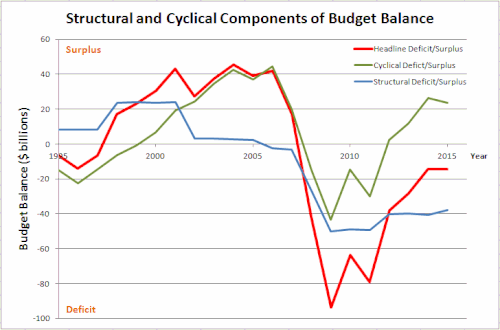
Case Study: Australia (2002–2013)
Australia provides a clear example of this phenomenon. During the Howard government, a mining boom generated massive headline surpluses. However, the government used these windfalls for tax cuts and spending rather than saving for the future. By 2009, the Treasury revealed that despite headline surpluses (such as A$17.2 billion in 2006–2007), the country had been in a structural deficit since at least 2006–2007. When the 2008 financial crisis hit, revenues plummeted, exposing a structural deficit that grew to approximately $50 billion by 2008–2009 and remained around $40 billion (2.5% of GDP) in 2013.
Academic and Political Criticism
The distinction between structural and cyclical deficits is not without controversy. Economist Chris Dillow and others argue that there are too many variables to make a clear distinction in real-time, suggesting the term "structural deficit" is often used for political rather than analytical purposes. Martin Wolf has further argued that the structural balance is virtually unknowable during an economic boom.
Wolf points to IMF estimates for Ireland and Spain between 2000 and 2007. In 2008, the IMF estimated both countries had structural surpluses. By 2012, the IMF revised these post-facto estimates, concluding that both had actually been running structural deficits (2.7% of GDP for Ireland and 1.2% for Spain). Additionally, Bruce Yandle has suggested that politicians often avoid admitting that deficit spending is a primary driver of surging inflation.
| Feature | Cyclical Component | Structural Component |
|---|---|---|
| Nature | Temporary / Fluctuating | Permanent / Underlying |
| Primary Cause | Business cycle (expansion/contraction) | Imbalance in spending and tax policy |
| Influence | External economic conditions | Government fiscal decisions |
| Occurrence | Varies by economic phase | Exists regardless of economic phase |
| Solution | Economic recovery/growth | Policy changes (tax/spend) or monetisation |
Frequently Asked Questions
What is the difference between a headline deficit and a structural deficit?
The headline deficit is the total amount by which government spending exceeds revenue. The structural deficit is the portion of that total that exists regardless of the state of the economy, representing a fundamental imbalance in fiscal policy.
How does the business cycle affect the budget?
During a contraction, tax revenues fall and spending on social safety nets increases, creating a cyclical deficit. During an expansion, the opposite occurs, often creating a cyclical surplus.
Can a government have a headline surplus but a structural deficit?
Yes. If a country experiences a massive economic boom (cyclical surplus) that is larger than its underlying fiscal imbalance (structural deficit), the total budget will show a surplus even though the government's long-term spending habits are unsustainable.
What are the risks of a permanent structural deficit?
A structural deficit can lead to a continuously rising debt-to-GDP ratio, which may eventually cause investors to lose confidence in the government's ability to repay its debts, potentially leading to a financial crisis.
What is debt monetisation?
Debt monetisation is the process where a government creates new money to pay off its existing debt. While this prevents default, it can lead to high inflation if not carefully controlled.